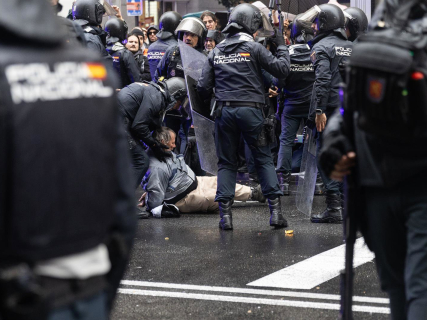

The Unified Police Union (SUP) has filed documents both with the General Prosecutor’s Office of the State and with the Ministry of the Interior to request that the restrictions on the use of the personal-defense tear-gas spray announced by the Minister of the Interior, Fernando Grande-Marlaska, be suspended, following the controversy generated by the police charges during the general strike of 11N.
"The officers continue to have no clear instructions on how to act in the event of an attack," the SUP warned in the documentation it submitted. The union also recalls that on 23 October last it already warned about the "risks" of the current protocol for the use of the police spray, the same one that Interior now intends to modify.
Along these lines, the SUP—whose filings were sent to the Specialized Unit for Workplace Safety and Health of the Prosecutor’s Office and to the State Secretariat for Security—stresses that on the day of 11N more than 25 police officers were injured. These injuries are added to "other recent episodes of violence," such as the one recorded at the Aluche Center for the Internment of Foreigners (Madrid), where several officers also ended up injured.
Last Friday, the department headed by Fernando Grande-Marlaska confirmed that it had issued instructions to the General Directorate of the National Police so that the use of individual-defense spray be prohibited in public-order devices, such as those deployed during the demonstrations of the general strike. In these operations, officers may resort to the launching of "harmless" tear-gas smoke canisters.
AUTHORIZES TEAR-GAS SMOKE CANISTERS
The order sent means that the General Directorate of the Police will review the internal protocol for the use of the spray that each officer carries and that they can use individually. This action had already been called into question by the Ministry of the Interior itself, which decided to open a reserved investigation.
In public-order deployments, such as those organized for 11N, the National Police will see the use of this spray restricted: only the use of ATL devices will be authorized—some canisters that generate an "harmless and non-injurious tear-gas smoke cloud" after being projected several meters away through muzzles, the accessory that attaches to the end of the barrel of the standard-issued shotguns.
The current protocol that allows the use of personal defense spray is dated October 19, 2026, that is, less than a month before the 11N strike, according to what Europa Press has verified. The document bears the signature of the head of the General Subdirectorate of Logistics and Innovation and has the approval of the Deputy Operational Director (DAO) of the Police.
Interior sources have detailed that the personal defense spray will continue to be available in public security interventions, for example to provide personnel for a patrol car of the “zeta” type when it is necessary to immobilize a person and proceed with their arrest.