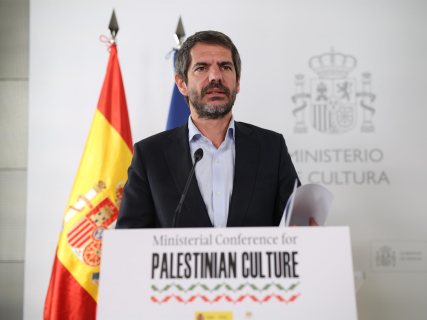

The Minister of Culture and spokesperson for Sumar, Ernest Urtasun, has assessed this Thursday on a national level the latest survey from the Centre d'Estudis d'Opinió (CEO) of the Generalitat of Catalonia. Based on this data, he has concluded that the majority of Catalan citizens aspire to renew, after future general elections, the "progressive and left-wing majority that currently exists in our country".
The poll places the PSC as the leading force in Catalan elections, with between 36 and 38 seats, followed by ERC, which is attributed between 24 and 26 deputies, in a technical tie with Alliança Catalana, which would obtain between 23 and 25. This latter pro-independence formation, led by Silvia Orriols, would manage to surpass Junts, which would be left with a range of 16 to 18 seats. PP and Vox would share fifth position, with between 12 and 13 deputies each, while Comuns and the CUP would be at the bottom of the table, with between four and five representatives.
In statements to the media after the presentation of the Ministerial Conference for Palestinian Culture, Urtasun emphasized that, although no regional elections are foreseen in Catalonia in the short term, a scenario of general elections is glimpsed. Therefore, he argued that the most relevant interpretation of the CEO study is its impact on Spanish politics as a whole.
CONCERN OVER THE RISE OF THE FAR-RIGHT
In the minister's opinion, "what emerges from the CEO is a clear desire of the citizens of Catalonia to revalidate the progressive and left-wing majority that currently exists" in Spain. In the same vein, he insisted that "the data is clear, there is a large majority of Catalans who wish for the current Spanish Government to continue".
In this context, he stressed that it is the shared "responsibility" of PSOE and Sumar to achieve "magnificent results" in the next general elections, along with the formations that support the current coalition government in the Congress of Deputies.
Although he expressed his "concern" about the growth of Alliança Catalana, which he placed within an international dynamic of far-right advance, he wanted to highlight that in Spain, "unlike in many European countries, there is a progressive government".
"There is no government of the right or the far-right here. I insist, the CEO data shows that there is a large majority of Catalans who want this Government to be revalidated. They do not want to see the far-right in the Government. And that is what we are going to work on," concluded the head of Culture.