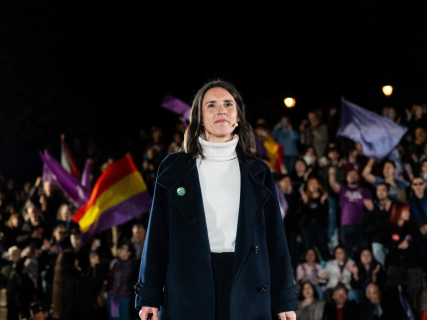

This Sunday, Podemos has certified its disappearance from the Madrid political scene by failing to win any of the 38 seats in play in the Congress for the province of Madrid, after having lost its presence in the Assembly in the most recent regional elections and failing to obtain councillors on its own in the municipal elections.
The purple party, which had Irene Montero, the MEP and former minister, as the head of its list for Madrid, was attending this call in an alliance with Gabriel Rufián (ERC), the candidate for Barcelona, betting on its own brand as an alternative to the major blocs and as a voice of the left.
After its disappearance in Madrid in the 2023 elections and without the megaphone granted by institutional representation, the party founded in 2014 with the intention of "storming the heavens" has barely brushed 1% of the votes, with 95% counted, and with just over 32,000 ballots still to come, behind options such as Democracia 21 or Se Acabó la Fiesta.
These results confirm the continued fall in support for the party in the Community and leave its head of list out of Congress. Irene Montero has concentrated much of her campaign in Madrid, with three buses touring the capital to publicize her proposals for action in the housing, fuel and food markets.
The campaign, with a marked personalist character and under the slogan "Peace, home and work", has focused on demanding a recovery of the basic material conditions of citizens, in a context of social unrest that led to the general strike on the 11th.
This event was the second time that Podemos ran on its own in order to obtain representation in Congress, after its debut in 2015, one year after its founding and at the height of a party led by Pablo Iglesias that was presenting itself with the goal of ending "the political caste". At that time, it obtained 756,257 votes in Madrid (20.9%) and eight deputies, its historical high point.
After the so-called 'pacto del botellín', Podemos presented itself in the following elections in coalition with Izquierda Unida, which had achieved its best result in Congress in the general elections of 1996 with more than half a million votes—547,901 ballots, 16.44%, and six seats—.
The dual electoral call of 2019, under the brand Unidas Podemos and together with Izquierda Unida and Equo, marked the start of a sustained decline in support at the polls, going from more than 600,000 votes —613,911 (16.23%)— to 463,629 ballots (13.01%).
In the last general elections of 2023, to which Podemos went integrated into Sumar, the platform led by Yolanda Díaz that brought together more than a dozen forces, the candidacy obtained 557,780 votes in the region (15.46%) and six seats.
The “knockout blow” came two months earlier, in the 2023 regional elections, when Unidas Podemos (Podemos-IU-Alianza Verde) chose Alejandra Jacinto to run for the Presidency of the Community against the PP leader Isabel Díaz Ayuso.
The candidacy did not reach the required 5% —161,032 votes, 4.76%— and was left out of the Assembly, where it had 10 seats, achieved when the former leader of the party, Pablo Iglesias, topped the list in the snap elections of May 4, 2021. “Spain owes me one; we’ve gotten Pablo Iglesias out of La Moncloa,” the regional president, Isabel Díaz Ayuso, celebrated, following the candidacy in Madrid of the founder of Podemos, which gave rise to the slogan “either communism or freedom.”
Those elections, which coincided with the municipal elections, left the party without an institutional presence in the region. The list led by Roberto Sotomayor to contest the Mayoralty against the mayor José Luis Martínez-Almeida also fell below 5% and, consequently, was out of Cibeles. In Congress, moreover, its four lawmakers went on to join the Mixto Group.
In this scenario, Montero has not managed to reverse the trend, with a solo bid outside Frente Amplio, after failing to negotiate to run together. Figures such as the former IU leader Alberto Garzón and former Podemos leaders, including the cofounder Carolina Bescansa, the former senator Ramón Espinar, the former deputy Tania Sánchez, or the first secretary of Organization Sergio Pascual, signed a manifesto in favor of voting for the Frente Amplio candidacy.
The candidate also has not been able to take part in the electoral debates, after the Junta Electoral Central (JEC) determined that her presence was not mandatory. In response, Irene Montero and her team have combined rallies with meetings with social groups and visits to the party’s information booths.
Within this framework, the head of the list for Madrid has been particularly involved in backing the non-university education strike that began on October 14 in the region. Far from the big events of other forces, the joint events with Rufián and the closing rally of the campaign with Pablo Iglesias have been the ones that have gathered the most attendees.
One of the central themes of the campaign has been to rebut the call for a useful vote for Pedro Sánchez and to draw distances from the management of the coalition Government on housing, military spending, and feminism. Its criticisms have also reached Frente Amplio, which it accuses of being subordinate to the interests of the PSOE.