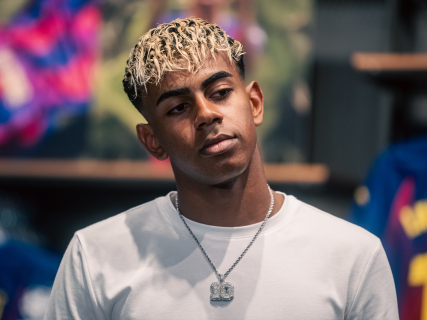
Lamine Yamal responds to Rajoy: "Football serves to integrate"

The Spanish international defends that Spain and France are examples of integration after the former Prime Minister stated that the French team has a great level, but plays "without Frenchmen".

1 minute

EuropaPress 6860770 futbolista lamine yamal atiende medios comunicacion firmar contrato fc

EuropaPress 6860770 futbolista lamine yamal atiende medios comunicacion firmar contrato fc

Add DEMÓCRATA to Google

Ask FREN

Published

Last updated

1 minute

Most read

Lamine Yamal has responded to the controversial words of Mariano Rajoy about the French national team with a defense of football as a tool for integration. "If football is good for anything, it is for integrating society, and France and Spain are a good example," stated the Spanish national team player.

The forward made these statements during the official press conference held this Monday in the press room of the Dallas stadium, where Spain and France will play the semifinal of the 2026 World Cup this Tuesday. Yamal asked to appear before the media on his birthday and assured that, facing one of the most important matches of the tournament, "there is no room" for this type of debate.

The response comes after Rajoy wrote in a column published on July 10 in El Debate that France has "a squad of the highest level. That said, without French people," referring to the family origin of a large part of its footballers. Only three of the 26 French call-ups were born outside of France.

The former president's words provoked criticism from the Spanish and French governments and the French Football Federation. The PP avoided disavowing Rajoy and attributed the phrase to a sarcastic expression uttered "without bad intentions."

More key points, information and questions with FREN

AI-GENERATED CONTENT

What is the current status of the parliamentary investigation into public statements by senior political officials regarding sports and integration?

At this time, there is no specific parliamentary inquiry commission in the Spanish General Courts dedicated to public statements by senior political officials on sports and integration. However, there are a number of parliamentary and governmental initiatives addressing related aspects: hate speech in sports, inclusive sports, equality, and the integration of migrants through sports. Investigation commissions have also been requested related to the Rubiales case and football governance, but these focus on possible episodes of harassment, corruption, or espionage, not on statements by senior officials about integration. The current parliamentary focus is more on regulation, prevention, and ordinary political oversight than on a major monographic investigation on this topic.

1. There is no specific investigation commission on “sports and integration”

Neither the Congress nor the Senate currently has a parliamentary investigation commission formally tasked with investigating statements by senior political officials regarding sports and integration (social, migratory, cultural, etc.). Active investigation commissions focus on other matters (for example, the “Koldo case” or SEPI), and the standing Education, Vocational Training, and Sports committees are used for political oversight and debates, not as ad hoc investigative bodies.

An analysis by the newspaper Demócrata recalls that ERC, EH Bildu, BNG, and Podemos requested that Congress investigate Luis Rubiales’ tenure at the RFEF — due to possible episodes of harassment, corruption, or espionage — as part of a broader package of reforms on sports governance, Athlete Statute, and federation ethical code, according to this analysis. That initiative points to a possible investigation commission on the RFEF, but it has not materialized into a specific investigation on statements by senior officials about integration.

2. What Congress and the Senate are doing

Strictly within the parliamentary sphere, the closest to your question is a set of non-legislative motions and resolutions on hate, inclusion, and governance in sports:

  • The Plenary of Congress approved on June 18, 2026, a PSOE non-legislative motion to combat hate speech in Spanish sports, with 176 votes in favor, 33 against, and 138 abstentions. The text urges the Government to strengthen the State Commission against Violence, Racism, Xenophobia, and Intolerance in Sports, regulate the responsibility of digital platforms, promote education on equality and diversity, and foster protection of victims and equality in women’s sports, according to the official Congress note available at this reference.
  • The Education, Vocational Training and Sports Committee of the Senate approved in May 2025 a socialist motion to promote inclusive sports and another from the PP to guarantee the international representation of Spanish sports federations, as noted in the official Senate release at this link.
  • A Subcommittee on the Athlete Statute has been created within the Education, Vocational Training and Sports Committee in Congress, according to various agendas and press releases (subcommittee creation note). Its focus areas include gender equality, dual careers, and social protection, all linked to the integrative function of sports.

Additionally, Congress recently debated a non-legislative motion to strengthen the response against hate speech in sports, approved under the terms of a transaccional amendment between PSOE and the Republican Group, always from a logic of guiding Government action rather than retroactive investigation of statements by senior officials.

3. Executive initiatives connecting sports and integration

Alongside parliamentary oversight, the Government has activated several regulatory measures directly linked to integration through sports:

  • A draft Royal Decree to grant a direct subsidy to the Spanish Olympic Committee aimed at promoting sports practice in centers of the public migration network and the integration of their residents. This regulation has undergone prior public consultation (consultation) and public hearing (hearing).
  • The recent regulatory reform of the Organic Law 4/2000 on Foreigners and Social Integration, through Royal Decree 1155/2024 and its amendment by Royal Decree 316/2026, published in the BOE and accessible at this link, strengthens the general legal framework of foreigners’ rights and social integration, which is then specified in sectoral policies such as sports.

These regulations are not “investigations” into politicians’ statements, but they do show that the institutional focus is on using sports as a tool for integrating migrants and other vulnerable groups.

4. Regional parliaments and oversight of hate speech in sports

At the regional level, there are clearer movements against hate speech and discrimination in sports, which directly touch on integration issues:

  • The Parliament of Catalonia has activated its Deputy Statute Committee following an intervention by Vox deputy Alberto Tarradas, who justified in plenary the chant “musulmà el que no boti” at a Spain–Egypt match. The Board plans to investigate this “targeting” of ERC deputy Najat Driouech, as reported by this Demócrata report. This is more an internal disciplinary mechanism than a classic investigation commission, but explicitly focused on hate speech in sports.
  • The Balearic Parliament has approved initiatives to condemn LGBTphobia in sports and demand specific protocols, as reported in this news, and has also requested from the Government a support plan for major international sports events with special attention to women’s, adapted, and universally accessible sports (resolution on sports events).
  • Several regional disciplinary regulations expressly sanction public statements by executives and athletes that incite violence or discrimination, as seen in sports regulations from Andalusia or Extremadura published in regional official bulletins (for example, the disciplinary regulation of the Extremadura Basketball Federation, published in this DOE, or the statutes of Andalusian federations in the BOJA, accessible at this and this other document).

5. Summary: dispersed investigation and preventive approach

In summary, the Spanish political system has not established a unique and formal parliamentary investigation into public statements by senior officials on sports and integration. What exists is a mosaic of:

  • Parliamentary initiatives of political orientation (non-legislative motions and resolutions on hate, inclusive sports, and federation governance).
  • Debates and hearings in the standing Education, Vocational Training, and Sports committees in both Congress and Senate.
  • Executive regulations explicitly linking sports and migrant integration.
  • Internal disciplinary procedures and regional regulations sanctioning hate speech and inciting statements in the sports field.

If in the future a specific investigation commission on statements by senior officials on these topics were to be established, it would have to be approved in the Plenary of the corresponding chamber, with a defined object (for example, management of a federation or a major sports event) and a concrete temporal mandate. As of today, such a commission does not yet exist.

Has any formal proposal been registered in Congress to create an investigation commission on the RFEF and the Rubiales case? What specific measures does the non-legislative motion of June 18, 2026, against hate speech in sports include? What sanctions do regional regulations provide when public statements by executives or athletes incite violence or discrimination?

What powers does a former Prime Minister have regarding institutional representation at international sports events?

A former Spanish Prime Minister does not have, according to current regulations, inherent and automatic powers of institutional representation of the State at international sports events. Their status is regulated by Royal Decree 405/1992, amended by Royal Decree 1306/2008, which grants them honors, material means, and a protocol position, but does not assign representative functions. They can only act as institutional representatives if the Government or, where appropriate, the Royal Household expressly appoints them for a specific mission, including in the sports field.

Legal framework of the former Prime Ministers’ statute

The basic regime is set out in Royal Decree 405/1992, regulating the Statute of Former Prime Ministers, later adjusted by Royal Decree 1306/2008. This text establishes that, after leaving office, former Prime Ministers shall enjoy the “consideration, attention, and support” due to those who have held the office, but it does not create a new State body or a public office with its own powers.

In particular, the decree recognizes that former Prime Ministers:

  • Retain the title of “President”.
  • Occupy the protocol position corresponding to them according to the State’s General Order of Precedence.
  • Have a small office and cabinet staff, budget allocation for office expenses, a representative vehicle, and security services.
  • May receive support from diplomatic representations during their travels abroad.

None of these elements, by themselves, constitute a formal power of representation of the State or Government.

Institutional representation of the State abroad

Representation of the State abroad, including at international sports events (Olympic Games, World Cups, etc.), primarily corresponds to the King as Head of State and the current Government (Prime Minister, vice presidents, and ministers). Institutional participation is organized based on political, diplomatic, and sports criteria, and is articulated through official invitations, accreditations, and delegation appointments.

The Statute of former Prime Ministers only indicates that, on their trips abroad, “they may enjoy the support of the Spanish diplomatic representation services.” This implies logistical and security facilitation, but not an automatic representative mandate. That is, a former Prime Minister attending an international sports event on their own initiative does not act, by virtue of their status alone, as an official State representative.

When can a former Prime Minister represent institutionally at a sports event?

In the absence of a general authorization in the Statute, the key is ad hoc designation. A former Prime Minister could perform an institutional representation function at an international sports event if:

  • They are formally appointed by the Government (for example, as head of delegation or special envoy) to attend the event on behalf of Spain.
  • They are invited by an international organization (IOC, federations, etc.) and the Government officially decides to endorse their attendance on behalf of the State.
  • In very specific cases, the Royal Household might count on their presence at an event where the King is the main representative, assigning them an institutional role of support or accompaniment.

In all these cases, the capacity for representation derives from the decision of the current authorities, not from a power inherent to the former Prime Minister. Their statute grants prestige, precedence, and facilities, but the institutional voice remains with those holding active constitutional offices.

Difference between protocol presence and representation

It is important to distinguish between a former Prime Minister’s protocol presence and the political or diplomatic representation of the State:

A former Prime Minister may be invited by a club, federation, or the Spanish Olympic Committee to attend a final or ceremony. In that case, unless officially appointed in the strict sense, their role is fundamentally honorary or symbolic: they are recognized for their career and placed in a prominent position, but do not act as spokesperson or negotiator for the State.

Only when there is an express decision by the Government (or, where appropriate, the Head of State) entrusting them with a specific mission can true institutional representation be said to exist. The Statute of former Prime Ministers does not foresee or regulate such missions; it simply does not prohibit them, leaving their eventual use to political practice and the opportunity assessed by the current Executive.

What is the exact protocol precedence position of a former Prime Minister relative to ministers, regional presidents, and other authorities at official acts? What does the General Order of Precedence say exactly about the participation of Spanish authorities in international sports events? Have there been recent cases where a former Prime Minister was formally appointed as head of the Spanish delegation at the Olympic Games or another international competition?

What has been Lamine Yamal’s professional and political trajectory before joining the Spanish national team?

Lamine Yamal is primarily a figure in professional football and not a relevant actor in Spanish institutional politics. Therefore, I do not have structured or validated information about his “professional and political trajectory” in the sense understood in parliamentary, governmental, or party contexts. My specialization is focused on politics and public life, so I cannot provide a detailed and reliable account of his sports career prior to joining the Spanish national team. However, I can help you understand how sports figures like him are treated in Spanish political and media debate.

Scope of the information I can offer

This assistant is designed to work with information of a political, institutional, and social nature linked to Spain and, secondarily, to the European and international context. This means I mainly handle:

  • Parliamentary activity: initiatives in Congress and Senate, legislative proposals, hearings, interpellations, written and oral questions, and debates on matters of public interest.
  • Executive activity: Council of Ministers agreements, bills submitted to the Cortes, royal decree-laws, royal decrees, government plans and strategies.
  • Political and party life: party positions, parliamentary negotiations, investiture pacts, debates on State–Autonomous Community competencies, and territorial issues.
  • Social and political current affairs: news on public policies (health, education, housing, employment, equality, migration, taxation, etc.) and their social impact.

Within this framework, I can analyze the role of athletes or public figures when they become actors in political debate (for example, in controversies about nationality, symbols, integration, immigration policies, racism in sports, or political use of sports success). However, I am not designed to provide detailed sports biographies or follow football careers unless they are clearly connected to political or institutional debate.

Why I cannot detail Lamine Yamal’s sports career

Your question focuses on Lamine Yamal’s “professional and political trajectory” before joining the national team. In strictly political terms:

  • There is no record that Lamine Yamal has held public office, notable party membership, or direct participation in political institutions.
  • There is no information, within political–institutional sources, about his interventions in Congress, Senate, or regional and local governments.
  • References that might exist about him are mainly in the sports field (clubs, youth categories, statistics, precocity records, etc.), which are outside the information scope for which this assistant is configured.

I could attempt to reconstruct details of his football trajectory (youth academy, professional debut, progression in youth teams, etc.), but that would go beyond my specific domain and, above all, contravene the main limitation: I should not answer questions unsupported by strictly political, institutional, or social sources. Doing so could result in incomplete, outdated, or unreliable information from the perspective for which I am specialized.

What I can do related to sports figures like Lamine Yamal

Although I cannot provide an exhaustive sports biography, I can assist you in several areas where sports and politics intersect:

  • Public debate on the Spanish national team: analysis of how parties and political leaders use the success of the national team or certain players in their discourse, whether in terms of unity, national identity, integration, or territorial conflict.
  • Integration and diversity: explanation of how the presence of players of diverse origins relates to public policies on immigration, nationality, social integration, or combating racism, and how this is discussed in Parliament and the media.
  • Sports policies: details of laws, plans, or public programs affecting youth academies, grassroots sports, club funding, high performance, and physical education, and how these policies may indirectly influence the emergence of talents like Lamine Yamal.
  • Media and political treatment: analysis of speeches and controversies, for example when a player’s image is politicized or they become a symbol of certain ideological positions.

How to reframe your query to obtain useful information

If you are interested in connecting Lamine Yamal’s figure with the political or social sphere, you could reformulate the question, for example:

  • Asking about the political use of the Spanish national team and its players in party discourse.
  • Inquiring about public policies that support grassroots sports and the detection of young talent in Spanish football.
  • Analyzing how Spanish parties address the debate on diversity and integration using the example of the national football team.

In all these cases, I could offer you a much more precise, documented analysis aligned with the sources and specialization framework for which I am designed.

How has the recent success of the Spanish national football team been politically used in party discourse? What public policies exist in Spain to support grassroots sports and the detection of young talent like Lamine Yamal? How do Spanish parties approach the debate on diversity and integration based on the example of the national football team?

Play

Test your knowledge with FREN!

How much do you know about this topic? Answer the following 3 questions.

What did Lamine Yamal defend in response to Rajoy's words about the French national team?

Question 1 of 3

How many of the 26 French call-ups were born outside France according to the news?

Question 2 of 3

What was the Popular Party's reaction to Mariano Rajoy's words?

Question 3 of 3

Hola, soy Fren. ¿Cómo te ayudo?