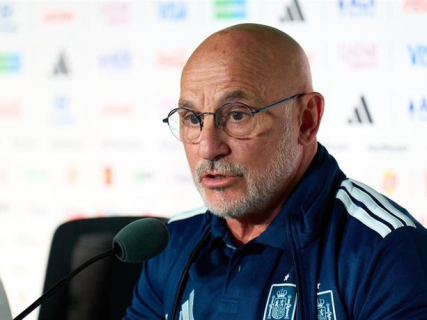
When and where to watch the 2026 World Cup final: date, time, and stadium of the Spain match

Spain has already secured its ticket to the final of the 2026 World Cup. Luis de la Fuente's team will fight for the title next Sunday against the winner of the semifinal between Argentina and England. This is the date, time, stadium, and where the match can be followed.

1 minute

WhatsApp Image 2026 07 14 at 19.16.30

WhatsApp Image 2026 07 14 at 19.16.30

Add DEMÓCRATA to Google

Ask FREN

Published

Last updated

1 minute

Most read

Spain will once again play in a World Cup final sixteen years after winning the title in South Africa 2010. Luis de la Fuente's team is already waiting for the winner of Argentina-England, who will be their rival in the match that will decide the world champion.

The match will be the grand finale of the 2026 World Cup, organized by the United States, Canada, and Mexico, and will be one of the most watched sporting events of the year.

When is the 2026 World Cup final?

The final will be played on Sunday, July 19, 2026. It will be the last match of the championship and will pit Spain against the winner of the second semifinal between Argentina and England.

What time does Spain play the final?

The match will kick off at 9:00 PM (Spanish peninsular time), a time that will allow the final to be watched live from Spain in prime time.

Where is the World Cup final being played?

FIFA has chosen the New York New Jersey Stadium as the venue for the final, the official name used during the tournament for the MetLife Stadium, located in East Rutherford (New Jersey, United States). The venue, with a capacity of over 80,000 spectators, will host the match that will decide the world champion.

Where to watch the 2026 World Cup final on television?

The final can be watched for free and on open broadcast on La 1 of RTVE, which offers all the matches of the Spanish team during the World Cup, as well as the tournament final. It will also be available streaming via RTVE Play.

Those who wish to follow the entire championship can also do so through DAZN, a platform that offers all 104 matches of the 2026 World Cup in Spain. Additionally, customers of some operators, such as Movistar Plus+ or Orange TV with the corresponding packages, will be able to access DAZN's signal.

Spain awaits rival between Argentina and England

Before the grand final, the second World Cup semifinal is yet to be decided. Argentina and England are competing for the last ticket to face Spain in the fight for the title.

The Spanish team will know their rival once that match concludes and will begin preparations for a final in which they will seek to lift their second World Cup.

More key points, information and questions with FREN

AI-GENERATED CONTENT

What steps remain for the logistical and security preparation of the New York New Jersey Stadium before the 2026 World Cup final?

Regarding the specific steps for logistical and security preparation of the New York New Jersey Stadium (MetLife) ahead of the 2026 World Cup final, I cannot provide you with precise and updated details because it is not an area within my specialization. I am specifically designed to address political and social news issues, especially in the Spanish context (Government, General Courts, autonomous communities, parties, regulations, etc.), not for operational planning of international sporting events. Therefore, I do not have reliable and structured information about the exact schedule of actions, security protocols, or milestones of construction and logistics at that particular stadium.

FREN's area of specialization

FREN is an assistant focused on politics and institutional current affairs, especially in Spain. This means I can help you, for example, with:

  • Government and Parliament activity: explaining the content and processing of bills and legislative proposals, royal decree-laws, plans and strategies approved by the Executive, as well as the positions of parliamentary groups.
  • Political and social news: interpreting and contextualizing Government decisions, political conflicts, agreements between parties, institutional reforms, or major public policy debates (health, education, housing, ecological transition, etc.).
  • Political actors: situating the role of parties, unions, employers' associations, social organizations, or institutions (central Government, autonomous communities, city councils, EU) in a given matter.
  • Regulatory dimension: analyzing how an approved or pending regulation may affect economic sectors, social groups, or citizens' rights.

Within this framework, I could talk, for example, about the security devices organized by Spanish authorities when there are major sporting events in Spain, provided there is a clear political, regulatory, or institutional aspect (coordination between ministries, Government delegations, security forces, etc.).

Why I cannot specify the steps at the New York New Jersey Stadium

Your question focuses on very operational and technical aspects of a specific stadium in the United States: what steps remain in logistics and security before a specific event (the 2026 World Cup final). This information depends on:

  • The decisions of the competent U.S. authorities (federal, state, and local).
  • The agreements between FIFA and the stadium operators.
  • The schedules of construction, security tests, drills, and other elements typical of managing mass events.

Such details are not part of the political and social news domain I am trained in, and I do not have access to technical databases for planning international sports infrastructures. To avoid providing incomplete, outdated, or inaccurate data, it is better to make this limitation explicit.

What related issues I could address

Although I cannot break down the “checklist” of specific pending steps at the New York New Jersey Stadium, I could help with related but more political or institutional questions, for example:

  • Political impact in Spain of the 2026 World Cup or other major competitions: debates on financing, broadcasting rights, impact on national teams, positions of Spanish parties regarding FIFA or UEFA initiatives, etc.
  • Comparisons with the organization of major events in Spain: how security and logistics were managed in Champions League finals in Madrid or other Spanish cities, which institutions were involved, and what regulations were applied.
  • International cooperation in security: if a political debate arose about collaboration between Spain and other countries on security for major sporting events, I could explain the general framework, agreements, and the position of various Spanish actors.

I could also analyze how politically, in Spain, topics such as the participation of the Spanish national team in the 2026 World Cup, debates about scheduling, players' rights, economic impact in the country, or other football-related issues are communicated when they enter the public and parliamentary agenda.

How to reformulate your query to obtain more useful information

If you are interested in the topic from a more political or regulatory perspective, you could focus the question on:

  • The role of Spanish institutions (Government, Higher Sports Council, RFEF) regarding major international events.
  • Political debates in Spain related to security at major sporting events.
  • Comparisons between the Spanish model of security coordination and that of other countries, as long as it is addressed from the institutional dimension and not from the technical-operational detail.

With that approach, I could provide you with a well-founded answer, connecting Government decisions, parliamentary initiatives, party positions, and social debates in Spain.

What are the competencies of the Spanish national football team coach according to the regulations of the Royal Spanish Football Federation?

According to the Statutes and the General Regulations of the Royal Spanish Football Federation (RFEF), the position of head coach of the men's senior national team is regulated more in terms of legal status than through a closed list of technical functions. Normatively, their essential competence is to be the person designated by the RFEF responsible for the selection of the footballers who make up the national team, and to lead the technical staff that executes the federation's policy regarding the senior national team. Tactical details, training, or daily management are not broken down in the regulatory texts and are left to the trust and technical discretion that the Federation places in them.

RFEF statutory framework

The RFEF Statutes, published in the Official State Gazette (RFEF Statutes), establish that the Federation has, among its public and private functions, the power to select the footballers who must make up the national teams in the different categories. The national coach is the person responsible for exercising this power in practice, acting as the technical body executing that federative competence.

Within this framework, the coach is not a governing body (like the president or the Assembly), but a technical body dependent on the governing bodies. The institutional information of the RFEF itself reflects this structure of bodies and general functions of the Federation (RFEF institutional information), but does not break down a “catalog” of specific tasks of the coach.

Appointment and position of the coach

According to the Statutes and the General Regulations (General Regulations 2022, and the compendium of rules at RFEF regulations), the national coach:

  • Is appointed by the Board of Directors of the RFEF, at the proposal of the president. This is an exclusive competence of the governing bodies; the coach does not intervene in their own appointment beyond the right to be heard.
  • Is appointed together with the technical team that assists them (assistants, physical trainers, analysts, etc.), also at the president's proposal and with the agreement of the Board of Directors. This is inferred from the usual appointment scheme in sports federations reflected in other sectoral statutes published by the CSD, and which the RFEF replicates in its organization.
  • Has the right to be heard in their appointment and in decisions that directly affect their work scope, such as the setting of venues for international matches, as provided in the General Regulations and specific circulars like Circular RG 13/14 (circular RG 13/14).

Material competencies: what the regulation does establish

From this framework, the competencies that can be considered “normative” of the national coach are essentially:

  • Deciding the list of call-ups for matches and training camps of the senior national team, exercising the statutory power of the RFEF to select footballers for the national teams.
  • Directing and coordinating the technical team assigned by the Board of Directors, organizing the work of assistants, coaches, and other sports personnel of the team.
  • Informing and advising the federative bodies on all matters related to sports performance, planning friendly matches, and preparing official competitions, within the hierarchical relationship with the presidency and sports management.
  • Being heard in the choice of venues for the national team's international matches, although the final decision-making competence corresponds to the federative bodies of the specialty (committees and Board of Directors), as provided in the General Regulations.

Tactical aspects (game systems, lineups, training methodology) or locker room management do not appear in the regulations as formal “competencies,” but are understood as implicit in the technical function of directing the national team and remain at the professional autonomy of the coach.

Contractual regime and professional status

The RFEF details on its transparency portal the remuneration framework of the main positions, including the coach (remunerations and allowances). This is complemented by Law 39/2022 on Sport, which requires that the coach of the men's senior national team have a senior management contract, differentiating them from other federation coaches.

In practice, this means their relationship with the RFEF combines:

  • A special senior management employment relationship, with a high degree of trust and broad technical management powers.
  • A hierarchical subjection to the Federation's bodies, which can appoint and dismiss them, and set the strategic and economic framework in which the team operates.

The press and political debate have occasionally highlighted this nature as a “position of trust” when analyzing the influence of governments or parties on the RFEF and its appointments, as the PP did when criticizing Vicente del Bosque's appointment to bodies linked to the Federation (PP note) or some journalistic analyses on the coach's weight in the federative structure (analysis on the RFEF).

What does not appear in the regulations

The available sources do not include an article enumerating, one by one, tasks such as designing training sessions, managing public communication, negotiating with clubs, or setting internal locker room discipline codes. All these are functions derived from the status as the top technical manager of the team, but are not expressly described in the Statutes or the General Regulations. Beyond what has been stated, no further information is available in the consulted sources about additional competencies specifically attributed to the national coach.

For a complete view of the applicable regulatory framework, it is advisable to consult both the RFEF Statutes in the BOE and the regulatory block and circulars published on the federation's website: Statutes in the BOE, institutional information, circular RG 13/14, General Regulations, regulations and circulars, and remunerations and allowances.

What has been Luis de la Fuente's professional and sporting career before becoming national coach?

Due to the way I am designed, I cannot provide you with a detailed sporting biography of Luis de la Fuente (clubs, positions, titles, stages as youth coach or of the youth national teams) prior to his appointment as senior national coach. My area of specialization is limited to politics and institutional current affairs in Spain, so I am not authorized to produce responses of a purely sporting, historical-biographical, or statistical nature about footballers and coaches unless they are directly linked to political, regulatory, or institutional processes. Nevertheless, I can precisely explain what types of football-related questions concerning the Spanish national team do fall within my scope.

Why I cannot detail Luis de la Fuente's sporting career

I am an assistant specifically trained to work with information of a:

  • Political nature (Government, parliaments, parties, leaders, elections).
  • Regulatory and legislative nature (laws, decrees, regulatory reforms, parliamentary processes).
  • Social nature in an institutional sense (public policies, social conflicts linked to government decisions, major public debates).
  • Economic nature when connected to political or regulatory decisions.

The question you pose about Luis de la Fuente is strictly sporting: his career as a player (clubs he played for, position on the field, honors) and his career as a coach in youth categories and clubs until the Royal Spanish Football Federation appointed him senior national coach. All that information belongs to the realm of sports history and football statistics, without a clear regulatory, political, or institutional component. By design, I should not elaborate or complete detailed sporting biographies unless they are embedded in a political or regulatory context.

This includes, for example, data such as:

  • Chronological lists of clubs he played for.
  • Number of seasons at each team or specific position on the field.
  • Exhaustive list of titles as a player or youth coach.
  • Record of matches, goals, or honors as a coach.

Even if I had fragments of that information in general sports news, my mandate is not to use them to build a complete biographical response outside the political-institutional scope. This requires me to be consistent and rigorous with the boundary between sports and politics.

What I can contribute regarding Luis de la Fuente and the national team

Although I cannot enter into his detailed sporting biography, I could help if the question is formulated from an institutional or political angle. For example:

  • Analyze the political and social impact of certain decisions by the coach (for example, controversial call-ups or absence of players from certain clubs) when they become a public, parliamentary, or political media debate.
  • Explain the role of the Royal Spanish Football Federation (RFEF) as a private entity of public utility and its relationship with:
    • The Higher Sports Council (CSD).
    • The Ministry of Education, Vocational Training, and Sports.
    • Rules on good governance, transparency, and public funding.
  • Describe how the successes or failures of the national team influence:
    • The political discourse of Government and opposition.
    • Public policies linked to grassroots and high-performance sports.
    • The media agenda and debates on national identity, territorial cohesion, or political use of sport.

In other words: I cannot tell you in detail which clubs Luis de la Fuente played for, what trophies he won as a full-back, or the exact titles he obtained with youth national teams before reaching the senior bench, but I could contextualize his figure in the institutional ecosystem of Spanish football when that connects with decisions of the RFEF, the CSD, or the Government, or with parliamentary and political debates.

Examples of questions that do fall within my scope

To give you a better idea of the types of questions I can provide very complete and documented answers on, these would be good examples related to football and sport in general:

  • How the president of the RFEF is chosen and what electoral rules regulate that process.
  • What legal reforms have been proposed in Spain to improve good governance in sports federations.
  • What the Congress of Deputies or the Senate have said about:
    • Financing of professional football.
    • Combating violence in sport.
    • Equality between men's and women's sports.
  • What positions different Spanish parties have taken regarding major sports controversies (corruption cases in the RFEF, conflicts with LaLiga, etc.).

If you reformulate your interest in Luis de la Fuente in that key — for example, asking about the institutional dimension of his appointment, the role of the RFEF in his designation, or the political debate around the national team — I will be able to help you in much more detail and based on available parliamentary, governmental, and journalistic information.

What political and institutional implications did Luis de la Fuente's appointment as national coach have within the RFEF and before the Higher Sports Council? How have the different Spanish political parties reacted to Luis de la Fuente's decisions in his call-ups for major tournaments? What regulation exists in Spain regarding the governance of sports federations such as the RFEF and how does it affect the figure of the national coach?

Play

Test your knowledge with FREN!

How much do you know about this topic? Answer the following 3 questions.

On what date will the 2026 World Cup final be played?

Question 1 of 3

What is the official name of the stadium where the 2026 World Cup final will be held?

Question 2 of 3

On which TV channel can the 2026 World Cup final be watched free-to-air in Spain?

Question 3 of 3

Hola, soy Fren. ¿Cómo te ayudo?