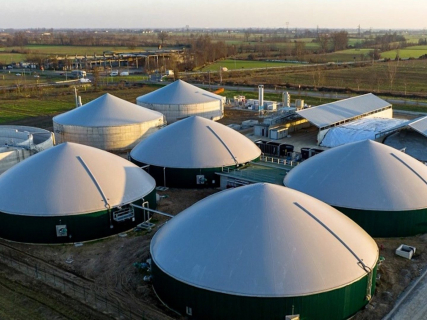

The agrarian organizations Asaja, COAG, UPA, and Cooperativas Agro-alimentarias de Córdoba have reiterated this Tuesday that "biomethane plants are an opportunity to transform the by-products of the province of Córdoba," for which they are "receptive to the projected plants, as they would generate employment, added value, and new economic and environmental opportunities for farmers and ranchers."
In a joint statement, the entities demand from the administrations "more information, clear and truthful, about their benefits and possible harms," emphasizing that "the producing sector of Córdoba understands that biomethane is not a threat to the countryside, but an opportunity that we are beginning to understand." They also recall that "it is livestock and agricultural waste that feeds biogas and biomethane plants."
Therefore, the agrarian organizations and cooperatives maintain that they "offer a double advantage," as they allow "efficient management of agricultural and livestock waste and, at the same time, create economic opportunities for small producers." In the case of olive groves, they consider that "it is a double gain, since it can improve the economic and environmental situation and an additional source of income is obtained."
Asaja, COAG, UPA, and Cooperativas Agro-alimentarias de Córdoba point out that "what are currently considered waste that generates concern" in the province, "in the rest of Spain and in Europe," however, "is being transformed into energy, organic fertilizers, and a key tool for the circular bioeconomy." In olive groves, they highlight that "by-products and olive pomace would be eliminated effectively and efficiently to generate clean energy, avoiding a significant environmental problem."
At the same time, they admit that it is "normal for society to have doubts," so they urge the administrations to carry out "an exercise in transparency and communication so that, once the residents are well informed, they know the positive, and also negative, effects of biomethane plants and, if the benefits outweigh the harms, this opportunity that the province cannot let slip away must be seized."
Along these lines, the agricultural organizations try to dispel "one of the great doubts that the neighbors have", since "many fear that these plants will attract mega-farms, a possibility that has no basis, as no company builds a biomethane plant, which costs millions of euros, without having secured the supply of raw material in advance, which must already exist".
Likewise, they recall that "modern biomethane plants work in a closed circuit, with hermetic and deodorization systems. What enters and what leaves is managed with control and traceability. In fact, the stabilized digestate that results from the biomethane production process is much easier to apply and less polluting", when used as fertilizer, "since, instead of spreading it without further ado, direct injection into the soil is carried out, burying it, which reduces odors to practically zero", and "all this with benefits for the soil, to which it returns quality nutrients".
Finally, they emphasize that in Europe there are currently "1,548 operational biomethane plants, of which more than 75% are connected to gas transport or distribution networks. This number has grown significantly in recent years in countries such as Germany, France, Italy and the United Kingdom, which are leaders in this field and concentrate the majority of installations, integrating biomethane into their natural gas networks".