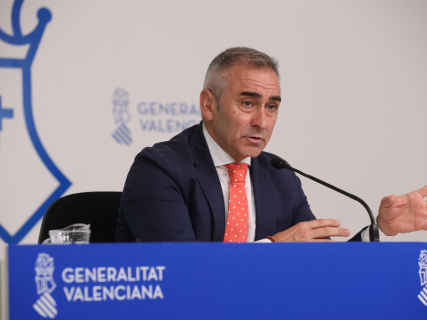

The Minister of Agriculture, Water, Livestock, and Fishing, Miguel Barrachina, has criticized the decision of the Ministry of Agriculture, Fisheries, and Food to deny the exceptional authorization to apply aerially formulations based on Prothioconazole 5% + Sulfur 62.5% against the blast (Pyricularia oryzae) in rice fields, "a resolution that represents a new blow to one of the most emblematic and strategic agricultural sectors of the Comunitat Valenciana."
"The Ministry of Agriculture leaves the rice sector defenseless by rejecting the aerial treatment against the blast," Miguel Barrachina stated, recalling that this is the second time this request has been denied, "fully justified from a technical point of view and especially useful in plots with access problems for ground machinery, given that the water-saturated soil during cultivation can cause equipment to get stuck."
"While the disease advances and farmers accumulate losses, the Government again closes the door to an exceptional solution precisely intended for situations like this. It is an incomprehensible decision that demonstrates an absolute lack of commitment to the Valencian rice sector," he condemned in a statement.
The request for authorization was based on "a perfectly documented exceptional situation": the appearance and spread of resistances of Pyricularia oryzae to the main fungicides currently authorized, a problem confirmed by IVIA analyses since 2023 and which has intensified in the 2024 and 2025 campaigns, with significant reductions in yield, grain quality, and deterioration of the affected areas.
The advance of the disease particularly impacts the traditional varieties protected by the Denomination of Origin Rice from Valencia, such as Bomba, Albufera, and J. Sendra, compromising both the economic viability of the farms and the survival of a cultivation system closely linked to the conservation of the Natural Park of l'Albufera.
In the Comunitat Valenciana, more than 15,000 hectares of rice are planted, and the territory has been a state reference for decades in integrated pest management and responsible use of phytosanitary products. Precisely because of this trajectory, Barrachina finds it even less understandable that the Ministry "ignores a request based on a real agronomic need, on technical criteria, and on scientific data."
The councilor has stated that "the Ministry once again demonstrates that it legislates and decides from the offices, without stepping into the field and without listening to those who have been warning about the problem for years."
As he has emphasized, "it is profoundly disappointing that an exceptional authorization for aerial treatment, intended precisely for extraordinary situations like the one our rice is going through and the state of our fields, is rejected. To a situation that is already complicated, an added difficulty is joined that prevents treatments from being carried out."
Barrachina has recalled that the product whose authorization was requested was designed for strictly controlled use, limited in time, with a maximum of two applications, at specific moments in the crop cycle and always before the formation of the marketable grain, in accordance with the tests carried out and following the procedure established in European regulations for exceptional authorizations.
The Ministry of Agriculture is already analyzing possible administrative actions against the Ministry's resolution and will maintain its demands for all necessary measures to be adopted in defense of the Valencian rice sector.
"The Generalitat is not going to resign itself while our farmers continue to lose production and competitiveness. We will continue to defend the rice sector with all the legal and technical instruments at our disposal because behind every hectare of rice there is employment, heritage, landscape, and future for the Albufera and for the entire Comunitat Valenciana," the councilor concluded.