
If packaging is key to protecting food, ensuring food safety, and facilitating its distribution, the next challenge is to ensure that the materials it is made of can be recovered and reused. In this process, the act of depositing packaging in the yellow bin becomes the first essential step. In a context where Europe is moving towards more circular models, the recycling of beverage and food carton packaging has become a priority for the food and packaging industry.
What the packaging is made of and how its materials are recycled
Tetra Pak packaging is mainly composed of cardboard —around 70%— from responsibly managed renewable sources, in addition to plastic and a thin layer of aluminum, materials that fulfill complementary functions to protect the food, guarantee its preservation, and minimize food waste.
Once deposited in the yellow container, the containers are collected and transferred to sorting plants, where they are separated by type and grouped into bales before being sent to specialized recycling facilities.
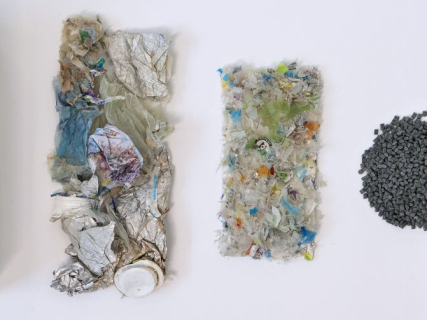
In these plants, the containers are mixed with water and agitated in a hydrapulper, a process similar to paper recycling, which allows the separation of paper fibers from polyethylene and aluminum.
From this process, two streams of recycled materials with value for other industries are obtained. On the one hand, paper fibers are reused to manufacture high-quality recycled paper, used in products such as boxes, bags, or corrugated cardboard. On the other hand, polyethylene and aluminum, known collectively as polyal, are recycled through mechanical recycling to produce granules, which are subsequently used in the manufacture of resistant and durable products such as pallets, urban furniture, or gardening elements.
In this way, the materials that originally formed part of a container can be reincorporated into the economy in the form of new products, extending their useful life and reducing the need for virgin raw materials.
Recycling and collaboration infrastructure: keys to closing the loop
The circularity of packaging does not depend solely on its design, but also on the existence of effective collection, sorting, and recycling infrastructures that operate at scale. For materials to be recovered and reused, it is necessary for all links in the chain —from collection to recyclers and processors— to be coordinated and have sufficient capacity.
In this system, the correct separation of containers at the source is the starting point. For this reason, Tetra Pak and other players in the food industry are promoting awareness initiatives in collaboration with public administrations to foster responsible recycling habits and reinforce the use of the yellow bin.
At the same time, the company works alongside recyclers and processing companies to strengthen recycling infrastructures and develop new applications for recovered materials.
In Spain, this collaboration has allowed a significant increase in the recycling capacity of the polyal fraction, favoring its reuse in industrial applications and contributing to closing the materials cycle.
“The recycling of packaging not only allows the recovery of materials, but also reduces the need for virgin raw materials and moves towards a more efficient use of resources,” explains Virginia Rodríguez, Head of Sustainability at Tetra Pak Iberia. “The challenge is to continue strengthening the recycling infrastructure, develop new applications, and promote the demand for these recycled materials to increase their incorporation into the final market.”