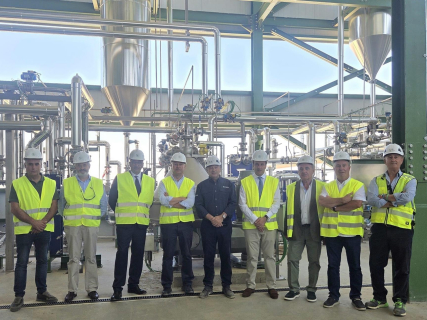

The counselor of Agriculture, Livestock, Rural Environment, and Environmental Policy, Joaquín Antonio Pino, has reiterated before Asaja Palencia his willingness to maintain a constant dialogue during a visit to their offices, where he also showed his support for the olive oil plant of Iberolea in Paredes de Nava.
Pino has traveled to both the headquarters of the agrarian organization and the facilities of the Iberolea plant in Paredes de Nava (Palencia). According to the Ministry, both meetings exemplify the commitment of the Junta to continuous communication with the sector and support for business projects that strengthen the competitiveness of agriculture and the agri-food industry in the Community.
In the meeting held at the offices of Asaja Palencia, the counselor met with the provincial leaders of the professional agrarian organization and expressed interest in the work that the technicians are doing at a particularly intense moment for the field, focused on monitoring the farms and providing ongoing advice to farmers and ranchers.
Pino emphasized the relevance of the work of professional agrarian organizations as a means of dialogue between the sector and the regional Administration, highlighting that they are a key tool for conveying the real needs of the field and helping to define public policies tailored to the situation of farmers and ranchers.
In this regard, he insisted that the Ministry of Agriculture, Livestock, Rural Environment, and Environmental Policy will maintain a policy of active listening and will integrate the proposals of agrarian organizations into government action, with the aim of continuing to promote measures that strengthen competitiveness, profitability, and future prospects of the primary sector in Castilla y León.
During the meeting, the representatives of the organization presented to the counselor the main concerns of the farmers and ranchers of the province, such as the drop in the harvest in the current campaign, the increase in production costs, the damage caused by wildlife, and other challenges that currently affect agricultural and livestock activity.
Investment project in Paredes de Nava
Subsequently, Joaquín Antonio Pino has moved to Paredes de Nava to check on the ground the degree of progress of the facilities of Grupo Ibereólica and Iberolea, a business project in a very advanced stage of construction in which the first tests of olive oil refining are already being carried out.
Grupo Ibereólica and Iberolea have presented their initiatives in the Community to the Junta de Castilla y León, among which stands out the investment of 185 million euros in the Paredes de Nava complex. The olive oil refinery "Net Zero Emissions," with a planned capacity of 100,000 tons per year, will begin its activity in September 2026 and the complex will create 120 direct jobs in its operational phase.
The plant will incorporate lines for the extraction, refining, and bottling of olive oil and sunflower and rapeseed seeds, with the aim of becoming an engine of economic development for the region by promoting the cultivation of oilseeds, mainly sunflower and rapeseed.
During the visit, the head of Agriculture, Livestock, Rural Environment, and Environmental Policy highlighted that this initiative "is an example of the growth potential that the agricultural and agri-food sector of Castilla y León has and represents an opportunity for farmers to improve the profitability of their farms, also adapting crop production to the needs and demand of the agri-food industry."
The counselor emphasized that environmental protection and the responsible use of resources can go hand in hand with economic growth and the development of the agricultural sector, and defended an environmental policy aimed at supporting productive activity, promoting innovation, and favoring an increasingly efficient and clean production.
Likewise, he stressed that the Ministry of Agriculture, Livestock, Rural Environment, and Environmental Policy will continue to support all business initiatives that promote the development of the territory, contribute to retaining population, generate added value to agricultural productions, and consolidate a more solid, innovative, and competitive agri-food sector, capable of creating wealth and employment in the rural environment.
Joaquín Antonio Pino has highlighted the notable agricultural potential of Castilla y León, a Community that, in addition to leading nationally in cereal production, occupies a prominent position in the cultivation of sunflower and rapeseed, two productions that have solidified in recent years as the main industrial crops of regional agriculture.
This leadership, the Ministry has pointed out, is evident in the 417,661 hectares of sunflower declared in the CAP 2026 and in the 31,392 hectares of rapeseed sown, figures that show the high degree of specialization achieved by the farmers of the Community and the growth opportunities provided by a transforming industry capable of taking advantage of this high productive capacity.
Finally, Joaquín Antonio Pino has emphasized the strategic location of the project of the Ibereólica Group and Iberolea, which will strengthen the economic development of this area of the province of Palencia, consolidating itself as an important vector of economic and social dynamization for the territory, and which will contribute to the progress of the whole of Castilla y León through the generation of added value at origin, the establishment of industrial activity in the rural environment, and the creation of quality employment.