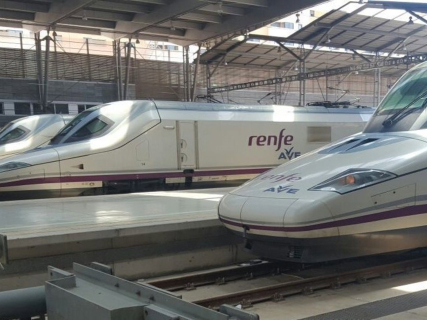

The new strike on Renfe on July 31 could disrupt the travel of thousands of passengers at one of the main departure times for summer vacations. The strike, lasting 24 hours, affects the driving and intervention staff of Renfe Viajeros throughout the national territory.
The Ministry of Transport and Sustainable Mobility has established minimum services to maintain part of the rail offer, guaranteeing 73% of High-Speed and Long-Distance services, 65% of Medium-Distance, and up to 75% of Commuter services during peak hours. In the scenario of maximum adherence, up to 322 commercial trains could be out of service, although this figure represents the possible limit and not a list of already confirmed cancellations.
Up to 92 AVE and Long-Distance trains could be canceled
In the High-Speed and Long-Distance services, Transport guarantees the operation of 73% of the scheduled trains.
Of the 343 services planned for Friday, 251 are included within the minimum services. The other 92 could be affected by the strikes depending on the number of workers who support the call.
The strike affects the trains operated by Renfe. The call does not include the staff of other companies that operate on the high-speed network, such as Iryo or Ouigo.
Medium Distance guarantees around 65% of the trains
In Medium Distance, the minimum services are around 65% of the usual offer.
Renfe has scheduled 662 trains of this category affected by the call. At least 432 must operate, while the other 230 could be canceled if the adherence to the strike prevents completing the ordinary schedule.
The sum of those 230 services and the 92 of High-Speed and Long-Distance raises to 322 the maximum number of trains that could be affected during the day.
Commuter services will operate at 75% during peak hours
The minimum services of Commuter will be 75% during peak demand hours and 50% during the rest of the day.
The peak times are concentrated in the morning, between 6:00 and 9:00; at noon, approximately between 13:30 or 14:00 and 15:30 or 16:00, depending on the area; and in the afternoon, between 18:30 and 20:30.
Catalonia and the Basque Country will set their own minimum services in the railway services whose competences are transferred to their respective autonomous governments.
Why has the Railway Union called the strike?
The Intersindical Railway Union has called on the train drivers and intervention staff to denounce the breakdowns and deficiencies in the air conditioning systems of some trains.
The organization claims that these failures are affecting both the working conditions of the staff and the travelers, especially during the episodes of high temperatures recorded this summer.
The call on July 31 is the third recently promoted by this union. The strikes on June 29 and July 15 responded to other demands related to Renfe Mercancías and recorded, according to the company, a follow-up of less than 2%.
What can affected travelers do?
Renfe will allow travelers whose train is ultimately canceled to transfer, when there are available seats, to another service with a schedule close to the contracted one.
Passengers will also be able to change the ticket for another date or cancel it at no cost. These operations will be available through the usual sales channels of the company.
The operator recommends checking the specific status of the train before going to the station. The services included in the minimums are guaranteed to operate, while possible cancellations will be concentrated in the remaining part of the offer.