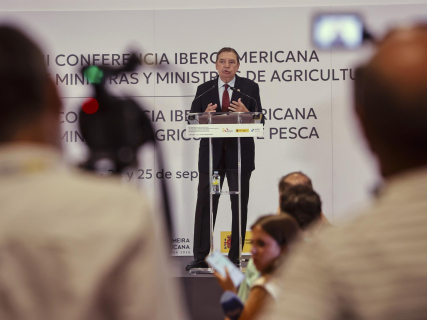

The Minister of Agriculture, Fisheries and Food, Luis Planas, emphasized this Thursday, regarding the implications of the sale of Deóleo, that "the situation is quite clear," recalling that the company "has an industrial center located basically in the province of Córdoba, which is the most important," and that he considers "very important to preserve and, if possible, enhance the current production structures of Deóleo," in addition to "guaranteeing the supply security of all producers and olive growers, who deliver their product."
In an appearance before the media in Córdoba, on the occasion of the XII Ibero-American Conference of Ministers of Agriculture and Fisheries, Planas indicated that "for each possible or potential buyer, the consequences are different in many ways, for example, in relation to supply or to the industry."
In this line, he stressed that "Deóleo does not have its own production, but acquires from cooperatives and from farms, from individual producers," so he estimates that "it is very important to ensure that supply." As he explained, the Government is "closely monitoring" the sale process, which "still has weeks to go," and he emphasized that he is "very cautious" in his statements so as not to "interfere in this process," although they monitor it "very closely."
Planas insisted that what is essential is that "industrial production is maintained and developed and that the interests of the producers are maintained." He recalled that it is "a private operation, because Deóleo is owned by two British investment funds that have decided to put Deóleo up for sale, and indeed there are several groups, Spanish and non-Spanish, interested in the acquisition."
In this regard, he specified that "the conditions will depend on the quantities handled in this buy-sell, but also on the regulatory conditions, that is, on the respect for the competition conditions in the markets where Deóleo is present," something he described as "really very important." Therefore, he reiterated that "he would prefer the buyer to be a Spanish group, but all of this depends on the conditions under which this buy-sell is carried out."
Debate on the olive oil quota
In relation to the olive oil forecast and the request from the Agrarian Association Young Farmers (Asaja) of Córdoba to the Junta de Andalucía to postpone the presentation of the forecast for the 2026/27 campaign due to the lack of rain and the high temperatures that the olive grove endures, Planas has stated that he respects Asaja's position, although he referred to "a misunderstanding."
He explained that "two circumstances come together," referring to the forecast prepared by the autonomous communities, whose presentation by the Andalusian Ministry of Agriculture is scheduled for September 29, and he recalled that Andalusia concentrates "three-quarters of Spain's production." In addition, "at the beginning of October, as soon as possible, the national forecast of Spain for the 2026-2027 campaign will be made public."
The minister emphasized that "it is a legal obligation that must be fulfilled." In his opinion, "Asaja's assessment is correct in the sense that this is a forecast," and he clarified that "when economic forecasts are made, it does not mean that the forecast will happen exactly."
Planas added that if meteorological changes occurred during the autumn, "if there were climatic variations throughout the autumn that could be in the form of rain, and therefore, greater capacity for fattening and production, or not, all of that will be seen and, as always, the forecasts of the forecast will be adjusted." In any case, he highlighted that "the forecast must be made under the conditions that exist, both the Junta de Andalucía and the Government of Spain, and subsequently it will be adjusted in the development of the campaign."