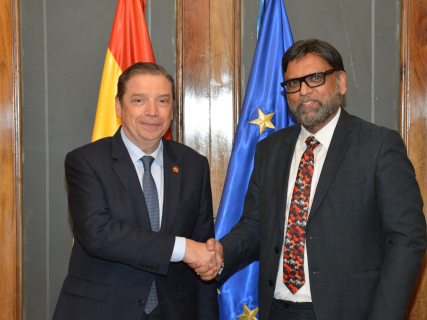
Planas proposed a "gentlemen's agreement" to obtain votes from Europe in his race for the FAO

After the failed attempt by the Presidency of Cyprus in Europe to present a single candidacy to the UN food agency, the Spanish minister proposes that those who obtain fewer votes withdraw from the competition.

3 minutes

28.05.2026 Ministro y embajador India  (3)

28.05.2026 Ministro y embajador India (3)

Add DEMÓCRATA to Google

Ask FREN

Published

3 minutes

Most read

An Irishman (the former Commissioner for Agriculture, Phil Hogan), an Italian (the Deputy Director-General of the FAO, Maurizio Martina) and a Spaniard (the Minister of Agriculture, Luis Planas) are competing for the position of Director-General of the FAO, the main Agriculture and Food agency of the United Nations. Therefore, to symbolize the union of Europe, during the past Cypriot presidency, an unsuccessful attempt was made to work towards a single, solid and strong European candidacy for the election in June 2027, according to sources from the Ministry of Agriculture.

The same sources assure that Ireland (a country presiding over the EU during the second half of 2026) has declared its neutrality in this race for the FAO leadership because it also presents a candidate and, as the future Lithuanian presidency (in January 2027) will leave little room for maneuver regarding the vote, Minister Planas wants to propose a "gentlemen's agreement".

From the Ministry of Agriculture of Spain, the proposal is launched that, if the objective of the European Union is to have a Director-General at the FAO (something that has not been achieved for 50 years), the European candidates with the fewest votes after the first round can withdraw and thus support the one or those who remain in better positions.
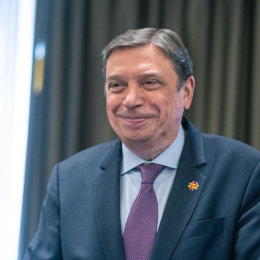
Moratinos' Experience

The first time a Spaniard ran for the directorship-general of the FAO was in 2011, when the then former Minister of Foreign Affairs and Cooperation, Miguel Ángel Moratinos, fell just a few votes short of achieving it. Precisely, two of those few votes were from European Union states, which turned their backs on the Spanish candidate, favoring the election of the Brazilian Graziano Da Silva.

Hence Planas' interest in establishing a "gentlemen's agreement" among the member states to support the candidate(s) from the 27.

In political and international terms, there are voices questioning whether the European Union, with a conservative majority, can support a Spanish candidacy defended by the president of the Socialist International, Pedro Sánchez.

Spain, a Model for the World

Since the mandate of the Dutchman Addeke Hendrik Boerma at the head of the FAO ended in 1975, no European has held the position, and the international organization responsible for reducing hunger in the world has been led by representatives from other regions such as Lebanon, Senegal, Brazil, or China.

According to ministerial sources, Spain's candidacy offers multilateralism as a tool to effectively combat malnutrition in the world, an objective that is not achieved more due to war and political conflicts than to the existence of food.

In fact, Planas's team presents Spain as a model of success in the agri-food sector, as in recent decades it has become the fourth largest food producer in the European Union and the eighth in the world.

Likewise, the minister also offers his long and consolidated professional experience in the agricultural sector, as after being, on two occasions, Minister of Agriculture of Andalusia (for two very brief periods of around one year) he is currently the second Minister of Agriculture to have served the longest in office in Spain, (surpassed, by only two months as of the date of this article, by Carlos Romero during Felipe González's era).

Planas knows North Africa well from his time as ambassador to Morocco, as well as the European Union, where he has worked intermittently for different periods.

Therefore, the team of the current Minister of Agriculture is confident that his knowledge of the primary sector, his experience as a senior official and ambassador, along with his consensus-building attitude are excellent assets for his candidacy for the FAO.

The spanner in the works

However, all these virtues may be conditioned by an external factor: Spain already has a representative at the head of one of the UN's international Agriculture and Food organizations, Álvaro Lario, who is the current president of the International Fund for Agricultural Development, IFAD.

As Luis Planas well knows, in diplomacy there are many elementary rules that are not written, and having two Spaniards at the head of two world entities that are also closely related could seem strange, although not impossible.

At 73 years old, the Spanish candidate presents a very consolidated career. In addition to the three Europeans, so far the Turkish Mehmet Mehdi Eker; the Angolan Josefa Sacko and a representative from Uganda have presented themselves to run for the position of FAO Director.

More key points, information and questions with FREN

AI-GENERATED CONTENT

What is the procedure and timeline for the election of the FAO Director-General?

The FAO Director-General is elected through a formal process within the organization itself, involving all Member States through the FAO Conference. The election is conducted by secret ballot, and the term is four years, usually renewable once. The procedure combines several phases: submission of candidacies by governments, campaigning and hearings, examination by the Council, and finally, voting and appointment by the Conference. The timelines are set by the FAO governing bodies but always follow a relatively stable sequence around the year in which the elective Conference is held.

Basic structure of the procedure

The election of the FAO Director-General is framed within the organization's so-called “Fundamental Texts” (Constitution and General Rules). Simplified, the process works as follows:

  • Electing body: the FAO Conference, which is the highest governing body where all Member States are represented.
  • Mandate: the Director-General is appointed for a period of four years, with the possibility of re-election (usually, only one re-election).
  • Voting: it is carried out by secret ballot, with the system of “one State, one vote.”
  • Candidate proposal: candidacies can only be submitted by the governments of Member States, not by individuals in a personal capacity.

Phase of candidacy submission and campaign

The process usually starts well in advance of the Conference where the election will take place:

  • Announcement of vacancy and schedule: the FAO Council (the smaller executive body than the Conference) approves a specific schedule for the corresponding electoral cycle. This schedule sets the deadline for submitting candidacies.
  • Deadline for submitting candidacies: Member States have several months to propose candidates. The State sends an official communication to the Director-General (or the FAO Secretariat), with the name and profile of the candidate it supports.
  • Publication of the list of candidates: once the deadline has passed, the FAO disseminates the list of valid candidacies among all Member States and governing bodies. From that moment, the candidates can fully deploy their campaign (bilateral meetings, program presentations, events in Rome, etc.).

In this preliminary phase, it is common for candidates to present a work program for the organization (priorities in food security, sustainability, digitalization of agriculture, financing, etc.) and to hold meetings with regional groups (countries of Latin America and the Caribbean, Africa, Europe, Asia-Pacific, Near East, etc.) to gather support.

Role of the FAO Council

Before the Conference votes, the Council meets in a preliminary session in Rome. In that meeting:

  • Candidates usually intervene to present their vision and answer questions from delegations.
  • The Council examines information about the candidacies (curricula, programs, compliance with formal requirements).
  • However, the final decision is not made by the Council but by the Conference; all duly presented candidates proceed to the final vote, with no candidate “eliminated” by the Council.

This stage mainly serves to increase transparency and allow Member States to compare proposals before the definitive vote.

Election at the Conference and assumption of office

The decisive phase takes place during the session period of the FAO Conference, which is generally held every two years (usually in June or July, in Rome). On one of the agenda days:

  • A closed plenary session is held for the election.
  • A secret ballot is conducted: delegations cast their ballots and the counting is done.
  • The candidate who obtains the majority of valid votes cast is elected.
  • If no candidate reaches the required majority in the first round, successive voting rounds are held, with the least voted candidates being eliminated until one achieves that majority.

Once the result is proclaimed at the Conference itself, the appointment resolution is adopted. The new Director-General does not assume office immediately on the election day but on the date set by the Fundamental Texts and the appointment resolution itself. In recent cycles, the practice has been for the new Director-General to take office around August 1 of the election year, thus beginning their four-year term.

Renewal of the mandate

If the incumbent Director-General wishes to renew the mandate, they must essentially follow the same procedure as any other candidate: their candidacy must be submitted by a Member State and compete on equal formal terms. There is no automatic renewal: the Conference must expressly vote for a second term.

At what specific time of the year does the FAO usually set the deadline for submitting candidacies for Director-General? What role does Spain usually play in the elections for the FAO Director-General and which candidates has it historically supported? What leeway does the FAO Conference have to change the rules or timelines for the Director-General election before the next electoral cycle?

What are the powers and functions of the Minister of Agriculture in Spain according to current legislation?

The Minister of Agriculture, Fisheries and Food is, generally, the highest political and administrative authority of the department responsible for agricultural, livestock, fisheries, and food policies, within the common regime of ministers established by Law 50/1997, of the Government and the royal decrees on restructuring and organic structure of ministerial departments (such as Royal Decree 829/2023). These norms set out the basic functions of leadership, regulatory promotion, coordination, and representation, which apply to any minister and therefore also to the Minister of Agriculture. Additionally, other sectoral provisions, such as Royal Decree 262/2019 on agricultural offices abroad, reflect their role in the international projection of the department. Below is a summary of the main powers and functions according to this legal framework.

1. General framework: the minister's position in the Government

Law 50/1997 configures the minister as a member of the Government, along with the president and, if applicable, the vice presidents. As such, they participate in the Council of Ministers, a collegiate body to which the Law attributes functions such as approving bills, royal decree-laws and regulations, declaring states of alarm and exception, or adopting programs and plans of the General State Administration.

Within this scheme, each minister heads a department and exercises broad autonomy and responsibility in their material scope, according to the so-called “departmental principle” highlighted by the Law itself.

2. Material scope of the Ministry of Agriculture

Although the consulted sources do not detail article by article the Ministry's matters, the restructuring royal decrees of departments, such as Royal Decree 829/2023, and the department's own name delimit its field of action around:

  • Agriculture and livestock: agricultural structures, plant and animal production, modernization of farms, Common Agricultural Policy aids, etc.
  • Fisheries and aquaculture: fleet management, fishery resources, and fish product markets.
  • Food: food chain, differentiated quality, designations of origin, and food safety in coordination with other competent departments.

This material perimeter frames the minister's specific functions within the general powers that the Government Law attributes to all heads of ministerial departments.

3. General functions of the minister as a superior body

Horizontally, the Government Law establishes that each minister exercises, within their scope, the functions of directing Government and Administration action. In summary, this translates into the Minister of Agriculture:

  • Politically directs the department, setting priorities, orientations, and objectives in agricultural, fisheries, and food policies.
  • Promotes the Ministry's regulatory activity, submitting draft bills and draft royal decrees related to their field to the Council of Ministers, in accordance with the general regulatory initiative regime provided in Law 50/1997.
  • Executes the Council of Ministers' decisions in their sector, ensuring their application by the Ministry's superior and management bodies.
  • Manages the department's human and material resources, within the budgetary and common public function framework, through the internal organization established by the organic structure royal decrees.

4. Coordination, delegation, and substitution powers

The Government Law provides a common regime for all ministers, highlighting several relevant faculties:

  • Internal coordination: the minister coordinates secretaries of state, undersecretary, general directorates, and dependent bodies, and participates, when appropriate, in Government Delegated Commissions on interdepartmental matters.
  • Delegation of powers: according to the Law, ministers may delegate the exercise of their own powers to secretaries of state, undersecretaries, government delegates, and other management bodies of the Ministry, with the non-delegable exceptions set by the text itself (for example, powers directly attributed by the Constitution or by law prohibiting delegation).
  • Substitution: the substitution of a minister is established by royal decree of the Prime Minister, always falling on another Government member; the substitution regime of secretaries of state within the department is determined in the organic structure royal decree.

5. External representation and relations with the EU and Autonomous Communities

Law 50/1997 attributes to the Government as a whole the direction of internal and external policy, without sectorally detailing each minister's role in the European Union or before the autonomous communities. However, from the overall regulations it follows that the Minister of Agriculture:

  • Represents the Government in their material scope before other States, EU institutions, and international organizations, normally in coordination with the Ministry competent in foreign affairs.
  • Channels Spanish participation in the EU on agricultural, fisheries, and food matters, including preparing positions in the EU Council of Ministers or specialized committees, although the consulted sources do not contain a specific provision detailing this.
  • Interacts with the autonomous communities on these matters through inter-administrative and sectoral cooperation bodies that general regulations may establish; no specific articles on this point for the Ministry of Agriculture were found in the available information.

Likewise, Royal Decree 262/2019, regulating the Ministry's offices abroad, shows that the minister is responsible for the sectoral representation network in other countries, a key instrument for agricultural, fisheries, and food policy internationally.

In which specific articles of Law 50/1997 are the functions of ministers collected and how do they apply to the Minister of Agriculture? Which current royal decree develops the basic organic structure of the Ministry of Agriculture, Fisheries and Food and what superior and management bodies does it provide for? How is the participation of the Minister of Agriculture articulated in the decisions of the Common Agricultural Policy and what coordination mechanisms exist with the autonomous communities?

What formal requirements must candidates meet to run for the FAO Director-General position?

To formally run for the position of FAO Director-General, there is no “closed list” of requirements as in a state examination, but there is a very clear legal framework: the FAO Constitution (art. VII) and its General Rules (art. XXXVII) define who can be a candidate, how the candidacy is submitted, and how the election is conducted. In summary, the aspirant must be a national of an FAO Member State, be officially proposed by their Government, demonstrate “relevant” experience in the organization's fields, and undergo a secret election by the Conference, where a simple majority of votes cast suffices. The term is four years, renewable only once for another four years. Beyond this, the real filter is political and diplomatic: the ability to gather support among the 194 Member States.

Nationality and legal eligibility

The organization's basic texts establish that the Director-General is appointed by the FAO Conference “from among the nationals of the Member States.” That is:

  • Nationality: the candidate must be a citizen of one of the member countries (currently 194), without formal regional quotas. This is derived from the Constitution and is included in the FAO electoral documentation, accessible in the institutional information, in the Director-General election procedure notes (election rules, explanatory note) and in the Constitution itself compiled in this document.
  • Legal eligibility: there are no additional specific prohibitions beyond the general incompatibilities with the FAO statute. The position is appointed for four years, renewable only once, as both the organization's documentation (2019 electoral calendar) and the Spanish press explain, noting that Qu Dongyu's current term is his second and last period.

Professional experience and required profile

The Constitution does not set a minimum number of years, but the FAO itself emphasizes that “relevant experience” is an essential requirement for high-level positions. In documents on the selection and evaluation of executives (selection guidelines) and in notes to States wishing to present candidates (candidacy form), it is required that the proposing Government submit:

  • A detailed curriculum vitae with the candidate's career.
  • A statement about their qualifications, experience, and capabilities in areas such as agriculture, rural development, food security, international management, or multilateral diplomacy.

In recent campaigns (for example, the 2019 European candidacies described in this 2019 analysis), it is observed that all aspirants have been former ministers, European commissioners, or senior FAO executives, which de facto consolidates a very high standard of experience.

Support from Member States and nomination procedure

The nomination procedure is highly state-centered:

  • Only Governments can submit candidates. Candidacies must be transmitted by the Government of a Member State to the FAO Council president; neither individuals nor NGOs can apply directly, as stated in the official election rules note (nomination rules and procedure note).
  • Deadlines: the Council sets them each cycle. In 2019, for example, a period of about three months was opened to send nominations, which had to be received at least two months before the election session, according to the call circular.
  • Minimum support: legally, the endorsement of a single Member State suffices for the candidacy to be valid. No minimum number of co-sponsors is required, although in practice broad regional support is sought, as seen in the European candidacies reported by media such as Infobae or in FAO notes on the 2019 election (Conference document).

Additionally, the candidate must be available for a “hearing” or presentation before the Council, where they present their program and answer questions before the final vote; this practice is included in the procedural documentation and reiterated by internal analyses of the organization.

Election at the Conference: voting and majorities

The appointment is decided at the FAO Conference, a plenary body where each Member State has one vote. The election proceeds as follows, according to the rules compiled in the “rules and procedures for the election of the Director-General” note and the General Rules (election guide):

  • Secret ballot, with a quorum of a majority of Member States present.
  • A simple majority of valid votes cast is required (excluding abstentions).
  • If no candidate reaches that majority, successive votes are held, eliminating the least voted in each round until two candidates remain, between whom voting continues until one achieves the majority.

All this process takes place under the FAO's general legal framework, accessible in the compilation of its Constitution and Rules (constitutional text) and in guidance to Member States (2026 call information note).

What role do regional groups (for example, the EU or the G77) play in negotiating support to elect the FAO Director-General? What specific schedule is planned for the election of the new FAO Director-General in 2027 and which countries have already announced candidates? How does the FAO Director-General election procedure compare with that of other UN agencies such as WHO or WFP?

Play

Test your knowledge with FREN!

How much do you know about this topic? Answer the following 3 questions.

What does Luis Planas propose to strengthen the European candidacy for the FAO Director-General position?

Question 1 of 3

Which country has declared its neutrality in the race for the FAO Director position?

Question 2 of 3

Which other Spaniard currently holds a relevant position in a UN international agricultural organization?

Question 3 of 3

Hola, soy Fren. ¿Cómo te ayudo?