
The Department of Agriculture, Fisheries and the Natural Environment has communicated this Wednesday to the farming organizations of Menorca the details of the next call for grants from Provilac 2026, which will have a total budget of two million euros for the whole of the Balearic Islands.
As the Department has explained, the program keeps the two lines of direct aid to dairy cattle farms, aimed at supporting livestock activity and at the digitalization of the farms, with the same conditions as in the previous edition.
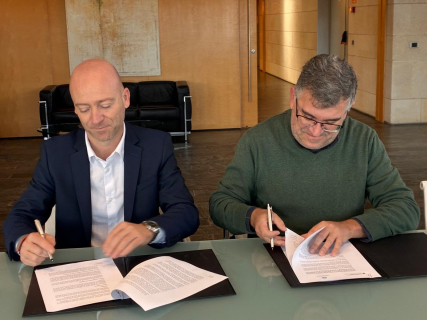
Before the information meeting, the councillor in charge of the portfolio, Joan Simonet, in his capacity as president of the Fondo de Garantía Agraria y Pesquera de Baleares (Fogaiba), and the president of the Consell de Menorca, Adolfo Vilafranca, have signed the collaboration agreement to co-finance the Provilac 2026 grants on the island.
The agreement sets an 820,000-euro contribution from Fogaiba and another 820,000 euros from the Consell Insular, which represents a joint allocation of 1.6 million euros specifically for Menorcan dairy farms.
For the whole of the Balearic Islands, the Department commits 1.2 million euros and the Consell Insular, 820,000 euros. Menorca concentrates around 86 percent of the production of cow’s milk in the archipelago.
According to 2025 data, the island produced close to 47 million liters of milk and 109 of the 124 professional dairy cattle farms in the Balearic Islands were located there.
Simonet has emphasized that Provilac 2026 preserves the aid structure from the previous year, set out in two separate lines. The first is oriented toward maintaining the dairy sector, in order to help offset the additional costs that dairy cattle farms bear, especially those derived from insularity and from market conditions.
The amount of this aid will be determined based on the number of breeding cows and the breed, with a cap of 0.020 euros per liter of milk produced during the year 2025.
The second line is aimed at the digitalization and improvement of the management of livestock farms. It includes additional aid of 0.015 euros per liter of milk to support the digitalization systems already implemented and 0.025 euros per liter for the rollout of new digitally managed systems.
In this sense, it has pointed out that both lines will be integrated into a single call for applications, which will be processed by the Fogaiba and whose publication is planned before the end of 2026.
Reinforcement of investments and impact on the dairy sector
With regard to investments, the INEA 2026 call for applications has been strengthened with a specific sub-line for the dairy sector, while the latest calls for aid for the transformation and marketing of agri-food products (ITC) have already met the sector’s needs without any budget restrictions. For this reason, it is not considered necessary to incorporate these actions specifically into this year’s Provilac.
After the signing of the agreement, the conseller met with representatives of the agricultural organizations of Menorca to address various issues related to the situation of the primary sector.
The meeting was attended by the councillor for Economy and General Services of the Consell Insular de Menorca, Maria Antònia Taltavull Fernández; the island director of Economy, Alicia Martí; the general director of Agriculture, Livestock Farming and Rural Development, Georgina Brunet, and the manager of the Fogaiba, Joan Coll.
During the meeting, representatives of the sector expressed their concern about the drought situation and discussed various aspects relating to agricultural insurance and the increase in production costs.
Regional aid aimed at alleviating the rise in production costs resulting from the conflict in the Middle East was also addressed.
In this context, Simonet recalled that the first package of measures, approved in April, included close to 13.5 million euros for the primary sector, with support lines to offset the increase in the cost of agricultural and fishing diesel fuel, fertilizers and animal feed, among other actions.
Throughout the meeting, special mention was made of the calls for aid for agricultural diesel fuel and fertilizers, detailing the conditions for access and the established criteria.
With regard to fertilizers, the call for applications has funding of 1.5 million euros and establishes aid of 67 euros per hectare of dryland and 176 euros per hectare of irrigated land. The deadline to submit applications ends on November 27.
Second package of economic support and complementary measures
The minister has also recalled the measures included in the second package of economic support, presented on 9 November by the President of the Govern, Marga Prohens, which provides for a new allocation of 11 million euros for the primary sector, with the aim of responding to the demands that agricultural and fishing organizations have raised in the face of the increase in production costs.
In this context, Simonet has highlighted that, among the actions planned, there is the continuation of aid to offset the increase in the cost of agricultural and fishing diesel, with a new item of 2.2 million euros.
Of this amount, 1.2 million will be directed to agricultural holdings and agri-food industries, including other energy costs, while the remaining million will be allocated to companies and entities in the fishing sector, for diesel and other operating expenses.
The new aid is proposed with retroactive effects from 15 June 2026, in order to link to the period covered by the previous calls.
It has also highlighted that the second package includes 4.5 million euros for a specific line of investments associated with agri-gastronomic experiences, promotion and dissemination, and energy efficiency; 2 million euros to reinforce agri-environmental aid and avoid cuts in premiums; 1.3 million euros for a new local product voucher campaign during the first four months of 2027, and 1 million euros for a support line for transport.
In the fishing sector, measures are also expected to provide bonification of port fees, concession charges, and certain taxes linked to the purchase of professional fishing vessels.
The meeting included the secretary of Agrame, Núria Pons Comellas; the president of Fagme, Catalina Pons; the president of the Regulatory Council of the DOP Mahón-Menorca, Julio Ramón de Olives Fernández; Cristóbal Capó, of the Asociación Frisona Balear; the president of the Asociación de Fabricantes y Curadores de Queso de Menorca, Àgueda Mercada; the vice president of Cooperatives Agro-alimentàries de Balears, Santiago Lafuente, and the general secretary of Unió de Pagesos de Menorca, Francesc Truyol.
The Provilac was launched in December 2021 as a support plan for the viability, modernization, promotion, and commercialization of the dairy sector in Balears, with a planned duration of five years.
This fifth edition is developed in a setting marked by the difficulties of profitability for dairy farms, the evolution of prices perceived by farmers, and the increase in production costs.
The plan seeks to contribute to the viability of farms, optimize their management through digitization, and ensure the continuity of livestock activity, especially in a sector with a prominent weight in Menorca and closely linked to the island’s agri-food production.