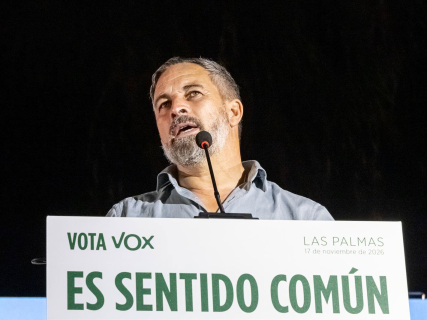
PP and Vox retain up to 196 seats while Podemos falls to 0.8%, according to Sigma Dos’s daily tracking

The PSOE rises to 26.7% and cuts its lead over the PP to four points, although the right-wing maintains a range of 185 to 196 seats. The undecided increase to 14.3% eleven days before the elections.

fotonoticia 20261118213444 1920

fotonoticia 20261118213444 1920

Add DEMÓCRATA to Google

Ask FREN

Published

Last updated

4 minutes

Most read

Elecciones 29N · Encuestas

La media de las encuestas

Media a 18 de noviembre de 2026 · 17 institutos

  • PP31,4 %
  • PSOE27,4 %
  • Vox19,0 %
  • Frente Amplio6,1 %
  • ERC2,4 %
  • SALF2,0 %
01020304050ene 2024jul 2024ene 2025jul 2025ene 2026jul 2026

Media del último estudio de cada instituto en 30 días y su evolución semanal desde el 23J. Partidos con al menos un 2 %.

Todas las encuestas

Elecciones generales del 29 de noviembre · Demócrata

The PP and Vox maintain an absolute majority of between 185 and 196 seats in Sigma Dos tracking for EL MUNDO from November 18, despite the PSOE's advance to 26.7% of the vote. The conservatives continue in the lead with 30.7% and Vox drops by one tenth, to 19.7%. Podemos falls to 0.8%, while the proportion of undecided voters grows to 14.3%, eleven days before the general elections of the 29N.

GENERAL ELECTIONS 29N · SIGMA DOS · 18 NOVEMBER

The right retains the majority and Podemos falls below 1%

185–196Seats PP + Vox
50.4%Joint vote PP + Vox
14.3%Undecided electors
PPPSOEVoxPodemos
0%10%20%30%40%12 Nov.13 Nov.16 Nov.18 Nov.

Evolution of voting intention. Only the dates with full available percentages are shown; the segments link measurements, they do not estimate intermediate results. The information provided does not include the exact national percentage for Frente Amplio on 18 November, so its series is not drawn.

Party 12 Nov. 13 Nov. 16 Nov. 18 Nov.
PP 30.8% 31.0% 30.7% 30.7%
PSOE 25.3% 25.4% 26.4% 26.7%
Vox 19.6% 19.7% 19.8% 19.7%
Podemos 1.4% 1.4% 1.2% 0.8%

Source: Sigma Dos for EL MUNDO. The estimate for 18 November comes from the published information provided for this update. First installment, 12 November. Pending incorporation of EL MUNDO’s specific URL for 18 November.

The PSOE reduces the lead of the PP to four points

With an increase of three tenths compared to the previous installment, the PSOE improves to 26.7% and keeps an estimate of between 108 and 114 seats. The distance with the conservatives is reduced to four points, although the PP remains at 30.7% and maintains a range of 123 to 129 seats.

Vox concedes one tenth and stands at 19.7%, with between 62 and 67 seats. The sum of both candidacies ranges between 185 and 196 seats, above the 176 needed for an absolute majority even at the lower end of the range.

Podemos falls to 0.8% while Frente Amplio recovers two tenths

The socialist growth coincides with the setback of Podemos, which drops to 0.8% of the national vote. The disseminated estimate does not attribute seats to it. Frente Amplio, in turn, improves by two tenths compared to the previous installment, thanks to the results of its coalitions in the Canary Islands and the Valencian Community, and keeps a range of between 10 and 14 seats.

14.3% of electors remain undecided

Uncertainty about the vote grows a few days ahead of the televised face-to-face between Pedro Sánchez and Alberto Núñez Feijóo. According to Sigma Dos, the 14.3% of electors have still not decided their ballot, compared to 12.9% in the previous installment provided. The estimated turnout is 77.3%.

Among those who voted for the PSOE in 2023, the percentage of undecided reaches 13.2%, while among former Sumar voters it is 10.8%. The proportion falls to 5.9% among PP voters and to 2.2% among Vox voters. Also declaring indecision is 20.3% of those who abstained in the previous elections.

Bildu retains an advantage over the PNV and ERC surpasses Junts

In the territorial allocation, ERC maintains an estimate of 8 to 9 seats and Junts, of 4 to 5. EH Bildu would obtain between 6 and 8 deputies, compared with the 4 or 5 of the PNV. Adelante Andalucía continues with a range of 3 to 5 representatives and the BNG, of 2 to 3. Coalición Canaria and Soria Ya! retain options of achieving a seat, although neither of the two parties has it assured.

Technical sheet of the Sigma Dos tracking

The estimate has been prepared with 4,511 interviews between November 11 and 17, using a mixed methodology of telephone interviews (CATI) and online questionnaires (CAWI). The study targets residents in Spain over 18 years of age with the right to vote. Sigma Dos reports a margin of error of ±2.0 percentage points, with a confidence level of 95.5% under the assumption of maximum indeterminacy.

More key points, information and questions with FREN

AI-GENERATED CONTENT

What parliamentary procedures and deadlines remain for the constitution of the new Congress and the investiture after the general elections of November 29?

After the elections on November 29, two processes must be distinguished: constituting the new Congress and obtaining its confidence to form a Government. The decisive deadline for the investiture is two months from the first vote, not from the elections nor from the constitutive session. Therefore, November 29 alone does not allow calculating when a possible failed negotiation would end.

1. Constitutive session and election of the Board

The Congress will meet on the day and at the time established in the royal decree calling the election. The exact date planned for this call has not been found in the consulted sources, so a political forecast should not be confused with an official date.

The session will follow this sequence, according to articles 1 to 4 and 36 and 37 of the Congress Regulations:

  • Age Board: initially presided over by the oldest elected deputy present, assisted as secretaries by the two youngest.
  • Initial readings: the call, the list of elected members, and the electoral appeals filed are read, indicating who they may affect.
  • Election of the Presidency: an absolute majority is required in the first vote. If no one obtains it, the two most voted candidates compete and the one with more votes wins.
  • Rest of the Board: four vice presidencies are elected and then four secretaries. In each election, each deputy writes a name; the four most voted persons are elected.
  • Formal constitution: the Presidency administers and requests the oath or promise to uphold the Constitution, declares the Congress constituted, and communicates it to the King, the Senate, and the Government.
2. Organization of the Chamber

Parliamentary groups must be constituted by a written notice addressed to the Board within five days following the constitutive session. Those who do not join one go to the Mixed Group. The Board organizes the work and sets the parliamentary calendar, after consulting the Board of Spokespersons.

The Regulations also provide for a solemn opening of the legislature within fifteen days following. This is a different act from the constitution and the investiture. Both regulatory deadlines are generally counted in working days; authorizations, periods without sessions, and agreements on deadlines must be considered.

3. Debate and investiture votes

Upon receiving the candidacy proposal provided in article 99 of the Constitution, the Presidency of the Congress calls the Plenary. Articles 170 to 172 of the Regulations do not establish a fixed number of days between the constitution and that first vote: it is not possible to announce a mandatory investiture date counting only from November 29.

The candidate presents their program without time limit. Then each group that requests it intervenes for thirty minutes, with corresponding responses and replies. Votes are public by roll call:

  • First vote: requires an absolute majority of the members of Congress.
  • Second vote: if the first fails, it is held 48 hours later and a simple majority suffices: more favorable than opposing votes. Beforehand, the candidate may speak for ten minutes and the groups for five each.
4. Success or deadlock

If confidence is obtained, the Presidency communicates it to the King for appointment. If both votes fail, successive proposals may be processed by the same procedure.

But those proposals do not restart the clock: after two months from the first vote without investiture, the Presidency submits to the King's signature the decree of dissolution of both Chambers and call for elections, and communicates it to the Senate. That first vote will therefore be the essential reference to date the deadlock limit.

What are the powers and functions of the President of the Government of Spain according to the Constitution?

The President of the Government of Spain is the highest authority of the executive power and one of the central figures of the parliamentary system designed by the 1978 Constitution. The Constitution itself does not offer a single definition but distributes its powers and functions in several provisions, especially in articles 97, 98, 99, 100, and 112 to 116.

1. Head of the executive power and direction of Government action

The starting point is article 97 of the Constitution:

  • The Government directs domestic and foreign policy, civil and military administration, and the defense of the State.
  • The Government exercises executive function and regulatory power.

Within that Government, the president has the key function of directing and coordinating the action of the entire Executive (art. 98.2). This means, in practice:

  • Setting the major political guidelines of the Government.
  • Coordinating the actions of the different ministries and resolving conflicts among them.
  • Promoting or halting regulatory projects and strategic decisions.
2. Relationship with the Cortes Generales: investiture, confidence, and control

Spain is a parliamentary system: the president comes from the Congress and is politically accountable to it.

  • Designation: after each renewal of the Congress, the King proposes a candidate for the presidency of the Government (art. 99). That candidate must obtain the confidence of the Congress through an investiture vote (absolute majority in the first vote, or simple majority in the second).
  • Political responsibility: the president and their Government are subject to parliamentary control (questions, interpellations, investigative commissions, etc.).
  • Vote of confidence (art. 112): the president may submit to the Congress a vote of confidence on their program or a general policy statement. If it is not passed (does not obtain simple majority), they are obliged to resign.
  • Motion of censure (art. 113): although the motion is presented by deputies, its eventual approval implies the forced dismissal of the president and their replacement by the alternative candidate included in the motion.
3. Appointment and dismissal of ministers

According to article 100, the other members of the Government (vice presidents and ministers) are appointed and dismissed by the King, at the proposal of the president of the Government. From this derives an essential power:

  • The president decides the structure of the Government (which ministries exist, whether there are vice presidencies, portfolio reorganizations).
  • They propose the names of all persons who make up the Council of Ministers and may request their dismissal at any time.

In practice, this makes the president the true “team leader” of the Council of Ministers.

4. Dissolution of the Cortes and call for elections

The Constitution assigns the president a particularly relevant power: the initiative for the early dissolution of the Chambers.

  • The president may propose the dissolution of the Congress, the Senate, or both Chambers to the King (art. 115.1), which entails the call for general elections.
  • This must be previously deliberated in the Council of Ministers, and there are a series of limits: for example, dissolution is not allowed when a motion of censure is underway or before one year has passed since the previous dissolution (art. 115.2).

Likewise, it corresponds to the president to promote, through the Government, the call for consultative referendums on political decisions of special importance (art. 92), which are formally carried out by the King at the president's proposal, with prior authorization from the Congress.

5. Powers in crisis situations and exceptional states

Regarding crises, the Constitution grants the Government, and therefore decisively its president, a central role (art. 116):

  • The Government may declare the state of alarm by decree, immediately reporting to the Congress.
  • It may propose to the Congress the declaration of the state of exception or siege, which must be authorized by the Chamber.

In all these cases, it is the president who promotes and politically defends these decisions, both within the Government and before the Cortes Generales.

6. Institutional representation and other functions

Although the Head of State corresponds to the King (art. 56), the president of the Government performs a fundamental function of political representation of the State internally and externally:

  • They are the main interlocutor before other governments and in international forums regarding government policy.
  • They participate in European Union summits and other international organizations, directing the position of the Spanish Government.
  • Domestically, they act as the coordination vertex with autonomous communities and other constitutional bodies.

In sum, according to the Constitution, the president of the Government is the center of gravity of the executive power: directing and coordinating the Government, politically accountable to the Congress, deciding on the composition of the Council of Ministers, promoting the dissolution of the Cortes and the call for elections, leading exceptional decisions in crisis situations, and projecting the political position of the State internally and externally.

How exactly is the president of the Government elected step by step according to article 99 of the Constitution? What differences are there between the functions of the president of the Government and those of the King in the Spanish constitutional system? In which cases is the president of the Government obliged to resign according to the Constitution?

What results did the PP obtain in the last general elections before this tracking?

The PP obtained 137 seats and around 33.1% of the votes in the general elections of July 23, 2023, the last held before the 2026 electoral tracking. That is the reference you should use to compare its representation with that attributed by the tracking, as long as it presents the PP separate from UPN. (Demócrata, comparison with 23J).

The starting result

The essential data of that call are as follows:

  • Date: the general elections were held on July 23, 2023. (Results of 23J).
  • Votes: the PP gathered approximately 8.16 million votes, about one-third of the national vote. (PP results).
  • Representation: it obtained 137 deputies in Congress, the figure used as a reference in later comparisons with polls. (Demócrata, electoral reference).
  • Position: it was the leading political force, although it did not gather the necessary support to form a Government. (Demócrata, 23J balance).
How it compares with the tracking

The comparison has two distinct parts: the percentage of votes and the number of deputies. To measure the change in electoral support, the 2023 percentage is subtracted from the percentage estimated by the tracking. To measure parliamentary change, its projection is compared with the 137 seats obtained at the polls. A difference of two percentage points does not mean a difference of two deputies.

As an example, the average of polls and tracking published by Demócrata with a cutoff of November 14, 2026 placed the PP at 30.9% and an average of 129.8 seats: 2.2 points and 7.2 deputies below the 2023 reference. It is an average of studies, not an electoral result nor necessarily the specific tracking you are consulting. (Demócrata, average of polls).

The decimals of that average also do not represent deputies that can be obtained fractionally. They only express the average of several projections, each with its own estimated distribution.

The important caution: PP and UPN

In 2023, PP and UPN ran separately and obtained 137 and one deputy, respectively; together they totaled 138. Some 2026 comparisons group both candidacies, so it would not be correct to contrast that grouping only with the 137 deputies of the PP. (Demócrata, PP and UPN comparison).

Therefore, before interpreting an increase or decrease, it is advisable to check the label: if it says only PP, the parliamentary reference is 137; if it includes UPN, the comparison must keep that same grouping at both times. This avoids attributing to electoral change what is actually a difference between candidacies compared.

What had changed compared to 2019

The 2023 result represented progress compared to the general elections of November 10, 2019: the PP went from 89 to 137 seats, a gain of 48 representatives, and from approximately 5.05 to 8.16 million votes. That background helps situate the starting point, but the immediate base to read the current tracking remains July 23, 2023. (PP electoral evolution).

Play

Test your knowledge with FREN!

How much do you know about this topic? Answer the following 3 questions.

What is the estimated total number of seats for PP and Vox according to the Sigma Dos tracking of November 18?

Question 1 of 3

What percentage of voting intention does Podemos obtain in the November 18 estimate?

Question 2 of 3

Which party surpasses Junts in seats according to the territorial estimate of the Sigma Dos tracking?

Question 3 of 3