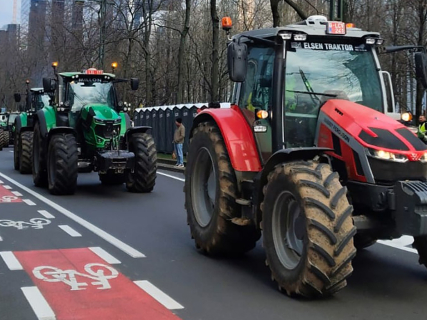

The meeting of the Council of Ministers in which the budgets for 2028-2034 are going to be discussed (in the Community jargon, the Multiannual Financial Framework or MFF) is once again being enlivened by protests from European farmers and ranchers who are resisting having the Common Agricultural Policy suffer further economic cuts and disappear as such from the budgetary structure. "Agriculture is at its limit, listen to the alarm!" is the slogan chosen for this "lightning action" that will continue next 17 December, the date on which the EU Council of Ministers has scheduled another meeting, the last one of the year, and in which they have set a limit to reach an agreement.
The COPA-Cogeca (an organization that groups food producers and cooperatives in the EU) rejects the 15% cut in nominal terms (without taking inflation into account) and the integration of the CAP into a Single Fund that will be transferred to each member state, giving each country the opportunity to apply it according to its needs and weakening the "C" of Common of the Agricultural Policy. This same entity also does not accept the budget proposal presented last Saturday by the President of the Council Antonio Costa, since it maintains those cuts and the text offers no guarantees of specific financing or the common character of the CAP, although they do acknowledge that the latest review of the text presents a slightly improved wording.
Countries most affected by future cuts
The Common Agricultural Policy emerged in 1962 with the aim of feeding a Europe broken after the war. According to data from COPA-Cogeca, in 1974 it accounted for 74% of the total EU budgets. Over time, the CAP has been a success and the European agri-food sector stands out not only in terms of food production, but also in exporting it. In this sense, for example, between 2020 and 2026 the CAP has accounted for around 30% of the Community budget. The proposal starting in 2028 is to reduce it to 15% of the total budget, in order to allocate more economic funds to other priorities of the 27 such as defense and competitiveness.
If the proposals presented move forward, Spain will be the third country most affected by the cut, with 9.9% fewer funds than in the 2021-2027 period. But it is behind France, which would suffer a 15.4% drop in CAP funds, and Germany, with 10.1% less. Italy is in fourth place, with 9.4% fewer funds than in the last period, and continues Poland, with a 6% decrease, and Romania and Greece with 4.5% less.
Spanish representation
Representatives of the different Spanish farming organizations (ASAJA, COAG, UPA Unión de Uniones and Cooperativas Agro-alimentarias) have traveled to Brussels to take part in this lightning action by European farmers.
The technical services of COAG have quantified that the budget adjustment projected by Brussels would imply a loss of 877.5 million euros per year in Spain’s farm incomes. For this organization, the consumer would notice the decline of these subsidies in their pocket, assuming an increase between 350 and 500 euros more per year in the shopping basket.
Since UPA they consider that Costa’s proposal, although it keeps the CAP as a priority, should be corrected and, while Cooperativas Agroalimentarias values that the document presented by the President of the Council reserves at least 10% of certain resources from national and regional plans for CAP interventions (a promise announced a year ago by Von der Leyen but that had not yet been reflected on paper). For its part ASAJA requests that the CAP has its own budget, that the money earmarked for the modernization of farms not be allocated to other policies, that no farmer or livestock breeder loses aid starting in 2028, and that those who have invested in the sector to live from it are not penalized.
Today the European field sounds the alarm and they announce that on December 17, they will go on the offensive again.