The Spanish Bar (Abogacía Española) is well aware of the value of elections as the foundation of representation and institutional legitimacy. Our Bar Associations, present throughout the national territory, democratically elect their governing bodies, just as the General Council of the Spanish Bar (Consejo General de la Abogacía Española) itself does. That is why democratic culture forms part of our organization and reflects an essential principle: those who assume the responsibility of representation have the legitimacy conferred by the ballot boxes and must carry out their functions with full respect for the rules that govern the institutions.
This experience reminds us that elections are not only a mechanism for choosing representatives, but a guarantee of participation, pluralism, responsibility and legitimacy. A principle that takes on a particularly relevant dimension when we talk about the entirety of our society and the functioning of our country’s democratic institutions.
On the eve of an election, it is important to remember that the legitimacy of democratic power arises from the ballot boxes, but it is upheld through respect for the law, for fundamental rights and for institutions. In a democracy, elections are never merely an administrative formality, nor do they constitute exclusively a procedure for determining who will exercise power during a given period. Above all, they are the expression of popular sovereignty, the instrument through which citizens participate in building their future, and the guarantee that political power finds its legitimacy in the will of the citizenry. And that must never be forgotten.

In Spain, this statement has an unequivocal constitutional basis. Article 1 of our Constitution defines our country as a social and democratic State governed by law and establishes that national sovereignty resides in the Spanish people, from whom the powers of the State emanate. In addition, Article 23 recognizes the right of citizens to participate in public affairs, directly or through representatives freely elected. We are therefore not dealing with an exclusively political matter, but with a fundamental right and one of the pillars on which our democratic system is built.
Elections allow the plurality of our society to find institutional representation, make possible the alternation, channel legitimate differences, and offer a peaceful and orderly channel for resolving them. In a democratic society not all of us think alike; that is evident, but we do not have to. Precisely for that reason we need shared rules that allow transforming that diversity into legitimate collective decisions. And those rules must be respected by everyone.
Abogacía Española understands that democracy and the rule of law are inseparable realities; there is no full democracy without free, transparent elections with guarantees. Democratic legitimacy does not end on election day, but rather is projected onto all the activity of public powers and requires ongoing respect for the legal order. For that reason, the strength of a democracy is measured not only by the holding of elections, but also by the quality and independence of its institutions, which must guarantee compliance with the law and respect for the separation of powers.
It is also essential to assert the value of truthful information. Freedom of expression and informational pluralism are indispensable guarantees so that the vote is truly free.
The legal profession knows well the value of guarantees, because our role consists, precisely, in defending citizens’ rights, ensuring the correct application of the law, and contributing to making Justice accessible and effective. That is why our institutional responsibility obliges us to reiterate that law is not an accessory element of democracy, but its protective structure.
Defending elections is defending each citizen’s right to decide freely and ensuring that no one is above the law.
At a time when institutional trust and the quality of public debate are challenges for many democracies, it is worth remembering that elections are not a formality that can be taken for granted, but a legal, political, and social achievement that we must not only respect and preserve, but strengthen.
From Abogacía Española we will continue to defend, with independence and institutional responsibility, the principles that make our democratic coexistence possible: the Constitution, the rule of law, fundamental rights, equality before the law, and respect for institutions. These principles, which we defend before society, must also inspire the operation of our own representative organizations.
Elections allow us to choose those who represent us, but it is the Law that guarantees that this representation is exercised with legitimacy, within the limits legally established and always in the service of those who have placed their trust in democratic institutions. Let’s not forget it; that is the foundation of democracy.
about the signature:
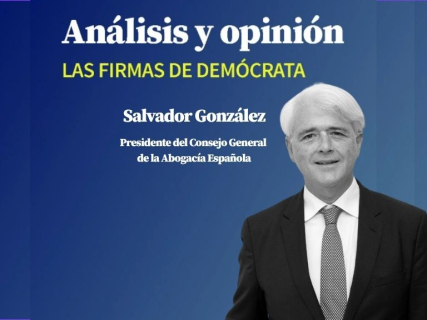
Salvador González is president of the Consejo General de la Abogacía Española