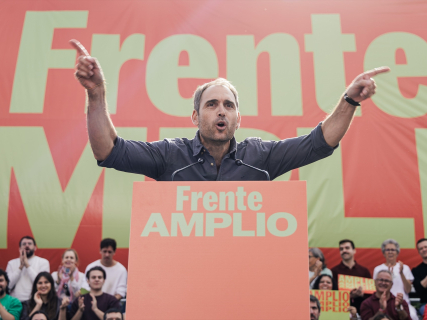

His energy and drive have been some of the great surprises of Frente Amplio’s campaign toward 29N, at least for those who did not know Toni Valero in the campaign. He put himself forward during the campaign to be the image of his coalition on the cover of Lecturas. Although he couldn’t match Sánchez’s good looks, the “good-looking son-in-law” —“to each Caesar what is Caesar’s”—, he presents himself, or presents Frente Amplio, as “the useful left that fixes things”
He is the general coordinator of Izquierda Unida Andalucía and presents himself for the elections as “number three” on the Madrid list, being the candidate of his party. The capital, however, is no stranger to him. As he acknowledged at a rally this campaign, he grew up in Málaga but was born in Madrid. In the same neighborhood of Chamberí.
QUESTION: Polls point to a very consolidated right-wing majority. Do you see it as possible to reverse that situation?
RESPONSE: Polls have an enormous performative character and you can’t fall for that bait. Everyone recognizes that an unprecedented electoral mobilization is going to take place and what worries the right is that they know that this electoral mobilization will not happen in the conservative block, which is already at the highest historical levels it can reach, but that it will happen in the progressive block.
“The right is worried; there will be an unprecedented mobilization of the progressive bloc”
P: They are then appealing for greater mobilization to make the comeback possible.
R: We already know that it is happening and it will increase; it’s a trend that hasn’t stopped. Now we’re not so much about mobilizing, but about offering a country project, which is what the people who hadn’t planned to vote in a few months want, and who will end up mobilizing. People will vote thinking probably about the coming five-year periods and not only about the next legislature.
P: In any case, the outlooks are quite a bit worse than what Sumar achieved three years ago. And yet one thing they insist on is that the Government coalition’s favorite measures are theirs. And even the PSOE has included many of them in its program. What has gone wrong?
R: The PSOE sells as its own many things that have been the result of pressure from our ministers, but people are gradually realizing that the PSOE has had the handbrake on fundamental issues. This has been evident in social and labor matters, but also even in its position regarding the genocidal State of Israel or the Maricarmen decree itself. If people become aware of this, and that everything that comes next will depend on Frente Amplio, because if not the PSOE will just go along, people will look at us when it comes time to take their ballot.
"The battle can be won; we are not resigning ourselves to letting Feijóo and Abascal govern"
P: Has more of a hard line or more pressure with the PSOE been needed in order to get more measures out?
R: We have had moments of a lot of tension with the PSOE, even to the point of not sitting in the Council of Ministers until certain decisions were made. And we have been on the streets and in social conflict as no other left-wing force in this country has been. The most recent thing has been the general strike, but not only that. We have put forward a strategy of pressure from the streets and from the Council of Ministers.
From there, it’s true that we ran into two limits. One is parliamentary arithmetic. The PP, Vox and Junts have joined up to put the brakes on some measures. And the other is the PSOE itself, which has also had to weigh its feet when it came to taking steps forward, with greater determination. But I think our strategy was right in combining that pressure on the streets and in the Council of Ministers.
P: Frente Amplio’s campaign appeals to the working class. This is not new in Izquierda Unida, which historically has maintained this line of argument but not so much other left-wing parties that accompanied it. What has changed?
R: It’s a phenomenon that is not only happening in Spain; we can see it in other countries where alternative left that is like ours is growing. There are common denominators with the campaigns of (Zohran) Mamdani (mayor of New York) and Die Linke in Berlin. The everyday stuff, the shopping basket, the materiality of people’s lives are at the forefront of public debate. That addresses that sense of belonging that people have to whatever puts them in society.
"The left has the challenge of turning protest into a country project with a hand in the BOE"
The vast majority of people feel like the working class. And in that need to respond to living conditions that are being worn down by speculation over housing and over the shopping basket, the feeling of class belonging emerges with greater force.
Q: Although you run for Madrid (number three), your political life is very closely tied to Andalucía, where Frente Amplio, Podemos and Adelante Andalucía present themselves. What went wrong so that there is no single candidacy?
A: I think those who wanted to go together and meet that demand of the left-wing voter did so by grouping under Frente Amplio and those who did not want to will have to give explanations. Whoever wants unity has the ticket for Frente Amplio, because they are the ones who wanted unity and they made it real.
Q: Aside from unity, what can Frente Amplio contribute or what can distinguish it from the other two candidacies?
A: We are the only alternative left-wing candidacy with a project for the country.
We are contesting this country against a few rentiers and oligarchs who have the PP and Vox as their tentacles and who do not find in the PSOE a strong resistance to their interests because it lacks that courage, that will to make deep changes.
"Belonging to the working class emerges powerfully in the face of living conditions made worse by speculation"
Second, we are a candidacy with deep roots. We are there in the very last town in Andalucía, but also in the very last town in this country. We are a political force that has contact with people every day because we are working people who are in all the towns of this country, raising the banner of Frente Amplio.
And we are the ones who have said that the battle can be won. We do not resign ourselves to Feijóo and Abascal governing. We are not doing what others do, who it seems don’t care who governs in Madrid. For us, it matters a great deal who governs in Madrid. We are the political force with the will to form a coalition government to roll up our sleeves and govern for the working people.
Q: In this campaign, the PSOE has competed for the left-wing voter with Frente Amplio despite the fact that it needs a good result from its potential partner if it wants to reissue a Government. Do you think the PSOE has given up on adding with Frente Amplio?
R: I don’t know what they could have thought, but people know that the PSOE alone cannot stop a right that is already far-right. And for there to be a progressive coalition government, the Broad Front needs to have a lot of strength. If not, that scenario won’t happen.
From there, if the PSOE has copied measures from the Broad Front program that it didn’t want to apply to us either, we don’t care much about that. We don’t think it’s okay to sell smoke to people, but in any case we’re clear that people know the PSOE needs a strong Broad Front.
P: What would be the first measure that the Broad Front would approve?
R: The first thing that has to be tackled is the housing problem. Tackle speculation by prohibiting the purchase of housing that is not meant to be lived in, expropriating the vulture funds, and promoting public housing for people from the public sector. That is fundamental.
"The far-right presents itself as a disruptive proposal to young people and it’s older than the proverbial wool"
P: After housing, immigration appears as one of the major concerns in society. What has the left gotten wrong when it comes to giving a discursive response to the increase in population?
R: This country doesn’t have a problem of an increase in population. On the contrary, it is generating more wealth with workers who contribute in our country to the well-being of everyone and all. What has happened is that right-wing regional governments are dismantling, undermining public services and, therefore, leaving the entire body of workers unprotected, whether they were born in our country or outside it. The problem isn’t having many workers—that is a strength. The problem is that we have regional governments in the hands of the PP destroying public services.
P: Based on that diagnosis, what is going wrong so that the majority of communities are governed by the PP?
R: From the coalition government we have taken measures to improve people’s lives, such as the Housing Law, but the PP doesn’t apply it. There have been historic transfers to the regions for healthcare and education. And then, the PP regions have been dedicated to closing public classrooms and increasing concerts and privatization. There is interference between the best proposals that are put forward from the central government because the regions sabotage them.
"PP and Vox are going to sell our public services on a silver platter to investment funds"
We have to keep pressing and conditioning funding so that it is the Administration that guarantees the provision of rights. That is why we propose that the dentist, the psychologist, or hearing aids be free and provided from the public sector, so that the PP’s regional governments are forced to provide those services.
Q: Why does it believe that the younger population, particularly men, is drawn to ideas of the far right?
A: We are living through a great fraud. Because it is true that part of the young population, well the entire young population in general terms, is always linked to more irreverent, disruptive, challenging proposals. And the great fraud is that the far right, that is stale, that is reactionary, that is older than the proverbial “needle in a haystack,” has been the one presented to this young sector as a disruptive proposal when it is not. It is a proposal for regression, reactionary, that goes against the interests of the social majority and in particular of young people. But it is true that we have had to live through these times of the great far-right fraud.
Q: Has the left lacked something—being more punk or more challenging?
A: The left has the challenge of channeling the conflict that is in the street and that is being expressed with mass protests where young people are the protagonists, and we have seen it in the housing movement. That is what we want: to turn it into a country project that has authority over the BOE. That is our challenge, to reach out to that youth of which we also feel part in the Frente Amplio, where there are many young people, and translate that into the BOE.
Q: What would you say to a person who finds it particularly hard to vote and who receives so many appeals that these elections can be a before and after?
A: That every day we find ourselves without being able to make decisions about what happens to us. We can’t decide what our salary will be, whether we will have quality public healthcare, how much they will charge us for rent or a mortgage. That is not within the framework of our decisions. However, on the day of voting, those who decide our rent, our salary, and how our public services are—have the same weight and the same decision-making power as we do. I invite people to let them decide that day and not allow those who are always deciding for them to decide also that day for them.
P: What worries him most about a possible Government of PP and Vox?
R: We are going through a constituent process. These people are going to take constitutional rights, social rights, and put them in the shredder. And, secondly, they are going to lay out our productive fabric and our public services on a silver platter for North American investment funds, which are for those who work.