Proof against falsehoods: the solidity of the Spanish electoral system in the face of the strategy of fear

The Spanish electoral system is among the most solid, transparent, and guarantor-based in the world. Its architecture distributes control of each ballot among independent judges, about 180,000 randomly selected citizens, thousands of career civil servants, and the political parties themselves. Stirring up suspicions about absentee voting or overseas voting in the final stretch toward 29-N seeks an ephemeral electoral gain at the cost of inflicting a deep and irreversible damage to democratic trust.

OPINIÓN PLANTILLA (4)

OPINIÓN PLANTILLA (4)

Add DEMÓCRATA to Google

Ask FREN

Published

Last updated

6 minutes

Most read

Hasta el día de las elecciones (29 de noviembre) se muestran los resultados de las elecciones generales anteriores, las del 23 de julio de 2023.

Resultados de las elecciones generales del 29N en directo

Elecciones generales del 23 de julio de 2023 · Congreso de los DiputadosSenado

Escrutado: 100,00 %Votantes: 24.952.447Participación: 66,59 %

Votos

PartidoEscañosVotosPorcentaje
PP1378.160.83733,06 %
PP: 137 escaños. Se presenta con estos nombres:
  • PARTIDO POPULAR (PP)131 escaños
  • PARTIDO POPULAR / PARTIT POPULAR (PP)5 escaños
  • PARTIT POPULAR / PARTIDO POPULAR (PP)1 escaño
PSOE1217.821.71831,68 %
PSOE: 121 escaños. Se presenta con estos nombres:
  • PARTIDO SOCIALISTA OBRERO ESPAÑOL (PSOE)85 escaños
  • PARTIT DELS SOCIALISTES DE CATALUNYA (PSC-PSOE) (PSC)19 escaños
  • PARTIDO DOS SOCIALISTAS DE GALICIA-PSOE (PSdeG-PSOE)7 escaños
  • PARTIDO SOCIALISTA DE EUSKADI-EUSKADIKO EZKERRA (PSOE) (PSE-EE (PSOE))5 escaños
  • PARTIDO SOCIALISTA DE ISLAS BALEARES-PSOE (PSIB-PSOE)3 escaños
  • PARTIDO SOCIALISTA DE NAVARRA-PSOE (PSN-PSOE)2 escaños
Vox333.057.00012,38 %
Sumar313.044.99612,33 %
Sumar: 31 escaños. Se presenta con estos nombres:
  • SUMAR10 escaños
  • SUMAR - EN COMÚ PODEM (SUMAR - ECP)7 escaños
  • SUMAR ANDALUCÍA (SUMAR)5 escaños
  • COMPROMÍS - SUMAR: SUMEM PER GUANYAR (SUMAR - COMPROMÍS)4 escaños
  • SUMAR GALICIA (SUMAR)2 escaños
  • SUMAR CANARIAS (SUMAR)1 escaño
  • SUMAR ARAGÓN1 escaño
  • SUMAR MÉS (MÉS PER MALLORCA-MÉS PER MENORCA-SUMAR)1 escaño
ERC7466.0201,89 %
Junts7395.4291,60 %
EH Bildu6335.1291,36 %
EAJ-PNV5277.2891,12 %
BNG1153.9950,62 %
CCa1116.3630,47 %
UPN152.1880,21 %
PACMA0169.2370,69 %
PACMA: 0 escaños. Se presenta con estos nombres:
  • PARTIDO ANIMALISTA CON EL MEDIO AMBIENTE (PACMA)0 escaños
  • PARTIT ANIMALISTA AMB EL MEDI AMBIENT (PACMA)0 escaños
CUP-PR099.6440,40 %
FO046.2740,19 %
NC-bc045.5950,18 %
PDeCAT-E-CiU032.0160,13 %
RECORTES CERO023.4210,09 %
PUM+J023.2900,09 %
PUM+J: 0 escaños. Se presenta con estos nombres:
  • POR UN MUNDO MÁS JUSTO (PUM+J)0 escaños
  • POR UN MUNDO MAIS XUSTO (PUM+J)0 escaños
  • BIDEZKO MUNDURANTZ (PUM+J)0 escaños
U.P.L.023.2010,09 %
EXISTE020.4400,08 %
EXISTE: 0 escaños. Se presenta con estos nombres:
  • TERUEL EXISTE - COALICIÓN EXISTE (EXISTE)0 escaños
  • ARAGÓN EXISTE - COALICIÓN EXISTE (EXISTE)0 escaños
PCTE013.3820,05 %
GBAI099380,04 %
SY096970,04 %
Adelante091910,04 %
JM+082930,03 %
ESCAÑOS EN BLANCO079860,03 %
XAV073620,03 %
BQEX058070,02 %
CJ056200,02 %
FE de las JONS046830,02 %
PAR041730,02 %
PCTC038750,02 %
ESPAÑA VACIADA031580,01 %
PH029020,01 %
ASTURIAS EXISTE EV023140,01 %
XH019310,01 %
VP019170,01 %
Zsi018430,01 %
VB017740,01 %
POR MI REGIÓN016980,01 %
AHORA CANARIAS-PCPC016740,01 %
PARTIDO AUTÓNOMOS014460,01 %
EVB014420,01 %
CpM012980,01 %
JxG012180,00 %
EV-PCAS-TC011840,00 %
PREPAL09640,00 %
Somos Cc09630,00 %
ALM08740,00 %
PCTG07020,00 %
F.I.A.05060,00 %
3e04840,00 %
Ud.Ca04630,00 %
ESCONS EN BLANC04620,00 %
GITV03660,00 %
PUEDE02690,00 %
EVC02650,00 %
LB02630,00 %
PCTE/ELAK02590,00 %
UNIDOS SI02530,00 %
+RDS+01650,00 %
CCD01530,00 %
FUERZA CÍVICA01150,00 %

Los partidos que se presentan con varios nombres van juntos: pasa por encima del ? para ver el detalle. Porcentajes sobre votos válidos. Resultados definitivos del 23J de 2023.

Escaños (350)

Mayoría: 176
PP: 137 escaños en 2023 (PARTIDO POPULAR: 131; PARTIDO POPULAR / PARTIT POPULAR: 5; PARTIT POPULAR / PARTIDO POPULAR: 1)PSOE: 121 escaños en 2023 (PARTIDO SOCIALISTA OBRERO ESPAÑOL: 85; PARTIT DELS SOCIALISTES DE CATALUNYA (PSC-PSOE): 19; PARTIDO DOS SOCIALISTAS DE GALICIA-PSOE: 7; PARTIDO SOCIALISTA DE EUSKADI-EUSKADIKO EZKERRA (PSOE): 5; PARTIDO SOCIALISTA DE ISLAS BALEARES-PSOE: 3; PARTIDO SOCIALISTA DE NAVARRA-PSOE: 2)Vox: 33 escaños en 2023Sumar: 31 escaños en 2023 (SUMAR: 10; SUMAR - EN COMÚ PODEM: 7; SUMAR ANDALUCÍA: 5; COMPROMÍS - SUMAR: SUMEM PER GUANYAR: 4; SUMAR GALICIA: 2; SUMAR CANARIAS: 1; SUMAR ARAGÓN: 1; SUMAR MÉS: 1)ERC: 7 escaños en 2023Junts: 7 escaños en 2023EH Bildu: 6 escaños en 2023EAJ-PNV: 5 escaños en 2023BNG: 1 escaño en 2023CCa: 1 escaño en 2023UPN: 1 escaño en 2023137121333120232023
  • PP 137
  • PSOE 121
  • Vox 33
  • Sumar 31
  • ERC 7
  • Junts 7
  • EH Bildu 6
  • EAJ-PNV 5
  • BNG 1
  • CCa 1
  • UPN 1

Simulador de Pactos

Pulsa los partidos para sumar sus escaños.
Abrir el Simulador de Pactos

Los escaños más ajustados

Quién tiene el último escaño, quién le sigue y los votos que le faltan
  1. GironaJxCAT - JUNTSyPP285 votos

    El último escaño de Girona (el 6.º) es para JxCAT - JUNTS. Le sigue el PP, que necesitaría 285 votos más para quitárselo. Ver Girona ›

  2. CantabriaVOXyPP403 votos

    El último escaño de Cantabria (el 5.º) es para VOX. Le sigue el PP, que necesitaría 403 votos más para quitárselo. Ver Cantabria ›

  3. TarragonaJxCAT - JUNTSyPSC1247 votos

    El último escaño de Tarragona (el 6.º) es para JxCAT - JUNTS. Le sigue el PSC, que necesitaría 1247 votos más para quitárselo. Ver Tarragona ›

  4. AlbacetePSOEyVOX1412 votos

    El último escaño de Albacete (el 4.º) es para el PSOE. Le sigue VOX, que necesitaría 1412 votos más para quitárselo. Ver Albacete ›

  5. SalamancaPPyPSOE1495 votos

    El último escaño de Salamanca (el 4.º) es para el PP. Le sigue el PSOE, que necesitaría 1495 votos más para quitárselo. Ver Salamanca ›

Ver todas las provincias y el mapa

Provincias donde el último escaño cambiaría de manos con menos votos, con lo escrutado hasta ahora. Pulsa una para ver el detalle.

Senado

100,00 % escrutado
PartidoSenadores
PP120
PSOEPSOE: 73 senadoresSe presenta con estos nombres:
  • PSOE48
  • PSC12
  • PSdeG-PSOE4
  • PSE-EE (PSOE)4
  • PSN-PSOE3
  • PSIB-PSOE1
  • PSOE-SUMAR-EUIB-ARA EIVISSA1
73
EH Bildu4
EAJ-PNV4
ERCERC: 3 senadoresSe presenta con estos nombres:
  • ERC-ESQUERRES PER LA INDEPENDÈNCIA2
  • ERC1
3
Junts1
UPN1
A.H.I.1
ASG1

Los partidos que se presentan con varios nombres van juntos: pasa por encima para ver el detalle. Baleares y Canarias eligen sus senadores por islas.

Senadores (208)

Elegidos en las urnas
PP: 120 senadores en 2023PSOE: 73 senadores en 2023 (PSOE: 48; PSC: 12; PSdeG-PSOE: 4; PSE-EE (PSOE): 4; PSN-PSOE: 3; PSIB-PSOE: 1; PSOE-SUMAR-EUIB-ARA EIVISSA: 1)EH Bildu: 4 senadores en 2023EAJ-PNV: 4 senadores en 2023ERC: 3 senadores en 2023 (ERC-ESQUERRES PER LA INDEPENDÈNCIA: 2; ERC: 1)Junts: 1 senador en 2023UPN: 1 senador en 2023A.H.I.: 1 senador en 2023ASG: 1 senador en 20231207320232023
  • PP 120
  • PSOE 73
  • EH Bildu 4
  • EAJ-PNV 4
  • ERC 3
  • Junts 1
  • UPN 1
  • A.H.I. 1
  • ASG 1

Los senadores designados por los parlamentos autonómicos no se eligen en las urnas.

Mapa

Ganador por provincia

    CanariasCeutaMelillaAraba/Álava: PSE-EE (PSOE) 27,7 %Albacete: PP 39,9 %Alicante/Alacant: PP 36,7 %Almería: PP 40,9 %Ávila: PP 43,3 %Badajoz: PSOE 39,2 %Illes Balears: PP 35,6 %Barcelona: PSC 35,7 %Burgos: PP 40,6 %Cáceres: PSOE 38,9 %Cádiz: PP 34,8 %Castellón/Castelló: PP 35,2 %Ciudad Real: PP 40,5 %Córdoba: PP 37,9 %A Coruña: PP 43,1 %Cuenca: PP 39,8 %Girona: PSC 28,9 %Granada: PP 37,0 %Guadalajara: PP 36,3 %Gipuzkoa: EH Bildu 31,2 %Huelva: PP 36,4 %Huesca: PP 38,2 %Jaén: PP 37,3 %León: PP 36,9 %Lleida: PSC 29,5 %La Rioja: PP 45,6 %Lugo: PP 50,2 %Madrid: PP 40,6 %Málaga: PP 38,3 %Murcia: PP 41,2 %Navarra: PSN-PSOE 27,4 %Ourense: PP 50,0 %Asturias: PP 35,7 %Palencia: PP 42,0 %Las Palmas: PSOE 33,2 %Pontevedra: PP 39,7 %Salamanca: PP 46,9 %Santa Cruz de Tenerife: PP 35,4 %Cantabria: PP 42,1 %Segovia: PP 45,0 %Sevilla: PSOE 36,6 %Soria: PP 37,2 %Tarragona: PSC 32,9 %Teruel: PP 35,0 %Toledo: PP 37,8 %Valencia/València: PP 33,6 %Valladolid: PP 40,8 %Bizkaia: EAJ-PNV 26,9 %Zamora: PP 44,7 %Zaragoza: PP 36,0 %Ceuta: PP 38,8 %Melilla: PP 49,2 %

    Pulsa una provincia para ver sus resultados y elegir municipio.

    Mapa

    Partido con más senadores por provincia

    CanariasCeutaMelillaAraba/Álava: PSOE, 3 de 4 senadoresAlbacete: PP, 3 de 4 senadoresAlicante/Alacant: PP, 3 de 4 senadoresAlmería: PP, 3 de 4 senadoresÁvila: PP, 3 de 4 senadoresBadajoz: PSOE, 2 de 4 senadoresIlles Balears: PP, 3 de 6 senadoresBarcelona: PSOE, 3 de 4 senadoresBurgos: PP, 3 de 4 senadoresCáceres: PP, 2 de 4 senadoresCádiz: PP, 3 de 4 senadoresCastellón/Castelló: PP, 3 de 4 senadoresCiudad Real: PP, 3 de 4 senadoresCórdoba: PP, 3 de 4 senadoresA Coruña: PP, 3 de 4 senadoresCuenca: PP, 3 de 4 senadoresGirona: PSOE, 3 de 4 senadoresGranada: PP, 3 de 4 senadoresGuadalajara: PP, 3 de 4 senadoresGipuzkoa: EH BILDU-INDEPENDENTZIA EZKERRETIK, 3 de 4 senadoresHuelva: PP, 2 de 4 senadoresHuesca: PP, 3 de 4 senadoresJaén: PP, 3 de 4 senadoresLeón: PP, 3 de 4 senadoresLleida: PSOE, 3 de 4 senadoresLa Rioja: PP, 3 de 4 senadoresLugo: PP, 3 de 4 senadoresMadrid: PP, 3 de 4 senadoresMálaga: PP, 3 de 4 senadoresMurcia: PP, 3 de 4 senadoresNavarra: PSOE, 3 de 4 senadoresOurense: PP, 3 de 4 senadoresAsturias: PP, 3 de 4 senadoresPalencia: PP, 3 de 4 senadoresLas Palmas: PSOE, 4 de 5 senadoresPontevedra: PP, 3 de 4 senadoresSalamanca: PP, 3 de 4 senadoresSanta Cruz de Tenerife: PSOE, 3 de 6 senadoresCantabria: PP, 3 de 4 senadoresSegovia: PP, 3 de 4 senadoresSevilla: PSOE, 3 de 4 senadoresSoria: PP, 3 de 4 senadoresTarragona: PSOE, 3 de 4 senadoresTeruel: PP, 3 de 4 senadoresToledo: PP, 3 de 4 senadoresValencia/València: PP, 2 de 4 senadoresValladolid: PP, 3 de 4 senadoresBizkaia: EAJ-PNV, 3 de 4 senadoresZamora: PP, 3 de 4 senadoresZaragoza: PP, 3 de 4 senadoresCeuta: PP, 2 de 2 senadoresMelilla: PP, 2 de 2 senadores

    Pulsa una provincia para ver sus senadores y candidatos.

    Resultados definitivos de las elecciones generales del 23 de julio de 2023 (Ministerio del Interior). Mapas: Instituto Geográfico Nacional (es-atlas, CC BY 4.0). Demócrata.

    In the last few weeks, a calculated offensive has been installed in public debate. From the ranks of the Partido Popular and Vox —with statements by Alberto Núñez Feijóo, Isabel Díaz Ayuso, or Santiago Abascal— it has been decided to sow doubt about the cleanliness of the postal vote and the vote of Spaniards resident abroad. Serious insinuations are launched in talk shows, rallies, and social networks, trusting that the noise of the campaign will drown out the facts and obscure a very robust and guarantor system.

    We have an obligation to halt this drift with data in order to safeguard trust. Citizens deserve to go to the urns on the next 29N with the certainty that their vote is protected. Explaining how our scrutiny really works serves to provide reassurance to millions of people and to expose the irresponsibility of those who play with the credibility of our institutions.

    The shield of chance: judges, neighbors, and neighbors in charge

    The first great strength of the Ley Orgánica del Régimen Electoral General (LOREG) lies in the draw —technically called insaculación—, a mechanism designed to prevent any political interference from the institutional summit down to the last ballot box in the country.

    At the top of the system sits the Electoral Administration, an independent body whose majority belongs to the judicial career and is appointed by draw. The Junta Electoral Central (JEC) is made up of eight Supreme Court magistrates chosen by draw by the Consejo General del Poder Judicial, together with five law, Political Science, or Sociology professors proposed jointly by the parliamentary groups. The Provincial and District Boards replicate exactly the same majority scheme of judicial magistrates chosen by draw between magistrates of the Provincial Courts and judges of First Instance. Therefore, the government has no influence at all over the highest body for electoral oversight.

    At the base of the system, chance acts again as the definitive guarantee. In each general election, close to 60,000 polling stations are constituted throughout Spain —only in Madrid city are there more than 3,500 polling stations, which mobilizes more than 30,000 neighbors between those appointed as officers and alternates—. Each polling station is run by a chair and two members chosen through public draw in town halls among all citizens over 18 and under 70 who know how to read and write.

    We are talking about around 180,000 people on foot, chosen at random and without any political affiliation required, who oversee the day’s proceedings, who are going to receive us at each polling station, and who count each ballot by hand on Sunday night. Over almost five decades of democracy, Spanish citizens have fulfilled this civic duty with exemplary impartiality and effectiveness. Such a capillary, manual and decentralized scrutiny in the hands of hundreds of thousands of people chosen at random is materially unassailable.

    A State that works and monitors itself

    In Spain, the direction, supervision and validation of the entire electoral process corresponds to that majority-judicial Electoral Administration, while the Government in office carries out a strictly logistical and transport function for resources. The day-to-day work of guarding the vote falls on thousands of public servants and career officials of the State and of the town councils — in each polling station, the offices of Correos, in embassies and in consulates — who work under regulated protocols, without political mandate and subject to strict administrative and criminal responsibilities.

    To this professional mechanism is added direct oversight of all candidates and a system of resources cascading down, which explains why in Spain it takes between one and two months until the definitive proclamation of the results.
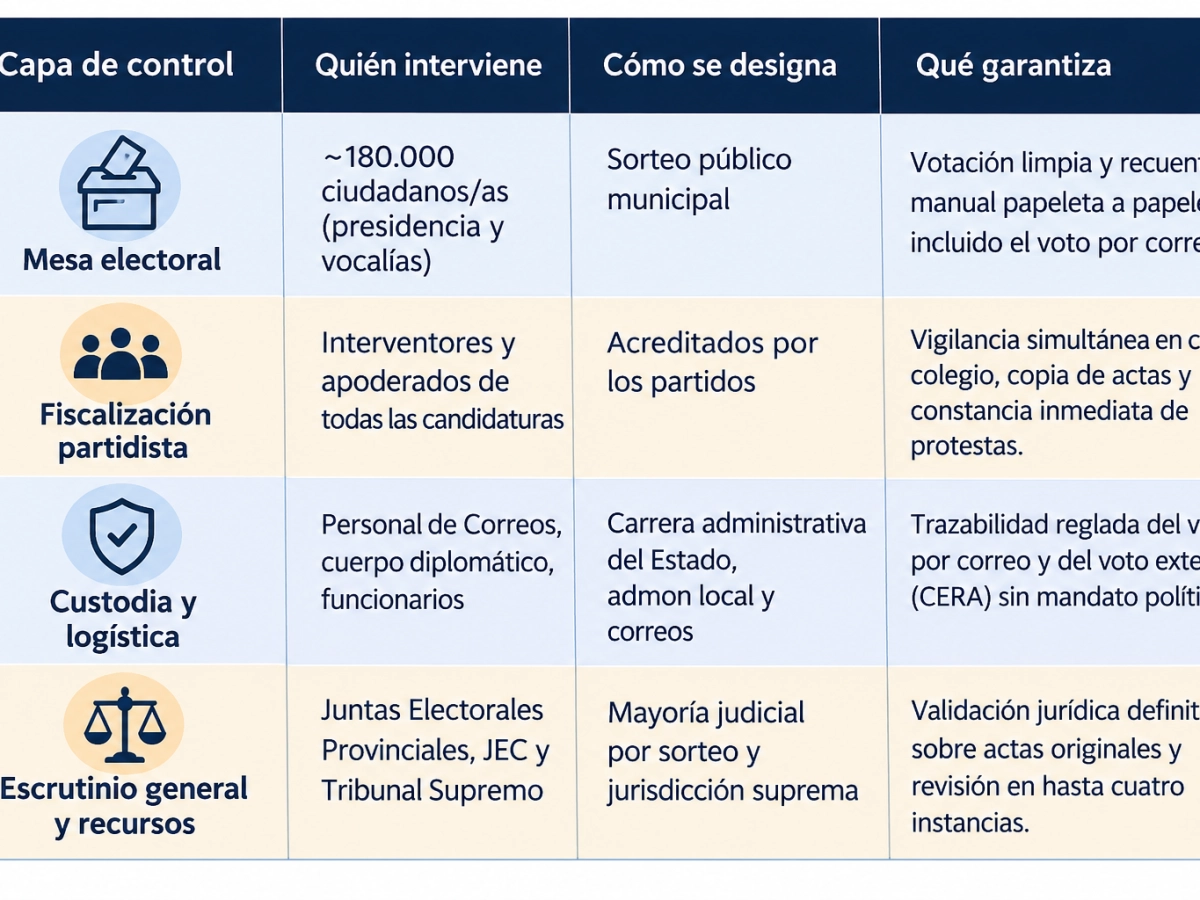
    Infografía sobre la transparencia electoral
    Infografía sobre la transparencia electoral - DEMÓCRATA.

    Each record signed at the polling station by citizens who act as chairpersons and vocal members is delivered, as a copy, to the parties present. Days later, the Provincial Electoral Board carries out the general scrutiny — the only one with legal validity, where overseas voting is incorporated — on the original records, opening fixed periods for complaints. Its decisions can be appealed before the Junta Electoral Central and, once this route has been exhausted, any organization has available the contentious-electoral appeal before the Chamber for Administrative-Contentious Matters of the Supreme Court. Therefore, it is the juces who, in the final instance, validate the result.

    Putting this process under suspicion, in practice, means dismissing the professionalism of thousands of public officials, doubting the honesty of almost 200,000 neighbors who fulfill their civic duty and questioning the independence of the magistrates who sit on the electoral boards and the Supreme Court.

    The international manual of preventive suspicion

    With such heavily fortified architecture and all legal control routes within reach of any party, the political question becomes inevitable: why do the PP and Vox, at this very moment, rattle the specter of voter fraud?

    The answer follows to the letter the playbook of the preventive strategy that the far-right has normalized on an international scale. Comparative experience shows an identical script across different democracies. In the United States, Donald Trump spent the months prior to the 2020 elections discrediting mail-in voting; after his defeat, he filed more than sixty lawsuits—every one dismissed—and fueled a fraud narrative that culminated in the assault on the Capitol. In Brazil, Jair Bolsonaro spent more than a year questioning electronic voting machines before losing to Lula da Silva in 2022, clearing the way for the assault on the headquarters of the three branches of power in Brasília; a pattern repeated just a month ago, in October 2026, when his son Flávio Bolsonaro fled the country, dodging a judicial order over alleged money laundering while sowing doubts about Brazilian voting machines with Trump’s backing from the White House. In Peru, Keiko Fujimori kept the country tense for weeks in 2021 with hundreds of challenges without evidence of alleged “fraud at the table.” And in Argentina, in 2023, the formation of Javier Milei illustrated with clarity the opportunism of this tactic: it raised suspicions about the count in the days prior to the second round and made them vanish at the exact minute when the ballot boxes handed him victory.

    In all these episodes, sowing suspicions about the voting machines pursues two very specific objectives in closely contested campaigns. The first is the emotional mobilization of one’s own electorate, turning the act of voting into a surveillance mission against a fabricated threat. The second, and more decisive, is to put the bandage on before the wound: building a preventive alibi to delegitimize in advance the outcome if the combined vote of PP and Vox falls short again, and eroding from day one the authority of the future Government. If they win, the suspicion disappears instantly.

    The moral damage of breaking trust

    Beyond tactical calculation, this strategy deserves a resounding moral condemnation. Those who aspire to govern a country have the basic duty of caring for common rules. Instilling fear and election paranoia in Spain to scrape together a small political gain at the ballot box constitutes an irresponsibility of enormous scope: the partisan benefit is fleeting, but the damage inflicted on democracy is profound and often irreversible.

    Institutional trust takes decades to build and only a few days of rumors are enough to undermine it. Undermining the faith of thousands of citizens of good will in the system that protects them and gives them assurances means crossing a red line improper for parties that claim to be constitutionalist. When the credibility of the referee is weakened and the idea is planted that the rules are mere paper, those who have economic power, media power, or influence always find a way to impose themselves. If the rules don’t count, the strongest prevails and complying with the standard becomes secondary. What is left defenseless is ordinary people.

    A robust, predictable, and well-ordered system is the greatest civilizational achievement to protect anyone: the person who only has their ballot as a tool of power, wherever they live, whatever resources they have, and whichever option they vote for. Defending the cleanliness of our electoral system is defending equality for all before the ballot boxes. The powerful person’s vote or the anonymous neighbor’s vote are worth the same.

    I want to convey a clear idea: we can all go to vote this 29-N with absolute peace of mind and with pride in our country. Each ballot will be guarded by chance, by our own neighbors, by thousands of impeccable public servants, and by the independent oversight of judges and judgewomen. Faced with those who choose fear out of pure election despair, the response is to fill the ballot boxes with serenity, trust, and democracy.