Every month we witness the same exercise in self-congratulation: permanent contracts increase and an attempt is made to sell the image of an increasingly solid labor market. But the data, when read honestly, say something very different. That more than half a million permanent contracts are signed in April and unemployment barely drops by 62,000 people is not a sign of strength; it is a demonstration that something is profoundly wrong with the Spanish labor model.
The question is inevitable: how can such a gap exist between the volume of permanent contracts and the real reduction in unemployment?
The answer lies in the very structure of the labor market and in the manipulation and political use of the figures.
The Distance from the Permanent Contracts of Yesteryear
First, it is worth remembering that a permanent contract no longer necessarily equates to stable employment or full-time work. After the labor reform, many temporary modalities disappeared formally to be transformed into discontinuous or part-time permanent contracts. That is, workers who are listed as "permanent" even though they chain periods without activity, reduced hours, or insufficient income. The contract improves the statistics, but not always real life.
Second, Spain maintains one of the labor markets with the highest job turnover in Europe. Millions of contracts are signed every year because many last weeks, even days or hours: the so-called "matchstick contracts." The same worker can appear several times in the hiring statistics. Therefore, the volume of contracts should never be confused with net job creation. What is relevant is not how many contracts are signed, but how many people actually leave unemployment and remain working stably.
Third, we continue to drag a structural problem of productivity and economic model. A large part of the employment created depends on seasonal campaigns linked to tourism, hospitality, and services. These are essential sectors for the Spanish economy, but also particularly vulnerable to hidden temporality and wage precariousness. Changing the contractual label does not automatically transform the quality of employment.
Furthermore, another worrying phenomenon exists: the growth of employed workers but in a fragile economic situation. Having a permanent contract no longer guarantees stability. Thousands of people work with salaries that barely allow them to pay for housing, energy, or food. Precariousness is no longer measured solely by the duration of the contract, but also by the ability to build a life project.
"The trap of the match contracts"
USO has been clearly denouncing it: the permanent contract is no longer synonymous with real stability. It has become, too often, a formal label that hides part-time work, discontinuity, and constant rotation. A very relevant portion of these permanent contracts are not full-time jobs, but part-time or permanent seasonal contracts, and only a minority corresponds to full-time employment.
Therein lies the trap of the official narrative. Permanent contracts are boasted about, but it is not explained how many of them are short-lived (“match contracts”), how many become fragmented employment, and how many only serve to cover seasonal campaigns, especially in sectors like hospitality or tourism. The statistics improve, yes, but the reality of the worker remains marked by insecurity, insufficient income, and dependence on a labor market that rotates more than it creates.
Fragmentation of employment
I want to emphasize that, in Spain, the permanent contract no longer guarantees anything. Its message is uncomfortable for those who prefer headlines to reality: if hundreds of thousands of "stable" contracts are signed each month and the decrease in unemployment is so limited, the problem is not in the monthly snapshot, but in the complete structure of employment. Solid work is not being generated; existing employment is being fragmented, and temporary precariousness is being replaced by disguised precariousness.
That is why it is misleading for the government to sell these figures as a great victory. The labor reform may have reduced temporality in formal terms, but it has not resolved the underlying fragility. What it has done, in part, is change the packaging of precariousness. And as long as involuntary part-time work, abusive rotation, and dependence on seasonal activities are not addressed, we will continue to confuse the quantity of contracts with the quality of employment.
Spain does not need an economy that distributes contracts like someone distributing flyers. It needs stable employment, decent wages, and career paths that allow for a life of certainty. The rest is statistical makeup. It is not enough for the contract to be permanent on paper; it must also be so in real life.
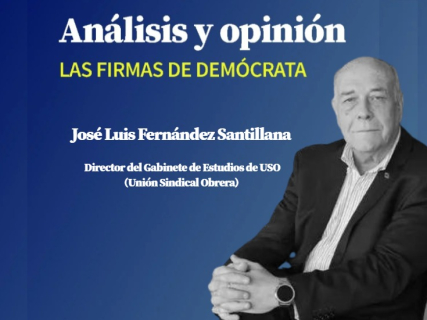
*José Luis Fernández Santillana:
José Luis Fernández Santillana is the director of the Studies Cabinet of the Workers' Trade Union Confederation (USO) and president of the Spanish Confederation of Organizations for the Elderly. A graduate in Physical Sciences from the Complutense University of Madrid, he has developed an extensive career in the trade union, educational, and social fields, holding various positions of responsibility within USO.
From the USO Studies Cabinet, he has become a reference in the analysis of the Spanish labor market. His studies are notable for rigorously explaining the evolution of employment, wages, and pensions, focusing on how these issues directly affect workers and their living conditions.
Currently, he combines this work with the presidency of CEOMA, from where he promotes initiatives in favor of the elderly. His work is characterized by combining technical analysis with a strong social sensitivity, which has earned him recognition in the labor and social protection fields.