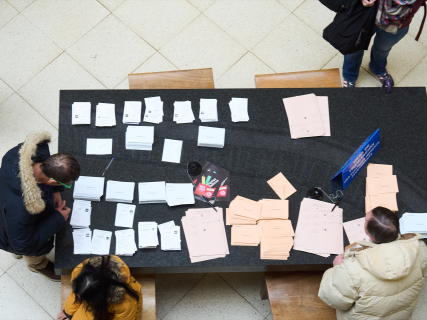

At 14:00 this Sunday, participation in Spain’s large cities had grown to double that in small municipalities compared with the last general elections. According to data from the first advance report by the Ministry of the Interior, voter turnout increases by 6.2 percentage points in cities with more than 250,000 inhabitants, compared with 3.1 points in towns with fewer than 5,000. Between these two extremes, the increase in participation is progressively greater as the size of municipalities increases.
By cross-referencing data from the Ministry of the Interior’s first participation advance report with the 2023 election results, it is also observed that the largest increases occur in the census sections where the left achieved its most comfortable victories. The metropolitan belts of Barcelona and Bilbao stand out in particular.
In some of these municipalities, several circumstances converge: a long-standing left-wing electoral tradition, a high concentration of population of foreign origin and, in the case of Catalonia and the Basque Country, participation in 2023 sensibly below the Spanish average.
The areas where the left swept in 2023 record the biggest increases
Where left-wing parties outperformed right-wing parties by 40 points or more in the last general elections, participation increases by 8.3 points. In the census sections where that advantage ranged between 30 and 40 points, the rise reaches 6.8.
The same difference is not observed between areas with a conservative predominance. Regardless of the advantage the right obtained in 2023, the growth in participation ranges between four and 4.6 percentage points.
| Electoral result of the census section in 2023 | Increase in participation |
|---|---|
| Left-wing advantage of 40 points or more | +8.3 points |
| Left-wing advantage of between 30 and 40 points | +6.8 points |
| Right-wing advantage (different ranges) | Between +4 and +4.6 points |
However, among the provinces with the greatest socialist tradition in southern Spain are precisely the four in which participation has fallen back: Jaén, Córdoba, Cáceres and Badajoz. The upturn in left-wing areas therefore has an important urban and territorial component.
The particularity of Catalonia and the Basque Country
To interpret the behavior of these municipalities, Catalonia and the Basque Country must be analyzed separately, two communities where electoral competition is not limited to the struggle between the left and the right, but where the nationalist axis also comes into play.
In both autonomous communities, furthermore, there is ample room for recovery in turnout compared with 2023. Three years ago, at 14:00, 36.78% of the Catalan electorate had voted and 37.20% of the Basque electorate, compared with 40.48% for the whole of Spain.
This Sunday, in Bilbao and Barakaldo, turnout increases by around 13 percentage points. L'Hospitalet de Llobregat (+9.7 points), Sant Boi de Llobregat (+9.5) and Barcelona (+8.8) also stand out.
Without discounting the weight of Catalonia and Euskadi in the analysis by census sections, it cannot be determined whether the greater mobilization in left-leaning territories is reproduced with the same intensity in the rest of Spain.
The factor of immigration and the case of Badalona
Among the municipalities where turnout grows the most are several cities with a high proportion of residents of foreign nationality. This is the case of L'Hospitalet de Llobregat, where they account for 27.34% of its inhabitants, or Barcelona, where they make up 25.55%, according to population data corresponding to January 2025.
Badalona also deserves special attention, where a significant volume of foreign population lives (18.43%) and where immigration has had a prominent place in the political debate.
In the municipal elections of May 2023, Xavier García Albiol won 18 of the 27 council seats of the Badalona City Hall. Barely two months later, in the general election, the PSC obtained 40.7% of the votes, compared with 16.6% for the PP.
This Sunday, the percentage of voters who have gone to the polls during the first hours of voting is well above that recorded on 23J. The electoral behavior of Badalona is particularly interesting because of the differences between the results of the municipal elections and those of the general election.
However, when the comparison is broadened to other municipalities, no uniform relationship appears between the weight of the foreign population and the increase in turnout. In Barakaldo, where foreigners represent 11.2% of its inhabitants, turnout grows more than in L'Hospitalet, despite the fact that in this latter city its demographic weight is more than double.
Outside Catalonia and the Basque Country, strong increases are also recorded in municipalities with very different demographic profiles. In Calvià, where one in three residents has foreign nationality, participation increases by 9.7 points, while in Sant Vicent del Raspeig, where they account for barely 9% of its inhabitants, the rise reaches 9.4 points.
Participation and foreign population in the municipalities
| Municipality | Foreign population | Increase in participation |
|---|---|---|
| Bilbao | 12,3% | +13 points |
| Barakaldo | 11,2% | +13 points |
| L'Hospitalet de Llobregat | 27,34% | +9,7 points |
| Calvià | 33,8% | +9,7 points |
| Guadalajara | 18,1% | +9,7 points |
| Sant Boi de Llobregat | 12,34% | +9,5 points |
| Sant Vicent del Raspeig | 9,0% | +9,4 points |
| Barcelona | 25,55% | +8,8 points |
Sources: Ministry of the Interior, INE and Idescat. Demographic data as of 1 January 2025. Selection of municipalities with high increases in participation.
It should be taken into account that citizens of foreign nationality do not have the right to vote in general elections. The people of immigrant origin who have acquired Spanish nationality and meet the legal requirements can exercise it. Therefore, it involves two different variables.
In rural Spain, a more moderate uptick is recorded
Compared with the increase in mobilization in the major urban hubs, in municipalities with fewer than 5,000 inhabitants participation increases by 3.1 points. This does not necessarily mean that in towns people vote less, but that growth compared with the last general elections is smaller.
It is also not yet possible to establish which political parties are benefiting from this increase in participation. The results from 2023 make it possible to know the electoral composition of each municipality or census section, but not to identify the direction of the vote of the voters who this Sunday have gone to the polling stations.
In addition, the decrease in postal voting compared with 23J and differences in voting times between elections held in July and others held in November may condition the comparison. The second participation update, corresponding to 18.00 hours, will make it possible to check whether the distance between the large cities and the small municipalities is maintained.