At what time do the polling stations open and close on 29N?

Citizens may vote between 9:00 and 20:00 hours, while members of the polling stations must arrive earlier to set them up and prepare for the start of the day’s polling

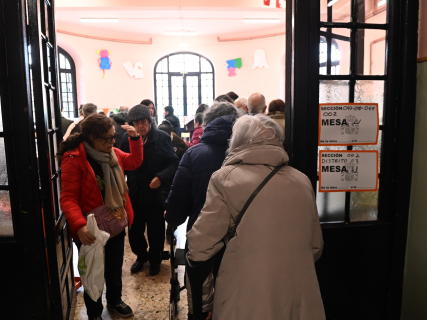
EuropaPress 7273870 aragoneses votan colegio electoral ceip joaquin costa febrero 2026 zaragoza

EuropaPress 7273870 aragoneses votan colegio electoral ceip joaquin costa febrero 2026 zaragoza

Add DEMÓCRATA to Google

Ask FREN

By Pepe Ribas

Published

Last updated

1 minute

Most read

Hasta el día de las elecciones (29 de noviembre) se muestran los resultados de las elecciones generales anteriores, las del 23 de julio de 2023.

Resultados de las elecciones generales del 29N en directo

Elecciones generales del 23 de julio de 2023 · Congreso de los DiputadosSenado

Escrutado: 100,00 %Votantes: 24.952.447Participación: 66,59 %

Votos

PartidoEscañosVotosPorcentaje
PP1378.160.83733,06 %
PP: 137 escaños. Se presenta con estos nombres:
  • PARTIDO POPULAR (PP)131 escaños
  • PARTIDO POPULAR / PARTIT POPULAR (PP)5 escaños
  • PARTIT POPULAR / PARTIDO POPULAR (PP)1 escaño
PSOE1217.821.71831,68 %
PSOE: 121 escaños. Se presenta con estos nombres:
  • PARTIDO SOCIALISTA OBRERO ESPAÑOL (PSOE)85 escaños
  • PARTIT DELS SOCIALISTES DE CATALUNYA (PSC-PSOE)19 escaños
  • PARTIDO DOS SOCIALISTAS DE GALICIA-PSOE (PSdeG-PSOE)7 escaños
  • PARTIDO SOCIALISTA DE EUSKADI-EUSKADIKO EZKERRA (PSOE)5 escaños
  • PARTIDO SOCIALISTA DE ISLAS BALEARES-PSOE (PSIB-PSOE)3 escaños
  • PARTIDO SOCIALISTA DE NAVARRA-PSOE (PSN-PSOE)2 escaños
Vox333.057.00012,38 %
Sumar313.044.99612,33 %
Sumar: 31 escaños. Se presenta con estos nombres:
  • SUMAR10 escaños
  • SUMAR - EN COMÚ PODEM (SUMAR - ECP)7 escaños
  • SUMAR ANDALUCÍA (SUMAR)5 escaños
  • COMPROMÍS - SUMAR: SUMEM PER GUANYAR (SUMAR - COMPROMÍS)4 escaños
  • SUMAR GALICIA (SUMAR)2 escaños
  • SUMAR CANARIAS (SUMAR)1 escaño
  • SUMAR ARAGÓN1 escaño
  • SUMAR MÉS (MÉS PER MALLORCA-MÉS PER MENORCA-SUMAR)1 escaño
ERC7466.0201,89 %
Junts7395.4291,60 %
EH Bildu6335.1291,36 %
EAJ-PNV5277.2891,12 %
BNG1153.9950,62 %
CCa1116.3630,47 %
UPN152.1880,21 %
PACMA0169.2370,69 %
PACMA: 0 escaños. Se presenta con estos nombres:
  • PARTIDO ANIMALISTA CON EL MEDIO AMBIENTE (PACMA)0 escaños
  • PARTIT ANIMALISTA AMB EL MEDI AMBIENT (PACMA)0 escaños
CUP-PR099.6440,40 %
FO046.2740,19 %
NC-bc045.5950,18 %
PDeCAT-E-CiU032.0160,13 %
RECORTES CERO023.4210,09 %
PUM+J023.2900,09 %
PUM+J: 0 escaños. Se presenta con estos nombres:
  • POR UN MUNDO MÁS JUSTO (PUM+J)0 escaños
  • POR UN MUNDO MAIS XUSTO (PUM+J)0 escaños
  • BIDEZKO MUNDURANTZ (PUM+J)0 escaños
U.P.L.023.2010,09 %
EXISTE020.4400,08 %
EXISTE: 0 escaños. Se presenta con estos nombres:
  • TERUEL EXISTE - COALICIÓN EXISTE (EXISTE)0 escaños
  • ARAGÓN EXISTE - COALICIÓN EXISTE (EXISTE)0 escaños
PCTE013.3820,05 %
GBAI099380,04 %
SY096970,04 %
Adelante091910,04 %
JM+082930,03 %
ESCAÑOS EN BLANCO079860,03 %
XAV073620,03 %
BQEX058070,02 %
CJ056200,02 %
FE de las JONS046830,02 %
PAR041730,02 %
PCTC038750,02 %
ESPAÑA VACIADA031580,01 %
PH029020,01 %
ASTURIAS EXISTE EV023140,01 %
XH019310,01 %
VP019170,01 %
Zsi018430,01 %
VB017740,01 %
POR MI REGIÓN016980,01 %
AHORA CANARIAS-PCPC016740,01 %
PARTIDO AUTÓNOMOS014460,01 %
EVB014420,01 %
CpM012980,01 %
JxG012180,00 %
EV-PCAS-TC011840,00 %
PREPAL09640,00 %
Somos Cc09630,00 %
ALM08740,00 %
PCTG07020,00 %
F.I.A.05060,00 %
3e04840,00 %
Ud.Ca04630,00 %
ESCONS EN BLANC04620,00 %
GITV03660,00 %
PUEDE02690,00 %
EVC02650,00 %
LB02630,00 %
PCTE/ELAK02590,00 %
UNIDOS SI02530,00 %
+RDS+01650,00 %
CCD01530,00 %
FUERZA CÍVICA01150,00 %

Los partidos que se presentan con varios nombres van juntos: pasa por encima del ? para ver el detalle. Porcentajes sobre votos válidos. Resultados definitivos del 23J de 2023.

Escaños (350)

Mayoría: 176
PP: 137 escaños en 2023 (PARTIDO POPULAR: 131; PARTIDO POPULAR / PARTIT POPULAR: 5; PARTIT POPULAR / PARTIDO POPULAR: 1)PSOE: 121 escaños en 2023 (PARTIDO SOCIALISTA OBRERO ESPAÑOL: 85; PARTIT DELS SOCIALISTES DE CATALUNYA (PSC-PSOE): 19; PARTIDO DOS SOCIALISTAS DE GALICIA-PSOE: 7; PARTIDO SOCIALISTA DE EUSKADI-EUSKADIKO EZKERRA (PSOE): 5; PARTIDO SOCIALISTA DE ISLAS BALEARES-PSOE: 3; PARTIDO SOCIALISTA DE NAVARRA-PSOE: 2)Vox: 33 escaños en 2023Sumar: 31 escaños en 2023 (SUMAR: 10; SUMAR - EN COMÚ PODEM: 7; SUMAR ANDALUCÍA: 5; COMPROMÍS - SUMAR: SUMEM PER GUANYAR: 4; SUMAR GALICIA: 2; SUMAR CANARIAS: 1; SUMAR ARAGÓN: 1; SUMAR MÉS: 1)ERC: 7 escaños en 2023Junts: 7 escaños en 2023EH Bildu: 6 escaños en 2023EAJ-PNV: 5 escaños en 2023BNG: 1 escaño en 2023CCa: 1 escaño en 2023UPN: 1 escaño en 2023137121333120232023
  • PP 137
  • PSOE 121
  • Vox 33
  • Sumar 31
  • ERC 7
  • Junts 7
  • EH Bildu 6
  • EAJ-PNV 5
  • BNG 1
  • CCa 1
  • UPN 1

Simulador de Pactos

Pulsa los partidos para sumar sus escaños.Abrir el Simulador de Pactos

Los escaños más ajustados

Quién tiene el último escaño, quién le sigue y los votos que le faltan
  1. GironaJxCAT - JUNTSyPP285 votos

    El último escaño de Girona (el 6.º) es para JxCAT - JUNTS. Le sigue el PP, que necesitaría 285 votos más para quitárselo. Ver Girona ›

  2. CantabriaVOXyPP403 votos

    El último escaño de Cantabria (el 5.º) es para VOX. Le sigue el PP, que necesitaría 403 votos más para quitárselo. Ver Cantabria ›

  3. TarragonaJxCAT - JUNTSyPSC1247 votos

    El último escaño de Tarragona (el 6.º) es para JxCAT - JUNTS. Le sigue el PSC, que necesitaría 1247 votos más para quitárselo. Ver Tarragona ›

  4. AlbacetePSOEyVOX1412 votos

    El último escaño de Albacete (el 4.º) es para el PSOE. Le sigue VOX, que necesitaría 1412 votos más para quitárselo. Ver Albacete ›

  5. SalamancaPPyPSOE1495 votos

    El último escaño de Salamanca (el 4.º) es para el PP. Le sigue el PSOE, que necesitaría 1495 votos más para quitárselo. Ver Salamanca ›

Ver todas las provincias y el mapa

Provincias donde el último escaño cambiaría de manos con menos votos, con lo escrutado hasta ahora. Pulsa una para ver el detalle.

Senado

100,00 % escrutado
PartidoSenadores
PP120
PSOEPSOE: 73 senadoresSe presenta con estos nombres:
  • PSOE48
  • PSC12
  • PSdeG-PSOE4
  • PSE-EE (PSOE)4
  • PSN-PSOE3
  • PSIB-PSOE1
  • PSOE-SUMAR-EUIB-ARA EIVISSA1
73
EH Bildu4
EAJ-PNV4
ERCERC: 3 senadoresSe presenta con estos nombres:
  • ERC-ESQUERRES PER LA INDEPENDÈNCIA2
  • ERC1
3
Junts1
UPN1
A.H.I.1
ASG1

Los partidos que se presentan con varios nombres van juntos: pasa por encima para ver el detalle. Baleares y Canarias eligen sus senadores por islas.

Senadores (208)

Elegidos en las urnas
PP: 120 senadores en 2023PSOE: 73 senadores en 2023 (PSOE: 48; PSC: 12; PSdeG-PSOE: 4; PSE-EE (PSOE): 4; PSN-PSOE: 3; PSIB-PSOE: 1; PSOE-SUMAR-EUIB-ARA EIVISSA: 1)EH Bildu: 4 senadores en 2023EAJ-PNV: 4 senadores en 2023ERC: 3 senadores en 2023 (ERC-ESQUERRES PER LA INDEPENDÈNCIA: 2; ERC: 1)Junts: 1 senador en 2023UPN: 1 senador en 2023A.H.I.: 1 senador en 2023ASG: 1 senador en 20231207320232023
  • PP 120
  • PSOE 73
  • EH Bildu 4
  • EAJ-PNV 4
  • ERC 3
  • Junts 1
  • UPN 1
  • A.H.I. 1
  • ASG 1

Los senadores designados por los parlamentos autonómicos no se eligen en las urnas.

Mapa

Ganador por provincia

    CanariasCeutaMelillaAraba/Álava: PSE-EE (PSOE) 27,7 %Albacete: PP 39,9 %Alicante/Alacant: PP 36,7 %Almería: PP 40,9 %Ávila: PP 43,3 %Badajoz: PSOE 39,2 %Illes Balears: PP 35,6 %Barcelona: PSC 35,7 %Burgos: PP 40,6 %Cáceres: PSOE 38,9 %Cádiz: PP 34,8 %Castellón/Castelló: PP 35,2 %Ciudad Real: PP 40,5 %Córdoba: PP 37,9 %A Coruña: PP 43,1 %Cuenca: PP 39,8 %Girona: PSC 28,9 %Granada: PP 37,0 %Guadalajara: PP 36,3 %Gipuzkoa: EH Bildu 31,2 %Huelva: PP 36,4 %Huesca: PP 38,2 %Jaén: PP 37,3 %León: PP 36,9 %Lleida: PSC 29,5 %La Rioja: PP 45,6 %Lugo: PP 50,2 %Madrid: PP 40,6 %Málaga: PP 38,3 %Murcia: PP 41,2 %Navarra: PSN-PSOE 27,4 %Ourense: PP 50,0 %Asturias: PP 35,7 %Palencia: PP 42,0 %Las Palmas: PSOE 33,2 %Pontevedra: PP 39,7 %Salamanca: PP 46,9 %Santa Cruz de Tenerife: PP 35,4 %Cantabria: PP 42,1 %Segovia: PP 45,0 %Sevilla: PSOE 36,6 %Soria: PP 37,2 %Tarragona: PSC 32,9 %Teruel: PP 35,0 %Toledo: PP 37,8 %Valencia/València: PP 33,6 %Valladolid: PP 40,8 %Bizkaia: EAJ-PNV 26,9 %Zamora: PP 44,7 %Zaragoza: PP 36,0 %Ceuta: PP 38,8 %Melilla: PP 49,2 %

    Pulsa una provincia para ver sus resultados y elegir municipio.

    Mapa

    Partido con más senadores por provincia

    CanariasCeutaMelillaAraba/Álava: PSOE, 3 de 4 senadoresAlbacete: PP, 3 de 4 senadoresAlicante/Alacant: PP, 3 de 4 senadoresAlmería: PP, 3 de 4 senadoresÁvila: PP, 3 de 4 senadoresBadajoz: PSOE, 2 de 4 senadoresIlles Balears: PP, 3 de 6 senadoresBarcelona: PSOE, 3 de 4 senadoresBurgos: PP, 3 de 4 senadoresCáceres: PP, 2 de 4 senadoresCádiz: PP, 3 de 4 senadoresCastellón/Castelló: PP, 3 de 4 senadoresCiudad Real: PP, 3 de 4 senadoresCórdoba: PP, 3 de 4 senadoresA Coruña: PP, 3 de 4 senadoresCuenca: PP, 3 de 4 senadoresGirona: PSOE, 3 de 4 senadoresGranada: PP, 3 de 4 senadoresGuadalajara: PP, 3 de 4 senadoresGipuzkoa: EH BILDU-INDEPENDENTZIA EZKERRETIK, 3 de 4 senadoresHuelva: PP, 2 de 4 senadoresHuesca: PP, 3 de 4 senadoresJaén: PP, 3 de 4 senadoresLeón: PP, 3 de 4 senadoresLleida: PSOE, 3 de 4 senadoresLa Rioja: PP, 3 de 4 senadoresLugo: PP, 3 de 4 senadoresMadrid: PP, 3 de 4 senadoresMálaga: PP, 3 de 4 senadoresMurcia: PP, 3 de 4 senadoresNavarra: PSOE, 3 de 4 senadoresOurense: PP, 3 de 4 senadoresAsturias: PP, 3 de 4 senadoresPalencia: PP, 3 de 4 senadoresLas Palmas: PSOE, 4 de 5 senadoresPontevedra: PP, 3 de 4 senadoresSalamanca: PP, 3 de 4 senadoresSanta Cruz de Tenerife: PSOE, 3 de 6 senadoresCantabria: PP, 3 de 4 senadoresSegovia: PP, 3 de 4 senadoresSevilla: PSOE, 3 de 4 senadoresSoria: PP, 3 de 4 senadoresTarragona: PSOE, 3 de 4 senadoresTeruel: PP, 3 de 4 senadoresToledo: PP, 3 de 4 senadoresValencia/València: PP, 2 de 4 senadoresValladolid: PP, 3 de 4 senadoresBizkaia: EAJ-PNV, 3 de 4 senadoresZamora: PP, 3 de 4 senadoresZaragoza: PP, 3 de 4 senadoresCeuta: PP, 2 de 2 senadoresMelilla: PP, 2 de 2 senadores

    Pulsa una provincia para ver sus senadores y candidatos.

    Resultados definitivos de las elecciones generales del 23 de julio de 2023 (Ministerio del Interior). Mapas: Instituto Geográfico Nacional (es-atlas, CC BY 4.0). Demócrata.

    The voting will begin at 9:00 and end at 20:00 hours on Sunday, November 29, local time. Members of the polling stations must go earlier to set them up and check the necessary materials for the day.

    This Sunday, November 29, the polling stations will hold the voting day for the general elections, with an uninterrupted schedule of eleven hours: from 9:00 to 20:00 hours.

    The schedule is set by the Ministry of the Interior and applies across the entire national territory according to local time. In the Canary Islands, therefore, voting will begin at 9:00 island time, one hour later than the peninsular schedule.

    What time do you have to go to the polling station?

    Voters may go to their polling station from 9:00 hours, when voting officially begins. Before traveling, they must check which premises and which polling station they correspond to based on the electoral register data.

    This information can be consulted on the census card sent to the home address or through the electronic headquarters of the National Institute of Statistics (INE).

    What time do the members of the polling stations have to be there?

    The schedule for members of the polling stations is different from that of voters. Its members must present themselves before 9:00 hours to set up the polling station and check that the electoral materials are ready.

    The formation of the polling stations begins at 8:00 hours. During that period, the necessary checks are carried out to ensure that voting can begin at the scheduled time.

    What happens if I arrive at the polling station at 20:00?

    The closing of the polling stations is planned for 20:00 hours. However, the regulations provide an exception for those who are still inside the polling premises or at their entrance when that hour arrives.

    In that case, the chair of the polling station will allow voters who remain inside or at the polling station entrance and who have not been able to vote earlier to vote. Once they have cast their vote, no more voters will be allowed inside.As established by the voting procedure set out by the Ministry of the Interior.

    Also check the Demócrata guide on how to vote and follow all the information from the day in the Elecciones 29N special.

    More key points, information and questions with FREN

    AI-GENERATED CONTENT

    What parliamentary procedures are necessary to modify the opening and closing hours of polling stations in Spain?

    To generally change the voting hours in Spain, it is necessary to amend the Organic Law of the General Electoral Regime (LOREG) through an organic law approved by the Cortes Generales. The decisive requirement is a final vote on the entire text by an absolute majority of the Congress; a decision by the Government or the Central Electoral Board alone is not sufficient.

    1. Which provisions must be modified

    Article 84.1 of the LOREG establishes that voting "will begin at nine o'clock" and continue "until twenty o'clock". Its article 88.1 regulates the announcement of closing at twenty o'clock and allows those still inside the polling station or at its entrance to vote.

    Therefore, article 84.1 would need to be modified and article 88.1 adapted if the closing time changes. Article 73.4 should also be coordinated, as it links the delivery of postal votes to nine and twenty hours. The general authorization to the Government to execute the law does not allow replacing these legal hours.

    2. How the reform begins
    • Government bill: it is submitted to Congress with a statement of reasons and background. The Board orders its publication, sends it to the competent committee, and opens the amendment period.
    • Parliamentary bill: it can be presented by a group or a deputy with fourteen other signatures. Before processing its content, the Plenary must approve its consideration: deciding whether to begin examining it. The Government's opinion is requested beforehand and, when applicable due to budgetary effects, its agreement.

    The Board of Congress, after hearing the Board of Spokespersons, must classify the initiative as organic. These rules are found in articles 109, 126, and 130 of the Congress Regulations.

    3. Debate and approval in Congress

    In the usual procedure, a period of fifteen working days to submit amendments is opened, subject to modification. If a bill receives total amendments, the Plenary first debates whether to return it to the Government or accept an alternative text.

    Then, a committee prepares a report; the commission debates the articles and approves its report; and the Plenary examines the text and the maintained amendments. Finally, article 131 requires an absolute majority of the members of Congress in a vote on the whole. If not reached, the text returns to the commission for a new report; if it fails again, it is rejected.

    4. Senate and resolution of discrepancies

    The text goes to the Senate, which can approve it without changes, introduce amendments, or oppose a veto. No mixed commission is formed to resolve discrepancies in this reform: Congress decides.

    • If there is a veto: lifting it always requires an absolute majority of Congress, as it is an organic law.
    • If there are amendments: Congress decides which to accept by simple majority. The resulting whole then requires an absolute majority. If not obtained, the text initially approved by Congress is ratified and all Senate amendments are rejected.
    5. Application and exceptions

    The reform must complete its sanction, promulgation, and publication, and be applied from the corresponding effective date. The Central Electoral Board interprets and applies the regulations but does not replace the legislator to change the general schedule.

    This is different from the already foreseen incidents: article 84.4 allows extending voting due to an interruption caused by a lack of ballots, and article 88.1 protects those waiting to vote at closing time.

    What are the competencies and functions of the Ministry of the Interior in organizing electoral processes?

    The Ministry of the Interior is mainly responsible for the administrative preparation, logistics, security, and dissemination of provisional results in electoral processes whose organization corresponds to the State. It does not direct the electoral boards nor decide the validity of votes: those guarantees correspond to the independent electoral administration.

    Its actions must be distinguished from the functions attributed by the Organic Law of the General Electoral Regime —LOREG— to the boards, electoral tables, the Electoral Census Office, and municipalities.

    1. Administrative preparation and coordination

    Interior plans and coordinates the necessary state resources to hold general, European, and local elections, as well as state referendums. It works with government delegations and sub-delegations and collaborating administrations. Its main tasks are:

    • Forecasting personnel, supplies, communications, and budget needs.
    • Acquiring and distributing ballot boxes, booths, envelopes, forms, and other electoral materials, according to the rules of each call.
    • Preparing manuals and operational information for table members and support staff.
    • Providing material and technical means to electoral bodies within the legal distribution of responsibilities.

    Interior does not freely set the electoral calendar: it executes the deadlines established by legislation and the call. In municipal elections, article 185 of the LOREG foresees that the Council of Ministers agrees on the call at the joint proposal of the departments competent in Interior and Territorial Administration.

    2. Information, accessibility, and voter support

    The Ministry provides information on how to vote, available procedures, and the development of the day. It also coordinates logistical accessibility measures and collaborates to ensure premises have the necessary materials.

    This support does not imply assuming all operations. The Electoral Census Office, integrated into the National Statistics Institute and subject to the direction and supervision of the Central Electoral Board, prepares and updates the census. Postal voting mainly involves this office and the Postal Service; exterior voting also involves the Foreign Ministry and consulates.

    3. Security and operation of the day

    Interior organizes the state security device and coordinates it with autonomous and local police, respecting their competencies. Its purpose is to protect polling stations, prevent coercion, maintain order, and assist in the custody or transfer of documentation when appropriate.

    During voting, it also coordinates the response to material incidents: lack of supplies, communication problems, or access difficulties. However, the immediate authority at each table corresponds to its presidency. The police can assist but cannot decide if a vote is valid or null.

    4. Participation and provisional results

    Interior organizes the collection, transmission, aggregation, and publication of participation data and provisional results on election night. These come from the count carried out by the tables.

    Disseminating data does not equate to certifying the legal result. The general scrutiny —the official verification of the records— and the proclamation of elected candidates correspond to the competent boards. In elections to the Congress and Senate, article 173 of the LOREG assigns this scrutiny to the provincial electoral boards.

    5. Limits and territorial distribution

    Interior does not proclaim candidacies, does not resolve electoral appeals, nor can it modify the results of the tables. It also does not choose their members: municipalities conduct the draw under supervision of the zone boards.

    In autonomous elections, the autonomous community assumes the administrative organization that corresponds to it. In summary, Interior provides resources, coordinates, protects, and informs; the tables and boards guarantee voting, control its legality, and determine its official effects.

    What requirements must a person meet to be part of an electoral table in Spain?

    To be part of an electoral table in Spain, one must know how to read and write, be included in the electoral census of the table, and be under 70 years old. The presidency also requires a specific qualification. Meeting the requirements does not mean one can volunteer: members are designated by public draw.

    General requirements

    Article 26 of the Organic Law of the General Electoral Regime (LOREG) establishes the conditions to be president or member of an electoral table:

    • Be registered in the corresponding table. The draw is made among people included in the voter list of that table, not among all residents of the municipality.
    • Know how to read and write. This condition is required for both the presidency and the members.
    • Be under 70 years old. Those aged 70 or older are excluded from the draw. From age 65, one can express refusal within seven days following the notification of appointment.
    • Not be a candidate. People running as candidates in the elections cannot be part of their electoral tables.

    The ordinary minimum age is the age of majority, since selection is made among voters. No prior experience, association membership, or legal or administrative knowledge is required.

    Qualification to serve as president

    To be president of a table, LOREG requires having the Baccalaureate degree, second-level Vocational Training, or, subsidiarily, School Graduate or equivalent. This additional academic requirement does not apply to members, for whom knowing how to read and write suffices in this regard.

    The law uses educational terms from different stages. Therefore, when a doubt arises about a specific degree, what matters is its official equivalence, not only the current name of the studies.

    How members are chosen

    Each table is formed by a president and two members. Also, two substitutes per position are designated, subject to the conditions of the position for which they were chosen.

    The formation of tables corresponds to municipalities, under the supervision of the zone electoral boards. The public draw is held between the twenty-fifth and twenty-ninth days after the call. The appointment must be notified within the following three days, accompanied by an instruction manual.

    The designation is also mandatory for substitutes: they must appear at the indicated time, even if they do not have to replace anyone.

    Impediments and excuses

    Meeting the requirements does not prevent requesting a dispensation for personal, family, or professional circumstances. Situations that may justify it include certain health problems, pregnancy under the provided conditions, or caregiving responsibilities. Not all circumstances produce automatic exemption: some require assessment and documentation.

    The designated person has seven days from notification to present a justified and documented cause to the Zone Electoral Board that prevents accepting the position. The Board resolves within five days and communicates, when appropriate, the substitution.

    Requesting dispensation does not mean obtaining it. Until the excuse is accepted, the obligation to attend should not be assumed to disappear. If the impediment arises later, it must be communicated as soon as possible through the corresponding procedure.

    Play

    Test your knowledge with FREN!

    How much do you know about this topic? Answer the following 3 questions.

    What time do the polling stations open on November 29 in Spain?

    Question 1 of 3

    What must the members of the electoral tables do before 9:00 AM?

    Question 2 of 3

    What happens if a voter arrives at the polling station at 8:00 PM and is still at the entrance?

    Question 3 of 3