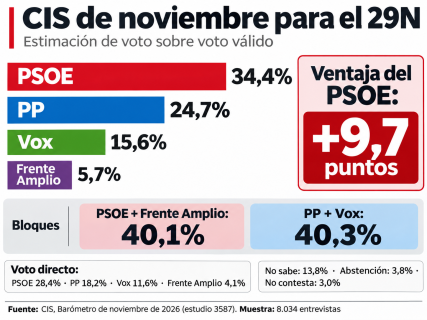

Six days before the general elections of November 29, the CIS places the PSOE in first position with an estimated vote of 34.4%, 9.7 points above the PP, which obtains 24.7%. The November barometer, prepared from 8,034 interviews, gives Vox 15.6% and Frente Amplio 5.7%, according to the data from study number 3587.
With these percentages, PP and Vox together account for 40.3% of the estimated vote, two tenths more than the 40.1% accumulated by PSOE and Frente Amplio. The distance between the two main parties is considerably larger: the socialists are ahead of the populars by almost ten points.
The CIS estimate differs from the results of much of the private polling published during the campaign, which have been putting the PP ahead of the PSOE. In the pre-election macro-survey disseminated by the organization itself on November 12, the socialists also led the estimates, although then they obtained 33.3%, compared with 25.5% for the populars and 18.4% for Vox.
Vox, third force with 15.6%, and Frente Amplio with 5.7%
In the breakdown of the estimated vote, Vox continues as the third force, with a gap of 9.1 points with respect to the PP. Frente Amplio occupies fourth position, with support of 5.7%.
Among territorial-scope formations, the CIS attributes 2.7% to ERC-Podemos, a candidacy that appears grouped in the study by the joint campaign developed by both organizations in Catalonia, although they do not formally run in a coalition.
Next, EH Bildu and Compromís: Front Valencià obtain 1.8%, the same percentage as Se Acabó la Fiesta. Adelante Andalucía receives 1.7% and the BNG, 1.1%.
Below are Junts, with 1%; Podemos, with 0.8%; and the PNV, with 0.7%. The study also attributes 0.4% to Unidad del Pueblo Canario, while Aramés-Front Ampli and CC-Municipalistas Primero Canarias receive 0.3% each.
The direct intention to vote also favors the PSOE
Aside from the estimate prepared by the CIS, the survey results show a direct intention to vote of 28.4% for the PSOE, compared with 18.2% for the PP. Vox obtains 11.6% of the responses and Frente Amplio, 4.1%.
The difference between the two indicators responds to the statistical treatment of the data. While direct intent collects the respondents’ answers in percentage terms over the census, the agency’s estimate uses a scenarios model to calculate electoral support over the valid vote.
Differences also appear in the responses regarding turnout. 13.8% of those surveyed still does not know which party they would vote for, while 3% does not answer. Another 3.8% states that they would not go to vote and 2.2% expresses their intention to vote blank.
The barometer uses the two-dimensional inertia-uncertainty model Alaminos-Tezanos, applied habitually by the agency to develop its electoral estimates. Unlike the preelection macro-survey from last November 12, the estimate document for this study does not offer a distribution of seats.
The CIS also publishes estimate intervals for the main formations. In the case of the PSOE, support is found between the 33.7% and 35.1%, while for the PP it is set between 24.1% and 24.9%. Vox presents an interval from 15.2% to 16% and Frente Amplio, from 5.6% to 5.9%.