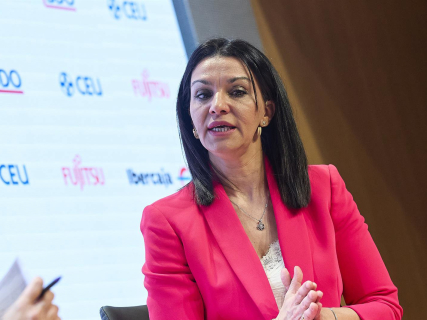

The Councillor of Education, Science and Universities of the Community of Madrid, Mercedes Zarzalejo, has again defended that at no moment has she criminalized the education strike and has insisted that her criticisms were directed exclusively at “violent attitudes”.
“Take an insult out of the teachers of this councillor aimed at that group. None,” Zarzalejo challenged Más Madrid during the Budget and Finance Committee of the Assembly, a session in which she presented her department’s Accounts for 2027.
In the final stretch of her appearance, the head of Education used the last two minutes to respond to criticisms from Más Madrid and the PSOE over the management of the conflict, which affects both early childhood educators—on strike for 7 months—and the rest of the pre-university stages, on leave for a month.
In this context, the councillor began by describing the strike in early childhood as “a lie” and went on to detail the reasons why, as she argued, she cannot accept the demands of the mobilized teaching staff, who were gathered in front of the Assembly while she spoke inside.
“I cannot accept a reduction in ratios of 15, which is not requested anywhere in Spain, because it means the loss of 282,000 students who would lose their place. I cannot accept the teaching hour, which I already have 18 of and they are asking me for 17, because that means more than 13,600 new contracts that we would have to fund. And I also cannot accept a pay rise of 600 euros,” the councillor reiterated, who quantified at an additional 1,500 million euros the cost of taking on these demands.
Therefore, she emphasized that in order to govern and plan “you have to be responsible” and has defended that the regional Executive acts according to that criterion “with its management throughout the whole term”.
Immediately afterward, she reproached the left-wing groups for questioning that the regional Government “does not negotiate and fulfills its obligations,” while, she pointed out, the central Executive has been without presenting Budgets for four years and the state resources that they claim are being implemented through “royal decrees, without consensus, without consulting the CCAA and only negotiating with the unions that the minister was interested in, without any economic impact report, without funding, only to sell that headline”.
In response, Más Madrid deputy María Pastor has denounced that the Accounts do not include "not a single demand from teachers" and has accused Zarzalejo of acting "with arrogance and trying to criminalize a legitimate and peaceful conflict".
"I’m telling you again, counselor, sit down to negotiate, stop insulting teachers and teachers, stop criminalizing and attacking them. A government has to be able to hold dialogue with its educational professionals and has to be able to hold dialogue with those who think differently from you," Pastor has demanded.
In the same vein, socialist Horacio Díaz has highlighted that there are thousands of teachers mobilized in the streets, together with families who say that "Education in Madrid does not work". "That is your responsibility as a counselor. And it is also your responsibility to sit down, listen and engage in dialogue because we are in democracy," he concluded.