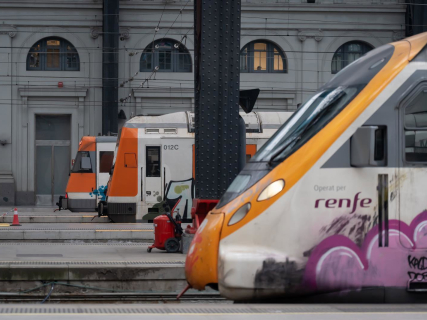
Renfe strike on November 17: schedules, minimum services, and trains affected

The protest will reduce the frequencies of Cercanías, Media Distancia and Alta Velocidad throughout Tuesday’s full day. Transportes guarantees 75% of the Cercanías trains at peak hours and 72% of the Alta Velocidad and Larga Distancia services.

fotonoticia 20261104122430 1920

fotonoticia 20261104122430 1920

Add DEMÓCRATA to Google

Ask FREN

Published

3 minutes

Most read

Elecciones 29N · Encuestas

La media de las encuestas

Media a 16 de noviembre de 2026 · 16 institutos

  • PP31,4 %
  • PSOE27,1 %
  • Vox18,9 %
  • Frente Amplio6,4 %
  • ERC2,5 %
01020304050ene 2024jul 2024ene 2025jul 2025ene 2026jul 2026

Media del último estudio de cada instituto en 30 días y su evolución semanal desde el 23J. Partidos con al menos un 2 %.

Todas las encuestas

Elecciones generales del 29 de noviembre · Demócrata

ELECCIONES 29N

¿Cuál es tu pronóstico? 29N

Reparte los 350 escaños del Congreso como creas que quedarán el 29 de noviembre. Puedes cambiar tu pronóstico hasta que cierren los colegios.

0 de 350 escaños

PP
PSOE
Vox
Frente Amplio
ERC
Junts
EH Bildu
PNV
Más partidos
Podemos
BNG
SALF
CC
UPN
Adelante
Aliança
Otros

Protegido por reCAPTCHA de Google: privacidad y condiciones

Pronóstico de DemócrataParticipación abierta, no es una encuesta

Renfe will have to cancel part of its trains this Tuesday, November 17, due to the 24-hour strike called in the rail sector, which will also affect Iryo, Ouigo and several freight companies. To guarantee essential travel, the Ministry of Transport has set minimum services of 75% on commuter rail (Cercanías) during peak hours and 50% outside those time slots, while on High Speed and Long Distance it will run 72% of the usual trains. The unions maintain the protest to demand greater safety guarantees after the accidents in Adamuz and Urda, which left 115 dead.

Although negotiations with the Government have continued during the last few days, no agreement has been reached that would allow the strikes to be called off. There was also no consensus on minimum services, which Transport ultimately set by means of a resolution of November 12.

Which trains will run during the strike of November 17

Those who use commuter rail (Cercanías) will find the greatest restrictions outside peak hours, when half of the usual services will be cancelled. Service will be reinforced between 06:00 and 09:00 hours, 13:30 and 15:30 hours, and 18:30 and 20:30 hours, with three out of four trains guaranteed.

For travel on Medium Distance, 65% of the planned offering will be maintained, compared with 72% for High Speed and Long Distance. For its part, rail freight transport will have to guarantee only 26% of its services.

Type of train Minimum services
Commuter rail (Cercanías) at peak time 75%
Commuter rail (Cercanías) outside peak time 50%
Medium Distance 65%
High Speed and Long Distance 72%
Freight 26%


The cancellations will be distributed unevenly among the different lines, since the minimum services are calculated for the whole of each rail mode and not individually for each trip

Where to check cancelled trains and ticket changes

Renfe allows you to check the scheduled services through the minimum services relationships published for commercial trains and those subject to public service obligations. Both are available in its official communication on the strike of November 17.

The resolution of the Ministry of Transport can also be consulted, which identifies the services that must be maintained during the day.

If the contracted train appears among those cancelled, it will be necessary to consult the travel alternatives and the change or cancellation conditions communicated by the operator. In Cercanías, where frequencies will vary depending on the time, it is advisable to check schedules before going to the station.

Catalonia and the Basque Country will have different minimum services

The Generalitat will set the essential services of Rodalies and of the regional services under its competence, while the Basque Government will determine those corresponding to the transferred railway lines. Therefore, the general percentages approved by Transportes do not have to coincide with those applicable to all routes in both communities.

To find out the final schedules, it will be necessary to consult the regional resolutions and the programming published by the operators.

Unions demand more security after the accidents in Adamuz and Urda

After 46 people died in the railway accident in Adamuz (Córdoba) last January, the collision that occurred on 28 October in Urda (Toledo) heightened concern about safety conditions on the network. In this second incident another 69 people died when a Renfe AVE collided with an Iryo train that was left stopped.

The investigation remains open, although it is already known that the AVE received authorization to resume its journey despite there being a red signal and the railway section being occupied, after the LZB signalling system failed. The unions are calling for a review of the procedures applied in these circumstances to reinforce circulation guarantees.

To these demands they add more staff for control and maintenance tasks, changes in the organization of shifts, and measures to reduce fatigue. During talks with Adif, the possibility of reviewing the maximum working times for railway controllers was discussed, without all the differences having been resolved so far.

After the Urda accident, Transportes announced eight extraordinary measures, including new audits, a review of circulation protocols in degraded situations, and improvements in communication with train drivers. Workers’ representatives are calling for additional commitments regarding their implementation.

Semaf postponed until November 23 one of the strikes initially scheduled for the 12th, with the aim of facilitating negotiations. The strike on Tuesday 17 remains called and will also affect freight transport companies such as Transfesa, Continental Rail, Tracción Rail, Captrain and Medway.

More key points, information and questions with FREN

AI-GENERATED CONTENT

At what stage of parliamentary processing are the extraordinary measures announced by the Ministry of Transport following the Urda accident?

As of November 16, 2026, the main extraordinary measures following the Urda accident are approved by the Government and pending parliamentary ratification debate scheduled for November 18 in the Permanent Deputation of the Congress. It is necessary to distinguish two royal decree-laws — aid to victims and operational safety — from the technical action plan, which by itself does not constitute a bill.

1. Aid to victims: in force, with ratification scheduled for the 18th

The Royal Decree-Law 32/2026, of November 3, on aid to the victims of the Urda (Toledo) railway accident and guaranteeing equitable accessibility to goods and services in emergency situations was approved by the Council of Ministers on November 3 and came into force on November 4. Its publication and application do not equate to its ratification: this is the parliamentary vote that decides whether the decree-law is maintained. The BOE text and its parliamentary file can be consulted.

The Demócrata information places its debate in the Permanent Deputation on November 18. Therefore, as of the date of this response, it should not be presented as ratified, rejected, or converted into a bill.

The package includes direct aid and advance compensation payments, special Social Security protection, comprehensive service offices, and temporary limitations on prices for alternative transport and accommodation linked to affected travel. Its administrative execution has already begun: Transport opened applications on November 6, with a deadline until February 5, 2027, according to its official communication. Affected persons do not have to wait for the vote to apply.

2. Operational safety and railway personnel: second decree pending vote

The royal decree-law on urgent measures to strengthen operational safety in railway transport and social protection of railway personnel is also scheduled to be addressed on November 18, according to the same information on the parliamentary agenda.

This block has already passed the mere announcement phase: Demócrata reported on November 11 its entry into force. It includes the possibility for drivers to stop or not resume the train in the face of serious risk, clarifications on driving times, reinforcement of supervision and inspection by the State Railway Safety Agency, and social protection measures for personnel. Its next parliamentary milestone is also ratification; no agreement to process it as a bill is recorded in the sources consulted.

3. Technical plan: Executive actions, not a bill in amendment phase

Separately, the Council of Ministers took note on November 3 of a report of actions on technological innovation, protocols, and human resources. This act does not imply approving a law or opening its parliamentary processing.

The announced plan includes new control software, artificial intelligence, validation by a second controller in degraded circulation, safety audit, deployment of ERTMS N2, and reinforcement of staff and training. No joint processing as a bill is recorded. In summary: two decree-laws pending ratification and a technical plan with its own executive course; not a single package pending amendments in Congress or Senate.

What are the specific competencies of the Ministry of Transport regarding the setting of minimum services during railway strikes?

The Ministry of Transport can set mandatory minimum services in railway strikes affecting services under state competence. Its function is to preserve the essential needs of the community, not to maintain usual operation or protect the operator's income. This power must be exercised by an authority with political responsibility, through a justified and proportional decision according to the scope of each strike.

1. Basis and scope of the competence

Article 28.2 of the Constitution recognizes the right to strike and requires guaranteeing the maintenance of essential community services. Its general legal instrument is article 10, second paragraph, of the Royal Decree-Law 17/1977: when its conditions concur, "the governmental authority may agree on the necessary measures to ensure the functioning of the services."

Therefore, Transport does not authorize the strike nor resolve labor claims by this means. It determines which railway service is indispensable during the stoppage, balancing workers' rights with the constitutional rights and goods served by transport.

2. What it can determine
  • The essential service to be maintained: railway services whose interruption would compromise protected needs and the minimum level necessary to meet them.
  • Its temporal and operational scope: the circulations, time slots, and service conditions necessary, adjusted to the personal, territorial, and temporal scope of the call.
  • Execution requirements: the criteria operators and managers must respect when applying the minimums, without leaving them the substantive decision on how much the strike should be restricted.

The competence is not conceptually limited to passenger transport: it can also cover freight when it is necessary to protect essential needs. However, the economic importance of rail does not automatically convert all its activity into a service that must be maintained.

3. Who must make the decision

The decision corresponds to a governmental authority, that is, a body with government powers and political responsibility. It is not enough to administratively direct the sector. Neither Renfe, Adif, nor another company can replace that authority by setting the essential content of the minimums, although they can provide information and execute what is agreed.

A specifically railway precedent is the Resolution of December 11, 2007: the Secretary of State for Infrastructure and Planning assumed this power, then attributed to the General Secretariat of Infrastructure, after several rulings denied the latter the status of governmental authority. It is a historical precedent, not an automatic identification of the current competent body.

4. Limits regarding autonomous communities

The Ministry does not have universal competence over any railway strike. The competent authority, state or regional, depends on who holds the competencies and political responsibility over the affected service. It is not enough, by itself, that Renfe operates or that a state infrastructure is involved to resolve the entire distribution.

The STC 296/2006 confirms both possible regional competence and the prohibition of leaving the determination of minimums in the hands of the employing entity.

5. Motivation, proportionality, and control

The resolution must explain why those specific minimums are necessary: generic formulas about the importance of transport are not enough. It must weigh the circumstances of the call and avoid that the required service empties the strike of content.

The STC 24/2026, on railway transport, recalls this weighing and addresses how increasing train capacity can alter the established balance. Administrative decisions are subject to judicial review: the competence allows ensuring the indispensable, not neutralizing the legitimate effects of the strike.

What results did Renfe and the main railway operators obtain in the latest sector union elections?

Semaf leads representation in Renfe's General Works Committee, with five of its thirteen seats; in Adif, UGT and CCOO share the top position, with four each. In private operators, the information found does not allow reconstructing the complete distribution of the latest elections, although it provides representativeness figures of CGT in Ouigo and Iryo. It is important to distinguish these data: the composition of a general committee, union representativeness, and percentage of votes are not equivalent measures.

Renfe: Semaf, first force in the general committee

The published composition of the Renfe General Works Committee distributes its thirteen representatives as follows:

  • Semaf: five representatives, 38.46% of the seats.
  • UGT: three representatives, 23.08%.
  • CCOO: three representatives, 23.08%.
  • CGT: one representative, 7.69%.
  • SF-Intersindical: one representative, 7.69%.

These percentages are calculated over the general committee seats: they should not be presented as vote percentages of the entire workforce, nor as the total number of delegates elected in different centers. The distribution appears in reports on the railway mobilizations of November 14, 2026, including those from Diario de Navarra and Infobae.

Adif: UGT and CCOO tied

Although Adif is the infrastructure administrator and not a train operator, it is relevant to include it to understand the sector's union representation. Its general committee also has thirteen members, with this distribution:

  • UGT: four representatives, 30.77% of the seats.
  • CCOO: four representatives, 30.77%.
  • CGT: two representatives, 15.38%.
  • Railway Traffic Union —SCF—: two representatives, 15.38%.
  • SF-Intersindical: one representative, 7.69%.

Therefore, UGT and CCOO sum eight of the thirteen seats. Here too it is the distribution of the general body, not the direct percentage of votes. The previously cited reports include this composition.

Ouigo and Iryo: partial representativeness figures

For the main private passenger competitors, no complete and comparable breakdown by unions, delegates, votes, and election date is found in the sources consulted. However, figures declared by the CGT railway sector general secretary, Noelia Martín Sanguino, on February 6, 2026, collected by Demócrata, were located:

  • Ouigo: CGT declared 42% representativeness.
  • Iryo: CGT declared 40%.
  • Renfe: the same union placed its representativeness at 10%.
  • Adif: it placed it at 17%.
  • Serveo: indicated it exceeded 20% among onboard service staff of Renfe trains.

These are figures attributed to the union, not a complete electoral scrutiny. They do not allow deducing how many delegates other organizations have. They should also not be confused with the percentages of general committee seats indicated above.

What is missing to compare the latest elections

No complete equivalent results have been found for Logirail, Captrain, Transfesa, Continental Rail, Tracción Rail, or Medway. Nor are the exact dates of the elections that originated each distribution, participation, or votes per candidacy recorded in the consulted material. The verifiable conclusion is, therefore, Semaf's leadership in Renfe's general committee, the UGT-CCOO tie in Adif, and CGT's declared representativeness in private companies; not an exhaustive electoral balance of the entire sector.

Play

Test your knowledge with FREN!

How much do you know about this topic? Answer the following 3 questions.

What percentage of Cercanías trains will run during peak hours on November 17?

Question 1 of 3

What was the main reason for the November 17 strike call in the railway sector?

Question 2 of 3

How many people died in total in the Adamuz and Urda accidents that motivated the strike?

Question 3 of 3