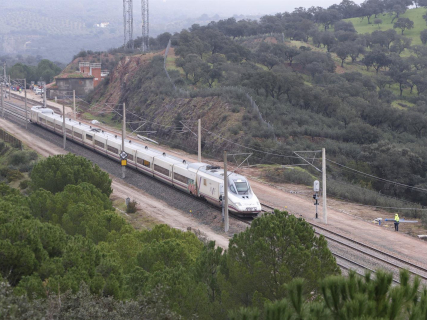










Adif has requested that the investigating judge of the Civil and Instruction Section of the Trial Court of Montoro (Córdoba), Plaza number 2, responsible for the investigation of the railway incident in Adamuz, in which on Sunday January 18, 46 people died and more than 120 were injured, order Renfe to provide the records of the accelerometers installed in the trains that ran on the affected track on January 17 and 18.
As stated in the written submission presented this Monday by Adif to the Court, which Europa Press has had access to, the data of the Talgo trains that passed through Adamuz are specifically requested, covering the section between Villanueva de Córdoba and the Alcolea junction, on both lines of traffic.
The requested documentation corresponds to Talgo's TSmart system, used to analyze instability in driving, and includes the accelerations recorded by each accelerometer, the running speed, and the exact position of each measurement.
In Adif's view, "the requested diligence is relevant and necessary to the extent that the provision of these data will make it possible to determine whether there were anomalous accelerations in the area of the accident and their possible correspondence with defects in the track, through comparison with the information and technical knowledge derived from the dynamic inspections that Adif carries out with onboard equipment".
In this regard, it adds that "the availability of records corresponding to both lines will make it possible to carry out a comparative analysis that can help rule out the existence of platform defects that could affect both" and that "the extension of the requested section on both sides of the Adamuz station will make it possible to have a greater reference length for comparing the records with the results of the track inspections".
To ensure their "integrity and authenticity", Adif asks that the request to Renfe include the transfer of the files in their original format and in a readable format (CSV/PDF), accompanied by the integrity 'hash', the complete documentation of the chain of custody, and the justification for the time synchronization with the infrastructure network.
Transfer of the ill-fated Iryo train
With regard to the road transfer of cars 1 to 5 of the derailed Iryo train, after the prior uncoupling of the bogies from the boxes, Adif recalls that, in accordance with the report issued by TÜV Rheinland InterTraffic on 18 November 2026, "while road transport is the safest option, it should be carried out with the bogies coupled to the cars."
The experts emphasize in that report that "the coupling mechanism between bogie and vehicle constitutes a critical element for the dynamic behavior and stability of the car, because its interfaces determine the movements and the rotation of the bogie with respect to the body" and that "the uncoupling of both elements is not merely a logistical issue, but affects aspects whose inspection may contribute to clarifying the causes of the accident".
The expert document expressly warns that "the separation of the bogies would prevent a future inspection of elements that contribute to the vehicle's dynamic behavior and stability" and adds that "maintaining the bogies coupled would allow, at the destination base, with the cars placed over a pit, a more precise inspection than could be carried out during the lifting maneuvers of the cars to uncouple the bogies, foreseen in the proposal of ILSA".
Consequently, it is concluded that "preserving the coupling is the most prudent option at this time, since it not only preserves the configuration of the elements subject to examination, but also allows them to be inspected with the necessary precision," and for this reason Adif argues that "the eventual transfer of cars 1 to 5 should be carried out under those conditions".
It is also recalled that the inspection authorized for Adif Alta Velocidad by an order dated 30 October 2026 remains pending, the dates for which are being finalized through the Unidad Orgánica de la Policía Judicial (UOPJ) of Córdoba.
With the aim of "making the practice of said inspection compatible with the need not to unnecessarily delay the transfer of cars 1 to 5", Adif proposes that "the inspection by the experts and technicians of Adif-AV regarding those cars may be carried out in connection with the transfer operations, by their presence during these and the corresponding graphic documentation", while the review of cars 6 to 8 would be carried out on the date agreed with the UOPJ of Córdoba.
Experts in track wear testing
On the other hand, Adif asks the judge to authorize the presence of its designated experts during the track wear measurement tests to be carried out by the Independent Administrative Authority for the Investigation of Accidents and Incidents (Aitat), under police supervision and already authorized by an order dated 11 November.
The request also extends to all phases of the laboratory metallurgical tests to be carried out on the rails, described in the final agreement for the transfer of management responsibilities and in the final specifications document for technical requirements incorporated into the case by an order dated 13 November.
In that decision, it was agreed to add to the procedure the final agreement for the transfer of management responsibilities between the Aitat and the State Agency Consejo Superior de Investigaciones Científicas (CSIC) for the performance of laboratory tests on the rails, as well as for the execution of verification and comparison tests in a second independent laboratory.