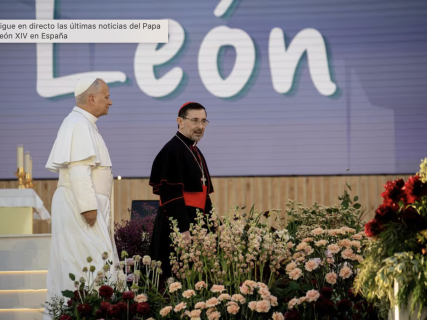

“Many things on social media deceive us, they tell us lies. Always seek the truth. God is truth,” the Pope stated before the young people gathered in the capital.
The message came during one of the most crowded events of León XIV's visit to Spain, after his papamobile tour through Madrid and following his visit to the Cáritas CEDIA center, in the Lucero neighborhood.
Pope Calls to Seek Truth Amidst Social Media Noise
One of the central moments of León XIV's speech was his warning about the digital world. The Pontiff encouraged young people not to uncritically consume everything they receive through social media and to maintain an active search for truth.
“Many things on social media deceive us, they tell us lies,” the Pope said, before asking them: “Always seek the truth.”
León XIV linked this call to the need to cultivate inner silence. As he explained, only by stepping away from the “din of a thousand voices” can one distinguish which messages truly nourish and which seek to manipulate, buy, or confuse people's desires.
“Be Human”: The Most Direct Message to Young People
Towards the end of his address, León XIV summarized his message with a simple and powerful expression: “Be human!”
The Pope asked young people to be “men and women of flesh and blood,” not mere appearances or profiles constructed to please. He called on them to become “reliable faces,” people capable of seeking justice, desiring an honest life, and maintaining real connections.
The message aligns with one of the main themes of the vigil: faced with the temptation to live from image, anxiety, or digital representation, León XIV defended a concrete, embodied, and responsible life.
Protagonists of Change in Family, Work, and the Digital World
León XIV also encouraged young people not to position themselves as spectators of the present, but as protagonists of change.
“Above all, you young people are called to give a new direction to society,” he stated.
The Pope situated this mission in the closest spaces: family, university, work, friendship, and also the digital environment.
The Pontiff has resorted to the Letter to Diognetus, an ancient Christian text, to recall that “Christians are in the world what the soul is in the body”. From that idea, he has invited young people to bear witness to their faith also in the digital reality, “to communicate the values and beauty of the Gospel”.
Do not be afraid of marriage or vocation
The Pope has also launched a direct call regarding marriage, family, and religious vocation.
“If I previously said do not be afraid to think about a vocation, marriage is also a vocation. Do not be afraid of marriage and of forming a family,” he stated.
Leo XIV has asked young people not to live paralyzed by the fear of commitment. His message has placed both ecclesiastical life and marriage within the same logic: that of a dedicated, responsible existence open to others.
Silence as a form of freedom
Another of the discourse's main points has been prayer. The Pope has presented it as a free voice, not as a way of pretending or showing something to others.
“Prayer is a free voice,” he pointed out, precisely because it does not speak to be accountable, to make oneself important, or to show that one is prepared.
Leo XIV has recalled that no one is born a master and that everyone, before God, is always a disciple. Therefore, he has encouraged young people to share their spiritual journey and not to walk it in solitude.
Three saints as guides: Chrysostom, Thomas of Villanova, and Toribio de Mogrovejo
In his first response to young people, Leo XIV has reviewed some figures who have accompanied his spiritual journey.
He has cited John Chrysostom, whose name means “golden-mouthed,” for his courage in speaking the truth to power. He has also highlighted Thomas of Villanova, a Spanish Augustinian educated at the University of Alcalá and linked to the reform of the Church.
The third reference has been Toribio de Mogrovejo, a Spanish missionary in Peru in the 16th century, whom the Pope has presented as a model for his fight against abuses and corruption and for his dedication to the poorest.
Leo XIV has connected these examples with his own experience as a missionary and bishop in Peru. “The encounter with the wounds and joys of the people made me grow,” he stated.
José Cobo opens the vigil with a call to “look up”
The vigil began with a welcome from the cardinal archbishop of Madrid, José Cobo, who invoked the motto of the trip and the image of the capital as a city that looks to the sky.
“We like to boast of having special sky colors, especially when evening falls. Perhaps that's why we repeat the saying ‘Madrid to heaven’,” said Cobo, before adding that the objective of the night was to “look at the sky, look up, and raise our gaze.”
The archbishop described the diversity of the young people present: those who arrive with enthusiasm, those who are suffering, migrants, young people in precariousness or loneliness, and also those who have lost hope.
Cobo expressly mentioned the young people who see suicide as a way out and asked to learn to respond as a Church “offering paths of accompaniment and life.”
Godspell, music, and a cross signed by the Pope
The vigil also had a strong musical and scenic component. Attendees witnessed a performance of Godspell, the musical directed by Antonio Banderas and based on the Gospel of Saint Matthew, with part of its original cast reunited for this occasion.
Before the central moment of prayer, Fito Robles, singer of Siloé, and priest Jaime Salmoreno performed.
The young people also asked the Pope to sign the cross that will preside over the events that bring them together in Madrid. Leo XIV agreed and stamped his signature on it, in one of the most symbolic gestures of the night.
“You can change history”
The closing of the speech left one of the most resounding phrases of the vigil.
“You can change history. Do it with love,” Leo XIV told the young people.
With that appeal, the Pope summarized the tone of his message in Madrid: less appearance, more truth; less fear, more commitment; less noise, more silence; less empty digital life, more concrete humanity.