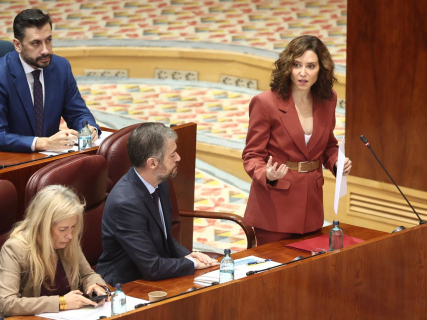










The president of the Community of Madrid, Isabel Díaz Ayuso, has said this Tuesday that the regional law on the unborn child is “in favor of life” and has attacked the head of the Executive, Pedro Sánchez, for again resorting to “the same old nonsense” with reference to abortion and euthanasia.
Ayuso made her comments in an interview on “Cope,” as reported by Europa Press, after the president of the Government announced the approval of a new regulation to ensure that women receive truthful and scientific information about abortion, as well as the filing of a challenge before the Constitutional Court against the Madrid law on the unborn child.
“Our law (on the unborn child), our proposals on maternity matters do not go against anything, in favor of life, in favor of the women who need to spend more time with their children, the fathers who want to do so, the children who are increasingly alone,” the regional leader defended.
In her view, it is necessary to encourage families to have more children through a system that makes it easier to reconcile work and family life and, at the same time, take into account that conceived human being, “who exists for their parents and whom they are waiting for with hope”.
“This man who governs us, who hates us and who hates everything that we are, has lost his way and couldn’t care less about feeding the class struggle, the civil-war spirit, he has raised a wall between Spaniards to hate life, the Spanish, and to force us to be on opposing sides; me, who was born in democracy,” the president lamented, who believes she should feel “ashamed” to use again the same “nonsense”.
What the law on the unborn child of Madrid establishes
The Madrid Assembly gave the go-ahead last July to the law on recognition of the unborn child in the implementation of family support measures.
The regulation establishes that, in certain procedures and within the Community’s sphere of competence, the embryo or fetus during gestation may be treated as a child already born when doing so involves a benefit for the pregnant mother or for the unit as a whole.
In practice, this means that it may be counted for the purposes of access to certain grants and benefits, especially those linked to the status of large family. It also includes regional tax advantages for households that meet those requirements.