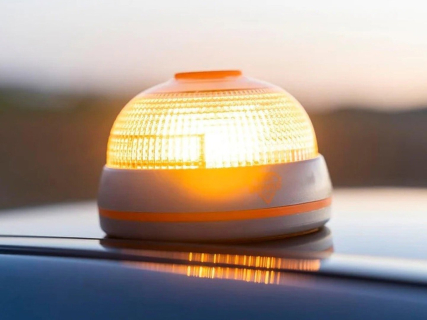

As of January 1, 2026, the connected V16 beacon is the only device recognized in Spain for signaling a vehicle immobilized on the roadway due to a breakdown or an accident. Its use has replaced the traditional emergency triangles and has raised doubts among drivers about where to place it and what penalties they can receive if they do not comply with the regulations.
The General Directorate of Traffic (DGT) states that the vehicles required to do so must carry a connected and approved V16. The older devices that lack a connection to the DGT 3.0 platform are not valid, even if they can emit a light signal.
Where the V16 beacon must be placed
The DGT’s recommendation is to place the device as high as possible on the vehicle and ensure its maximum visibility. As a general rule, this means placing it on the roof, provided it can be done safely and without needing to expose oneself to traffic.
The regulations provide exceptions when it is not possible to access that area. In those cases, the device must allow it to be placed at another elevated and visible point, such as the driver’s door. This alternative is especially relevant for vehicles of large dimensions, such as trucks and buses.
The beacon must be able to be placed from inside the vehicle, without the driver having to walk along the roadway to signal the incident. Once switched on, it emits a visible light under favorable conditions up to a distance of one kilometer and automatically transmits the vehicle’s location to the DGT 3.0 platform.
How much is the fine for not carrying the V16
The DGT sets the penalty for not carrying the mandatory V16 beacon at 80 euros. This is a minor infringement and the amount is the same as that previously set for not having the pre-signaling triangles.
However, it is advisable to distinguish between not carrying the device and using it. The obligation to have a connected beacon does not mean that any error related to its placement automatically carries the same penalty.
In particular, a fine of 500 euros for placing the beacon in an area other than the roof should not be taken as proven. The DGT indicates where it must be positioned to ensure its visibility and includes alternatives when the upper part of the vehicle cannot be accessed, but it does not establish that specific penalty for placement.
Carrying it, turning it on, and signaling correctly
The regulations establish different obligations that it is advisable not to confuse. First of all, the driver must have a V16 beacon connected and type-approved in the vehicle. Secondly, it must be activated when a breakdown or accident occurs that forces it to be immobilized and placed outside, in an elevated and visible position.
In addition, the DGT reminds that, when the vehicle is immobilized, emergency lights must also be used if it has them and, when applicable, the position lights and clearance lights.
The beacon transmits the vehicle’s location through its own connection, without the need to use a mobile phone. However, it does not call 112 or request roadside assistance: if emergency help or a tow truck is needed, the driver must contact the corresponding services directly.