









The president of the Canary Islands, Fernando Clavijo, has submitted a formal request to the president of the European Commission, Ursula von der Leyen, to hold an “urgent” meeting to address the migration situation facing the archipelago and to demand an “extraordinary” response from the European Union (EU) in the face of a “crisis without precedent.”
In the letter sent this Wednesday to the top official of the community executive, the head of the Canary Government conveys his “deep concern for the unprecedented deterioration” of the migration emergency on the islands and warns that the archipelago is under greater pressure than any previous record. In the letter, he also demands a “prompt, coordinated and effective response from Europe,” as the regional executive said in a statement.
As a sign of the “seriousness” of the moment, Clavijo reminds Von der Leyen that in a single day, this Tuesday, more than 2,000 migrant people arrived on the shores of El Hierro, a “remarkable” figure which, he stresses, shows the “enormous pressure” to which the islands are being subjected.
That volume of arrivals, the regional government adds, worsens the “limit” situation of the reception system in the archipelago, after having received more than 16,000 migrants so far this month, and places November 2026 as the month with the most arrivals to the islands in the 32 years of the history of the Atlantic route.
The Canary Islands president emphasizes that the archipelago has reached a point where the ordinary mechanisms and resources available to the community are “clearly insufficient” to manage the emergency. “The situation is unsustainable and requires an immediate, coordinated and effective response from Europe,” he stresses in his message to the president of the Commission.
REQUESTS “EFFECTIVE” COMMITMENT
Clavijo also recalls that the Canary Islands “is not just any border, but one of the external borders of the European Union,” and therefore insists that migration pressure cannot fall solely on the Canary and Spanish administrations. In his view, it must be addressed as a European challenge requiring “solidarity, shared responsibility and effective commitment” on the part of the EU institutions.
On this line, the regional president thanks “the swift response” from the European Commissioner for Home Affairs and Migration, Magnus Brunner, following the communication sent days ago by the Government of the Canary Islands, which made it possible to hold a working meeting to analyze the situation on the ground.
However, he considers that the events of the past few hours and the scale reached by the crisis require raising the dialogue to the highest level of the EU’s institutional framework. “The European Union must translate its principles of solidarity into specific, immediate and effective actions,” Clavijo argues, warning that the Canary Islands cannot continue to practically shoulder alone the consequences of a phenomenon whose scope far exceeds the regional and national sphere.
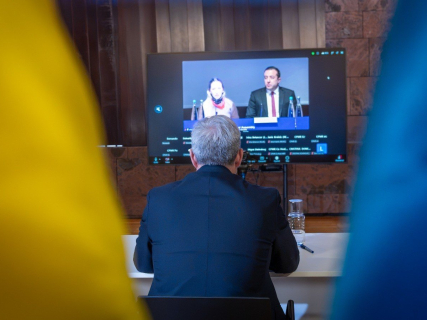
For this reason, the president requests from Ursula von der Leyen an “urgent” meeting, either by videoconference or in person in Brussels next week, to which he would attend accompanied by a delegation from the Government of the Canary Islands. The purpose is to set out firsthand the seriousness of the situation, review the current status of the migration emergency, and specify the extraordinary measures that the European Commission could activate to reinforce support for the archipelago.
Clavijo concludes his letter to the President of the Commission by appealing to the “political leadership” of the European institutions in the face of an “exceptional” situation which, he stresses, does not allow for further delays. “The Canary Islands needs a European response commensurate with a European crisis,” the president emphasizes, convinced that the moment calls for “firm decisions, sufficient resources and immediate action” on the part of the European Union.