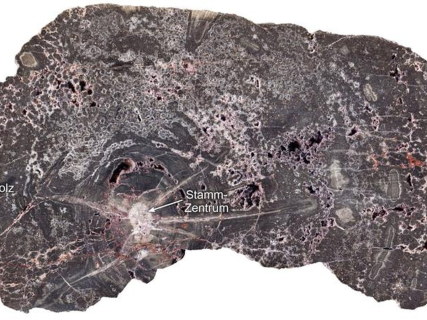

A fossilized wood found in central Germany has preserved a record of 300 million years of Europe's geological history. The analysis of the different generations of quartz present in the trunks has allowed for the reconstruction of how that region sank, became buried several kilometers deep, and then returned to the surface.
A fossilized wood reveals 300 million years of Europe
A research led by the University of Münster has demonstrated that fossilized wood can function as an archive of the geological processes that occurred over hundreds of millions of years. The work, published in the scientific journal Scientific Reports, studies several trunks located in the Kyffhäuser mountains, in central Germany.
The trees grew around 300 million years ago, when the region was near the equator and was part of the supercontinent Pangea. They were extinct relatives of today's conifers and belonged to dry tropical forests crossed by river systems.
Five stages trapped in quartz
The researchers identified five successive phases of mineralization inside the fossils. Each generation of silica and quartz preserves information about the temperature, pressure, and fluids that circulated through the rocks at different times.
The five stages span about 200 million years, from the late Carboniferous to the early Cretaceous. By incorporating the subsequent uplift and emergence of the materials to the surface, the complete record reaches approximately 300 million years, the longest documented successive mineralization sequence of wood so far.
The first mineralization occurred between 304 and 299 million years ago, shortly after the trees were swept away and buried by floods. The silica-rich water penetrated their structure and coated their cells before the plant matter completely decomposed.
The trunks were buried five kilometers deep
The wood did not always remain near the surface. Analyses indicate that the fossils came to be between three and five and a half kilometers deep, subjected to temperatures between 160 and 240 degrees during one of the phases of maximum burial.
The successive movements of the Earth's crust later caused the uplift of the area. The last great generation of quartz formed about 100 million years ago, during a stage of inversion of the basin prior to its final elevation.
In this way, the trunk preserves both its initial process of fossilization and the traces left by the sinking of the basin, the circulation of hot fluids, tectonic movements, and the subsequent rise of the rocks.
How the geological history has been reconstructed
The team combined different techniques to differentiate and date the mineral phases. Among them are cathodoluminescence of quartz, analysis of small fluid inclusions, electron microscopy, Raman thermometry, and uranium-lead dating.
The inclusions are tiny pockets of liquid trapped within the crystals during their formation. Their composition allows calculating the pressure and temperature conditions in which the wood was located at each stage.
The study has been based on five representative samples of wood and sandstone, selected after a decade of research on dozens of fossil trunks from the region and hundreds of specimens preserved in public and private collections. Some of the known trunks in Kyffhäuser reach lengths of 20 meters.
A tool to study other regions
The discovery expands the scientific value attributed so far to fossilized wood. These remains were mainly used to study ancient trees, ecosystems, and conservation processes, but they can also reveal the evolution of sedimentary basins and major tectonic movements.
The authors believe that the methodology could be applied to other sites around the world. Not all fossils will be equally useful: their ability to preserve various phases depends on the climatic and sedimentary conditions in which they were buried and on whether different generations of minerals have subsequently penetrated their structure.