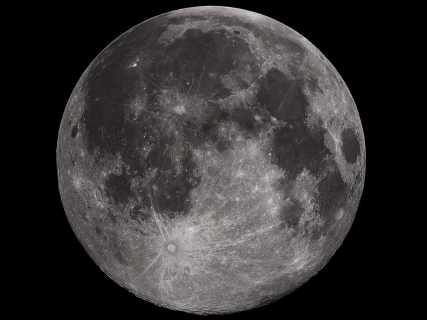

The last night of September with a full Moon arrives this Saturday with a name especially linked to the beginning of autumn: Harvest Moon. The satellite will reach exactly its full phase at 18:49 hours, Spanish peninsular time, and throughout the night it will be practically completely illuminated. In the Canary Islands, the astronomical moment will occur at 17:49 hours. Observation does not require telescopes or special equipment: it is enough to find a place with good visibility towards the east shortly after sunset.
The spectacle will also have planetary companions. NASA highlights the night of September 26 as one of the main astronomical events of the month because the Harvest Moon will appear visually close to Saturn and Neptune. Saturn can be distinguished with the naked eye as a nearby bright point, while Neptune, with an approximate magnitude of 8, will require binoculars or a telescope and favorable observation conditions.
What time can the full Moon be seen in Spain
The full phase occurs before the Moon rises above the horizon in much of the country, so the most spectacular moment to observe it will be at the beginning of the night, when it appears in the east while there is still some light from twilight. In Madrid, for example, the rise is expected around 19:49 hours; in Barcelona it will be a little earlier, around 19:24, while in Seville it will appear approximately at 19:59 and in A Coruña around 20:06 hours. In Las Palmas de Gran Canaria, it will rise near 19:42 hours, according to the astronomical calculations of Time and Date.
The hours vary by a few minutes even within the same autonomous community, so there is no single valid schedule for all of Spain. In any case, the practical rule is simple: look towards the eastern horizon approximately at dusk. After that, the Moon will gain height and remain visible for practically the entire night, moving towards the west before setting during the morning of Sunday.
Why is it called Harvest Moon
The name does not mean that it is a different type of full Moon. Harvest Moon is the traditional name for the full moon closest to the autumn equinox in the northern hemisphere. This year it perfectly meets that condition: the astronomical beginning of autumn occurred this week and the full Moon arrives just a few days later.
The term comes from a time before electric lighting, when the brightness provided by the full Moon allowed for the extension of agricultural tasks typical of the late summer and early autumn harvest during the night. It does not always fall in September: depending on how the lunar cycle and the equinox fit together, in some years the Harvest Moon occurs in October. In 2026 it corresponds to the full moon of September 26.
A particularity of these dates is that for several consecutive days the Moon rises with relatively little time difference from one day to another. That succession of illuminated nights was precisely what made this full moon an important reference for agricultural societies.
Why it may appear huge and orange when rising
Those who observe it when it appears on the horizon may find a Moon that is apparently much larger and in yellow, orange, or even reddish tones. The size is largely an optical illusion: when the lunar disk is near buildings, mountains, or trees, the brain has references to compare it to and may perceive it as larger than it actually is. NASA describes this well-known phenomenon as "moon illusion."
The change in color does have an atmospheric explanation. When the Moon is low, its light must pass through a greater amount of atmosphere before reaching the observer. In that journey, shorter wavelengths are more easily scattered, while warm tones prevail, in a way comparable to what happens during a sunset. That is why the best time to photograph a particularly golden Moon may be precisely during its rise.
This appearance should not be confused with a lunar eclipse. The Moon tonight does not need to pass through the Earth's shadow to acquire reddish tones: the color observed near the horizon may be due solely to atmospheric conditions.
Is it also a supermoon?
The term Harvest Moon says nothing about the distance between the Earth and the Moon, but only about the proximity of the full moon to the September equinox. A Harvest Moon may coincide with a supermoon in some years and not in others. NASA presents the phenomenon of this September 26 simply as the Harvest Moon and focuses the additional interest of the night on its apparent proximity to Saturn and Neptune.
In Madrid, the predicted lunar distance during the day is around 237,600 miles, about 382,000 kilometers, a figure close to the average distance between the Earth and its satellite. Therefore, the attraction of this night does not lie in an exceptional approach of the Moon, but in its rise at dusk, the beginning of autumn, and the possibility of observing Saturn at the same time.
Where to look and what is needed to see it
To observe it, binoculars or a telescope are not necessary. In fact, the effect of the Moon emerging over the landscape can be better appreciated with the naked eye. The ideal is to be in a spot with a clear eastern horizon, avoiding buildings, nearby mountains, and excessive urban lighting. An elevated viewpoint, a rural area, or a beach facing east can offer good conditions.
Light pollution is also not as problematic for a full Moon as for observing stars, since its brightness is very high. However, leaving the city does improve the experience if you want to locate Saturn or try to find Neptune with binoculars. For the farthest planet, it will also be necessary to know its exact position and have a sufficiently dark sky.
The main condition will be cloud cover. The general forecast from AEMET points to a situation of stability in much of Spain, although there will be territorial differences and the presence of high clouds or cloudy intervals in some areas, so the specific conditions will depend on the observation location.
A full Moon practically all night
Although the mathematical moment of the full moon occurs at 18:49 hours, it is not necessary to observe it exactly at that moment. To the human eye, the Moon will continue to appear completely full for many hours and will also offer a practically circular appearance the following night. In Madrid, calculations place the illumination of the lunar disk around 99% during the day.
The best combination of landscape, color, and apparent size will therefore come shortly after sunset. Those who wait until late at night will still find a very bright Moon, but higher in the sky and usually whiter. Between approximately 19:20 and 20:15 hours, depending on the point in Spain, one of the most interesting moments to look east and see the Harvest Moon of 2026 will occur.