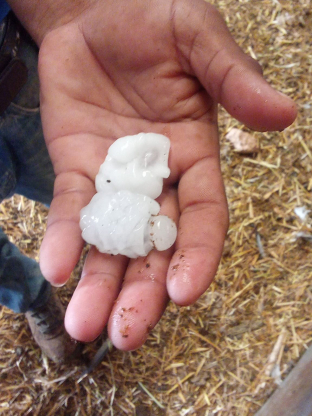

Hailstorms can cause significant damage to vehicles, from small dents in the hood and the roof to the breaking of the windshield or damage that necessitates replacing different parts of the bodywork. When this happens, one of the main doubts that drivers have is whether their insurance is required to pay for the repair or whether they can claim compensation from the Consorcio de Compensación de Seguros, especially when the storm has affected numerous cars in the same town.
The answer depends on two fundamental questions: the type of policy purchased and the specific cause of the damage. Although hail can produce significant damage, it is not included among the extraordinary risks that the Consorcio directly compensates. Therefore, owners who only have basic third-party insurance may find that they must personally cover the cost of repairing the bodywork.
The Organización de Consumidores y Usuarios (OCU) reminds that all-risk insurance policies usually expressly cover damage caused by hail, while expanded third-party policies may include certain guarantees, such as broken glass. However, not all types offer the same protection or automatically include damage caused by weather events, so it is essential to review the specific terms of the contract.
This difference is especially important after episodes of heavy rain, hailstorms, or tempests, when the same weather phenomenon can cause damage of different kinds. While dents caused directly by ice normally fall within the scope of private insurers, extraordinary floods and certain wind-related phenomena can indeed lead to compensation from the Consorcio, even when the vehicle only has compulsory insurance.
What the car insurance covers if hail falls
Owners of vehicles with all-risk insurance are, in general, those who have greater protection against this type of event. These policies usually include own-damage coverage, which allows one to claim the repair of dents in the hood, the roof, the doors, or the trunk, as well as other damage derived from the impact of hail.
However, having all-risk insurance does not necessarily mean that the repair will be free. If the driver has taken out a policy with an excess (franchise), they must assume the amount established in the contract before the insurer pays the rest of the covered cost.
For example, if hail causes damage valued at 1,500 euros and the insurance sets an excess of 300 euros per claim, the driver would have to pay those first 300 euros and the company would cover the remaining 1,200, provided that the damage is included in the coverage. This is an indicative example, since the conditions may vary between insurers.
The situation changes with extended third-party insurance, which usually includes additional guarantees, such as theft, fire, or broken glass. In these cases, if the hail breaks the windshield or any of the side windows, the company may cover its repair or replacement when the vehicle has that coverage contracted.
However, the glass guarantee does not imply that dents in the bodywork are also covered, and not all glass elements necessarily receive the same treatment. Panoramic roofs, certain types of glass, and other components may be subject to specific conditions.
Lastly, those who only have basic third-party insurance generally do not have coverage to repair damage caused directly by hail to their own vehicle. This type is designed mainly to respond for damage caused to other people or property, not for the weather-related defects suffered by the insured car.
When does the Consorcio de Compensación de Seguros pay
One of the most common misconceptions is to think that the Consorcio pays for all damage caused by severe weather events. However, this public body only steps in when the damage is the consequence of legally considered extraordinary events.
Among the scenarios covered are extraordinary floods, earthquakes, volcanic eruptions, tornadoes, and atypical cyclonic storms, a category that includes certain episodes with wind gusts higher than 120 kilometers per hour.
On the contrary, hail and snow are expressly excluded from the Consortium’s coverage when they act as the direct cause of the damage. This means that a hailstorm that dents dozens of vehicles does not automatically entitle you to compensation from this body, even if it has caused significant damage in a locality.
The difference appears when a storm combines several phenomena. If a car is damaged by an extraordinary flooding caused by the rains, the Consortium may cover the repair or the corresponding compensation. It may also intervene when the damage is the consequence of a tornado or of extraordinary winds that meet the conditions established.
In these cases, the Consortium may pay compensation even to owners who only have a basic third-party insurance policy, provided that the policy is in force, includes the corresponding surcharge for extraordinary risks, and that the other legal requirements are met.
In addition, the body establishes that no deductible applies to the extraordinary damage covered in vehicles, even if the owner has contracted a deductible for ordinary incidents under their private insurance.
The key, therefore, is not only the intensity of the storm, but which phenomenon effectively produced the damage. If the car shows dents due to the direct impact of the hail, its repair does not become the Consortium’s responsibility merely because, during the same weather event, flooding or strong winds were also recorded.
How to claim damage from hail and what deadline you have
The Law 50/1980, on Insurance Contract, generally establishes that claims must be reported to the insurer within a maximum period of seven days from when they are known, unless the policy provides for a longer one. Exceeding that period does not automatically mean losing all compensation, although it may have consequences under the conditions provided for by law.
Therefore, after a hailstorm, the recommended course of action is to photograph the damage before repairing the vehicle, keep any document related to the weather event, and contact the insurer as soon as possible to open the corresponding claim.
The OCU advises collecting evidence that makes it possible to establish both the origin and the extent of the damage. Among them are the photographs and videos of the vehicle, the meteorological reports from AEMET, news about the storm, and any possible documents issued by emergency services.
It is also advisable to avoid permanent repairs before the company has been able to assess the damage, unless intervention is necessary to prevent the damage from increasing. In any case, invoices and receipts for the expenses incurred must be kept.
When it involves an extraordinary risk, the affected party may process the application directly with the Consorcio de Compensación de Seguros, through its official website or its telephone service. In damage related to extraordinary winds, the Consorcio recommends initially reporting the incident to the insurer, since it may be necessary to check meteorological records to determine who must assume the compensation.
The economic assessment will depend on the cost of repair and the coverage conditions. If the damage is so significant that repairing the car exceeds its value, the compensation can be calculated based on the vehicle’s market value, taking into account the applicable conditions and the expert assessment.
In short, a hailstorm does not guarantee that the Consorcio will pay for the repair of the car. The usual protection against the direct impact of hail depends primarily on the coverage contracted with the private insurer, while the intervention of the public body is reserved for extraordinary risks recognized by the regulations. Checking the policy, documenting the damage, and reporting the incident as soon as possible will be decisive in determining who must take care of the repair.