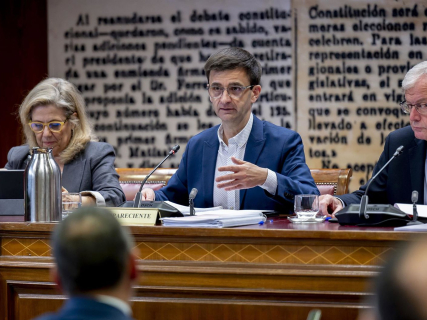
Javier Ruiz approaches his departure from RTVE: Mañaneros seeks a replacement

Javier Ruiz approaches his departure from RTVE at the end of the Mañaneros 360 season. The corporation is already negotiating a replacement for the morning program on La 1, according to Vozpópuli.

1 minute

fotonoticia 20260429165256 1920

fotonoticia 20260429165256 1920

Add DEMÓCRATA to Google

Ask FREN

Published

Last updated

1 minute

Most read

Javier Ruiz shoots up again in Google for his possible departure from RTVE. The journalist would be close to closing his stage at the helm of Mañaneros 360, the morning format of La 1, at the end of the season.

The information is advanced by Vozpópuli and has been picked up by other television media: if there is no change, Ruiz would end his stage on July 30 and RTVE would be urgently negotiating a replacement. ([Mundo Deportivo][16])

The move comes amid a reorganization of the television market, with new projects underway and changes of pieces in the mornings. Javier Ruiz became one of RTVE's bets to reinforce the political, economic, and current affairs profile of the morning slot.

RTVE seeks a replacement for Mañaneros 360

Mañaneros 360 was born as a reformulation of La 1's morning space, with more informational and political weight. Ruiz fit that line due to his profile as an economic and analysis journalist.

His possible departure forces RTVE to decide whether to maintain that orientation or to shift towards a lighter format. 

More key points, information and questions with FREN

AI-GENERATED CONTENT

What is the usual procedure for selecting and appointing presenters at RTVE?

At RTVE, presenters are chosen through two main channels: public selection processes for permanent labor staff positions and more flexible procedures (candidate pools, databases, and internal castings) for temporary coverage or to select the specific “face” of a program. Public processes are governed by the principles of publicity, equality, merit, and ability, with opposition and competition phases regulated in the calls and internal human resources regulations. For occasional collaborations, panelists, and commentators, service contracts are used, which the Court of Auditors has urged to be better defined. There is no single, detailed specific regulation “for presenters,” but rather a framework of agreements, call bases, and internal protocols applied to all Corporation staff.

1. Presenters as permanent labor staff

RTVE is a public corporation with the nature of a state company, so its staff are not statutory but labor personnel. Access to permanent positions is through selection processes regulated in public calls, accessible via RTVE’s corporate employment website (https://www.rtve.es/corporacion/ofertas-empleo/) and the specific calls platform (https://www.convocatorias.rtve.es and https://convocatorias.rtve.es/puestos-ofertados).

These calls (for example, Call 1/2022, whose bases are also disseminated by trade unions: https://rtve.usoindustria.org/…) establish a competition-opposition system. According to RTVE opposition summaries (https://www.campustraining.es/noticias/oposiciones-rtve/), there usually is:

  • An opposition phase (approx. 70% of the score), with theoretical and practical tests, which in audiovisual profiles may include locution or presentation simulations.
  • A competition phase (approx. 30%), where merits such as professional experience, RTVE Institute courses, languages, or participation in previous processes are evaluated.

The documentation to be submitted and how to prove experience are detailed in corporate FAQs on selection processes (https://www.cgtrtve.org/files/faqs‑corporativo_pub_02.pdf). Registration is online and must be done within the deadline set in each call, usually 15 calendar days from publication. The status obtained by passing the process is that of permanent labor personnel, with professional categories and functions included in the agreement and the bases.

2. Databases, candidate pools, and temporary hiring

Besides permanent positions, RTVE uses databases or candidate pools by occupation type; internal documentation indicates that being in such a database does not guarantee hiring but is a requirement to be proposed (Union FAQ). The Joint Commission Resolution for Relations with the Court of Auditors on personnel hiring at CRTVE (2014-2019) urges RTVE to strengthen selection and justification procedures for temporary hiring, requiring evaluation reports listing candidates and their merits (BOE‑A‑2024‑13269).

The same resolution requests approval of a specific internal procedure for temporary hiring, detailing responsible units, how to justify urgent needs, and selection criteria. This also affects roles that in practice may be presenters or reporters on screen, although the text does not describe exactly how a specific program presenter is chosen.

3. Internal castings and selection of the “face” of programs

For certain programs, especially news and magazines, RTVE combines this general framework with editorial decisions about who presents each show. Various reports on RTVE’s strategy reflect the use of internal castings of “in-house” journalists to present new news programs, instead of external hires, with studio tests and internal evaluations before finalizing the appointment (for example, processes described in Dircomfidencial).

In other cases, the presenter is part of a program initially produced by an external company, and the main legal relationship is between RTVE and the producer. The news about the internalization of “Aquí la Tierra”, after twelve years managed by an independent producer, notes that from July 2026 RTVE assumes production “with own resources,” keeping presenter Jacob Petrus within this new internal scheme (Audiovisual451).

4. Collaborators, panelists, and service contracts

A visible part of the screen is occupied by panelists, commentators, and collaborators, whose relationship is not labor but service leasing. The Court of Auditors and the General Courts have asked RTVE to better identify the services covered by these contracts and clearly define their legal nature (BOE‑A‑2024‑13269). Also, in the Joint Parliamentary Control Commission, questions have been raised about whether RTVE’s Style Manual should also apply to these collaborators, and whether ethics and respect for the law should be guiding principles in their hiring (agendas of 5.2.2026 and 25.9.2025, references event_84240 and event_80336).

5. General principles and complementary references

The Joint Commission has also urged RTVE to apply principles of merit, ability, suitability, free competition, and publicity in the selection of management personnel (BOE‑A‑2024‑13269), principles that also inform human resources policy and, by extension, processes for positions of public relevance such as presenters. Appointments of senior officials (for example, Josep Vilar heading the Audiovisual Expansion area or new directors of RNE and territorial areas) are publicly communicated and linked to long internal careers (Panorama Audiovisual, Panorama Audiovisual), showing a preference for professionals already integrated into the Corporation.

As a general sector reference and for related professional profiles (announcers, editors, content programmers), agreements such as that of Radio Popular, SA, can be consulted, where functions of editor-presenter and main announcer are defined (BOE‑A‑2025‑22737). Although not RTVE, it illustrates the typical labor framework of those who present and host programs in the audiovisual field.

Finally, other links cited in the documentation used (not directly focused on RTVE presenters but related to the audiovisual environment and selection processes) include: Televisión Española seeks deputy director of new formats, TV Hunters: the great TV casting, information about RTVE’s new afternoons, as well as various resolutions of selection processes in the General State Administration describing the general audiovisual market context (BOE‑A‑2024‑15264, BOE‑A‑2024‑15266, BOE‑A‑2024‑15274). References from the Senate and regional parliaments on other public entities have also been used (for example, the Assembly of Extremadura: event 30/03/2026).

What powers does RTVE management have regarding programming and hiring presenters?

RTVE regulations assign major decisions about programming and hiring to the Board of Directors and the Presidency, while operational details (specific schedules, presenter selection, formats) are managed through the executive structure and corporate bylaws. Law 17/2006 and its reforms do not explicitly mention “presenters” but regulate content production and programming and personnel and hiring regimes generically. In practice, the Board sets the principles and main lines of programming and personnel, and the Presidency and executive management implement those decisions by specifying which programs are made, with which producers, and which professionals appear on screen. All this is also subject to the framework mandate, the program contract, and general audiovisual communication regulations.

1. Who decides programming

The central piece is the Law 17/2006, on state-owned radio and television, amended by Law 5/2017 and by Royal Decree-law 5/2024 (published in the BOE of October 23, 2024).

From this regulation it follows:

● The Board of Directors is the “administration and governance” body of RTVE Corporation and “will carry out its ordinary executive management functions through its President” (art. 15 Law 17/2006, as currently worded). Additionally, the law expressly assigns it responsibility for “fulfilling the general objectives set for the Corporation, compliance with programming principles (…) and good administration and governance” (art. 16.2).

● Among the Board’s powers is “developing general principles regarding production, programming, and commercialization in state radio and television” (art. 16.4.c, according to the consulted version). That is, the Board does not approve each schedule but does approve the strategic lines of programming and the production model (in-house, associated, external, etc.).

● The Presidency exercises “ordinary executive management” and represents the Corporation (arts. 15.2 and 17 Law 17/2006). This implies, de facto, steering channel offerings and coordinating content management, although details are referred to the corporate bylaws, which the Law mentions as an instrument to develop internal organization but are not reproduced in the BOE excerpts consulted.

● The framework mandate approved by the Cortes, pursuant to art. 4 of Law 17/2006, sets general programming and public service objectives. The current one was published as “Framework mandate to RTVE Corporation” in the BOE (BOE-A-2008-11038) and conditions programming decisions (mandatory genres, presence of European and Spanish content, attention to minorities, etc.).

2. Powers over schedules and program commissioning

The Law distinguishes between strategic decisions, which belong to the Board, and ordinary management, which belongs to the Presidency and executive team:

● The Board “develops general principles” of programming (art. 16.4.c). Based on this, the Presidency and area directors prepare specific schedules, decide time slots, seasons, and format renewals. The analyzed regulation does not go down to the level of approving or rejecting a specific program in the Board, unless the bylaws provide so.

● Regarding contracts, art. 16.4.g establishes that the Board will approve contracts, agreements, or legal transactions subject to the Public Sector Contracts Law that the Board declares within its competence “due to their amount,” with a minimum of 2 million euros annually. “The rest of the contracts (…) will be approved by the person holding the presidency.” This includes program production contracts, co-productions, and commissions to external producers.

● Art. 20.5 of Law 17/2006 (according to the consulted text) states that RTVE “may not assign to third parties the production and editing of news programs and those expressly determined by the framework mandate.” Therefore, management can commission many programs to externals, but news must be produced internally, limiting outsourcing of news formats and also conditioning the hiring of their presenters.

3. Margin for selection and hiring of presenters

Law 17/2006 contains no specific articles on “presenters,” but general rules on personnel and hiring:

● The Corporation and its companies have personnel governed by labor relations (preamble and general personnel regime). This includes both permanent and temporary labor personnel, according to the Workers’ Statute and collective agreements (for example, RTVE agreements historically published in the BOE, such as the X Agreement of the entity, in BOE-A-1994-7063, although it is a framework prior to the current Corporation).

● For external hiring (producers providing formats and presenters), the Public Sector Contracts Law applies, expressly referred to by art. 16.4.g of Law 17/2006. RTVE’s executive structure prepares files and awards contracts within competence limits: the Board reserves the higher-value ones, and the Presidency resolves the rest.

● Art. 16.4.d grants the Board the competence to “approve basic guidelines on personnel matters.” Within these guidelines (staffing, types of contracts, relevant hiring policies, etc.), the executive management (Presidency and executive team) determines which profiles are hired as labor personnel and which are linked through commercial contracts (for example, presenters who invoice as professionals or through producers), always respecting the budget limits of the program contract (Law 8/2009 on financing).

● The Law 13/2022, General Audiovisual Communication Law sets principles of independence, pluralism, and separation between editorial content and advertising that also condition program design and the image of their presenters, although it does not enter RTVE’s internal organizational detail.

In summary, state regulations establish a fairly clear corporate governance and hiring framework but leave the fine distribution of decisions to the corporate bylaws and RTVE’s internal practice: the Board sets the rules of the game (strategy, programming principles, and personnel policy), and the Presidency and senior management decide, within that framework, which presenters are hired, with what type of contract, and on which programs.

Who exactly appoints the person responsible for news at RTVE and what parliamentary controls exist? What limits does the current RTVE framework mandate impose on program genres and the presence of external production? How has Royal Decree-law 5/2024 changed the balance of power within RTVE’s Board of Directors?

What has been Javier Ruiz’s professional and political career before joining RTVE?

Javier Ruiz Pérez is a journalist specialized in economic and political information whose career has mainly developed in private radio and television before joining RTVE in 2021. Before directing and presenting programs such as Las claves del siglo XXI and later the morning magazine Mañaneros 360 on La 1, he built his profile at Cadena SER and Cuatro, where he presented prime time news and a prominent political talk show. The sources consulted do not record formal membership in any party, although he has been intensely exposed to political debate and criticism of parties like Vox. The newspaper Demócrata focuses mainly on his current role at RTVE and his possible departure, without detailing his previous career.

Education and early professional steps

According to biographical profiles gathered in the research, Javier Ruiz was born in Valencia in 1973 and graduated in Journalism from CEU Cardenal Herrera University, later completing a master’s in International Economics and Journalism at Columbia University (New York), which explains his strong specialization in economic journalism. He comes from a humble family background and financed his studies with scholarships, something he has explained in interviews collected in media such as 20minutos and popular profiles like Wikipedia, FormulaTV or Lecturalia.

His career began in Cadena SER’s news services in the mid-1990s, where he was a reporter for Hoy por hoy with Iñaki Gabilondo and later a correspondent in New York. At SER he became chief editor of news services and directed and presented the economic news program Hora 25 de los negocios, establishing himself as a leading voice in economic and data information.

Jump to television and responsibility at Cuatro

The next major stage of his career took place at the Prisa group and its audiovisual subsidiary Sogecable. From 2006 he became deputy director of Sogecable’s News Services and presenter of Noticias Cuatro, first in the midday edition and from 2010 in the 8:00 p.m. news, when he replaced Iñaki Gabilondo. This stage at Cuatro placed him at the forefront of televised political debate.

Besides the news, he was an economic commentator in talk shows and, from 2014-2015, took on presenting Las Mañanas de Cuatro, a current affairs and political debate magazine in which he eventually replaced Jesús Cintora, as recalled in reports on program renewals at Mediaset cited by elDiario.es. In parallel, he collaborated as an analyst in other shows and media, including Vozpópuli and COPE, where he was an economic commentator on Así son las mañanas.

Strengthening the economic profile and return to SER

After his most visible stage at Cuatro, Javier Ruiz reinforced his image as an economic and data analyst. He returned to Cadena SER as head of Economics, combining that role with television collaborations. This dual radio-television presence would be relevant later, as some critics reproached him for a supposed conflict of interest in combining SER microphones with his work at RTVE, a controversy discussed in analysis pieces such as those by El Debate.

In the editorial field, he has published several books on economic dissemination and inequality, the most notable being Edificio España, for which he received the Espasa Prize in 2022, recognition cited in the collected profiles (Lecturalia). He also received the Pilar Narvión Prize for his data interpretation work during the Covid-19 pandemic, reinforcing his image as a “data” journalist.

Political links and public image before RTVE

Strictly speaking, the sources agree that there is no record of Javier Ruiz’s formal membership in any political party: he is presented as an independent journalist specialized in economics and politics. However, his work places him at the center of partisan controversy. He himself has denounced harassment on social media by Vox and has been accused by conservative sectors of ideological bias, while other sectors recognize him for his insistence on data verification.

This controversial character is also reflected in parliamentary and media debate about RTVE. For example, in a Popular Party note on RTVE’s Joint Commission, “programs led by Javier Ruiz and Jesús Cintora” are mentioned when accusing the corporation of favoring the Government, as the PP itself reports on its website (PP note). This political criticism affects the public perception of the journalist even before his consolidation on public TV.

In parallel, later interviews emphasize his defense of professional independence, with phrases like being willing to “go out on the street” to save his principles, collected by media such as El País and also spread on social media (Facebook, Instagram, X).

Situation at RTVE and recent references

He joined RTVE in 2021, first with the debate program Las claves del siglo XXI on La 1. Later, in 2025, he began co-presenting the renewed morning magazine Mañaneros 360, with an explicit focus on politics and economics, as detailed in various TV chronicles from elDiario.es, the official launch of Mañaneros 360, its editorial reorganization (format revolution) and news of his new stage signed by Audiovisual451.

Meanwhile, the newspaper Demócrata has recently reported on his possible departure from the program, emphasizing that his signing was part of RTVE’s bet on a more political and analytical morning show, but without providing additional data on his previous career at SER and Cuatro or on party membership (Demócrata). In summary, before RTVE, Javier Ruiz’s career is that of a data and economics journalist with strong exposure to political debate but without an institutional or party role.

Other links cited or used in the documentation: Mañaneros 360, RTVE afternoons, Mañaneros revolution, Audiovisual451 on Mañaneros 360, interview with Jesús Cintora, Buenafuente signing.

How has Javier Ruiz’s arrival at “Mañaneros 360” influenced the editorial line and the weight of politics in La 1’s mornings? What specific political criticisms have PP and Vox made against Javier Ruiz’s programs on RTVE? What impact has Javier Ruiz’s book “Edificio España” had on political and media debate about inequality in Spain?

Play

Test your knowledge with FREN!

How much do you know about this topic? Answer the following 3 questions.

What date is being considered for Javier Ruiz's departure from Mañaneros 360?

Question 1 of 3

What was one of the main objectives when creating Mañaneros 360 on La 1?

Question 2 of 3

What professional profile did Javier Ruiz bring to Mañaneros 360?

Question 3 of 3

Hola, soy Fren. ¿Cómo te ayudo?