ES-Alert in Valencia due to the red alert for rains: Emergencies asks to avoid travel

Emergencies warns of red level rains in Castellón and Valencia and asks to avoid travel.

es alert valencia lluvias

es alert valencia lluvias

Add DEMÓCRATA to Google

Ask FREN

Published

Last updated

2 minutes

Most read

Elecciones 29N · Encuestas

La media de las encuestas

Media a 19 de noviembre de 2026 · 17 institutos

  • PP31,3 %
  • PSOE27,5 %
  • Vox19,0 %
  • Frente Amplio6,2 %
  • ERC2,5 %
01020304050ene 2024jul 2024ene 2025jul 2025ene 2026jul 2026

Media del último estudio de cada instituto en 30 días y su evolución semanal desde el 23J. Partidos con al menos un 2 %.

Todas las encuestas

Elecciones generales del 29 de noviembre · Demócrata

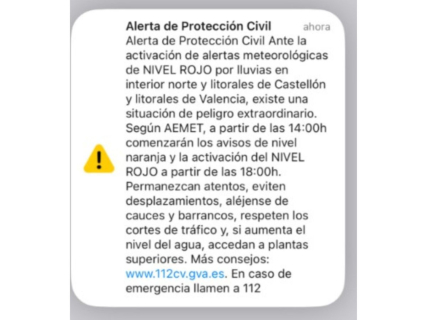
The Generalitat has sent this Thursday a ES-Alert to the mobile phones of the population in Valencia due to the activation of red-level weather alerts for rain. The Civil Protection message warns of a "extraordinary danger" situation and asks the population to avoid travel, stay away from riverbeds and ravines, and respect traffic closures.

The notice indicates that the red level affects the northern interior and the coastlines of Castellón and the coastlines of Valencia. According to the message received on mobile phones, starting at 14:00 hours, orange-level alerts will begin, and the activation of the red level is expected to start at 18:00 hours.

The alert occurs while AEMET forecasts extraordinarily intense precipitation in several areas of the Valencian Community. In the areas with the highest risk in Castellón, accumulations of up to 90 liters per square meter in one hour and 260 liters in 12 hours are anticipated.

The Emergency message: "Avoid travel"

The ES-Alert sent by Civil Protection urges the population to avoid travel during the rain episode. The message also asks to stay away from riverbeds and ravines and to respect any traffic closures that may be established as a consequence of the weather situation.

Emergency services also recommend that, if the water level rises, people access upper floors. The notice refers to the official emergency website of the Generalitat for more advice and indicates the phone number 112 as a reference number in case of emergency.

The sending of the ES-Alert represents a direct communication from Civil Protection to the phones located in the affected areas. The objective of the system is to convey safety instructions to the population in the face of an emergency situation that may require immediate changes in travel and in usual activity.

Up to 260 liters in 12 hours in Castellón

The data from AEMET places the highest risk in several areas of Castellón. The northern coastline, northern interior, and southern coastline of Castellón are expected to receive a maximum of 90 liters per square meter in one hour and 260 liters in 12 hours.

In the northern coastline of Valencia, the notice anticipates up to 90 liters per square meter in one hour and 180 liters in 12 hours. In the southern coastline of Valencia, up to 90 liters in one hour is also expected.

The red level warnings have an estimated probability of between 40% and 70%, according to the information from AEMET that accompanies the episode. The end times vary by area and some of the warnings extend into the early hours of Friday.

The episode intensifies this afternoon

AEMET maintains a special warning for very strong and persistent showers in the eastern peninsula. The forecast for the coastal waters of Castellón and Valencia also includes very heavy downpours and storms during the day.

The evolution of the precipitation may cause rapid accumulations of water, especially in low-lying areas and near riverbeds and ravines. For this reason, ES-Alert expressly calls to avoid these spaces and follow the instructions of emergency services.

The situation will remain under surveillance during the next few hours. AEMET will update the warnings based on the evolution of the precipitation and storms, while Emergencies maintains its recommendations to the population regarding the episode.

More key points, information and questions with FREN

AI-GENERATED CONTENT

What requirements must the Generalitat Valenciana meet to activate and send an ES-Alert to the population?

The ES-Alert system is the mass mobile alert channel integrated into the National Alert Network of the Ministry of the Interior, designed for serious civil protection emergencies or those with imminent risk. Within this state framework, the Generalitat Valenciana, through the Valencian Agency for Security and Emergency Response (AVSRE) and the Emergency Coordination Center (112 Comunitat Valenciana), has ordinary competence to activate and send alerts in its territory up to emergency levels where a national interest emergency is not declared.

From a legal perspective, the system is part of the National Civil Protection System and the State General Civil Protection Emergency Plan, which regulates the National Alert Network. This Plan foresees that:

  • The National Alert Network can use mobile telephony networks to transmit direct warnings to the population in affected areas.
  • The emergency coordination bodies of the autonomous communities are the ordinary channel to inform the National Emergency Monitoring and Coordination Center (CENEM) and to disseminate alerts to authorities, citizens, organizations, and companies.
  • The activation of regional civil protection plans entails a mandatory notification to CENEM.

On this basis, the specific state ES-Alert protocol — approved within the National Civil Protection Council — assigns the autonomous communities the competence for the “immediate sending” of alerts when it is necessary to protect the population. The state Director General of Civil Protection has explained in the Senate that, up to level 3 of emergency, the communities have “absolute autonomy” to activate ES-Alert “when they consider, where they consider, and with the text they consider.”

In the case of the Comunitat Valenciana, activation is articulated through the Generalitat Emergency Coordination Center (112 Comunitat Valenciana), integrated into the AVSRE. The material requirements that must concur, according to public explanations by the Minister of Emergencies and the Generalitat itself, are essentially:

  • Existence of a serious emergency or imminent risk for the population (floods, DANA, forest fires, other civil protection risks).
  • Need for the population to adopt immediate self-protection actions (evacuation, confinement, avoiding travel, staying away from watercourses, etc.).
  • In the meteorological field, two reference cases:
    • Automatic preventive sending when AEMET activates a red level warning in the area.
    • Reactive sending when, without reaching red or beyond the initial warning, a risk of overflow of ravines and watercourses is confirmed, or a multiplication of incidents makes it necessary to “take action.”

Regarding procedural and signature chain requirements, the available information points to a double filter:

  • A technician from the emergency center drafts the message, defines the geographic scope (using polygons on maps, selection of municipalities or prerecorded zones from external emergency plans), and sets language(s) and content.
  • An authorized institutional official (designated by the autonomous community since 2023) validates and orders the sending. This official is part of the Generalitat's emergency management structure (management or sub-management of AVSRE / competent ministry).

This “technician who writes + official who signs” scheme is common to all communities and is foreseen in the ES-Alert system design itself. Persons with signing capacity are previously registered in the state platform (Public Warning Portal) managed by the Interior Ministry; without being registered, they could not authorize alerts.

Additionally, the message must meet content requirements:

  • Identify the type of emergency (torrential rains, flood risk, fire, etc.).
  • Precisely delimit the affected or predictably affected area.
  • Include clear, concise, and actionable instructions for the population (do not cross floodable areas, stay in high zones, close windows and turn off air conditioning in case of smoke, do not use the car, etc.).
  • Identify the issuing authority (112 / Emergencies Generalitat Valenciana, Civil Protection, etc.).

Coordination with the General State Administration operates on several levels:

  • The Generalitat must communicate relevant situations and the activation of its civil protection plans to CENEM.
  • In specific risks under state competence (for example, nuclear) or when the emergency is declared of “national interest,” ES-Alert dissemination can be carried out from CENEM, at the request of the state authority (such as a Government Subdelegation) and in coordination with the autonomous community.
  • In other cases, the Generalitat directly executes the territorial sending, informing state Civil Protection as a courtesy, but without needing prior authorization from Madrid.

In summary, to activate and send an ES-Alert, the Generalitat Valenciana must: perceive a serious or imminent risk situation that requires immediate instructions to the population; process the decision through its emergency coordination center and AVSRE; correctly draft and delimit the alert; obtain validation from an authorized official; and maintain proper informational coordination with CENEM within the National Alert Network.

Can you summarize in a scheme who decides each phase (technicians, AVSRE, minister, CENEM) when an ES-Alert is sent in the Comunitat Valenciana? How does the use of ES-Alert differ in a DANA compared to a large forest fire in the Comunitat Valenciana? What problems and debates have been identified after the 2024 DANA regarding the timing and manner in which the Generalitat activated ES-Alert?

What competencies does the Generalitat's Civil Protection have in managing emergencies derived from meteorological phenomena?

The Civil Protection of the Generalitat of Catalonia plays a central role in managing emergencies derived from meteorological phenomena (floods, snowfalls, wind and sea storms, cold or heat waves). According to the Statute of Autonomy and the Catalan civil protection law, the Generalitat exercises exclusive competence in civil protection and, through the Directorate General of Civil Protection, plans, directs, and coordinates the response to these risks, in coordination with municipalities and the State when the emergency requires it.

Legal and organizational framework

Article 132 of the Statute of Autonomy of Catalonia assigns the Generalitat exclusive competence in civil protection, and Law 4/1997, of Civil Protection of Catalonia (published in the BOE: text of Law 4/1997) entrusts it with:

  • Regulating the Catalan civil protection system.
  • Approving the Civil Protection Plan of Catalonia (PROCICAT) and special plans for specific risks (floods, snowfalls, etc.).
  • Directing and coordinating civil protection services at the regional level.

The Generalitat exercises these functions through the Directorate General of Civil Protection, which develops the system, its resources and structures, and through the Operational Coordination Center of Catalonia (CECAT), which coordinates the management of meteorological emergencies and issues alerts to the population.

Planning and prevention of meteorological risk

A key initial competence is preventive planning. It corresponds to the Generalitat's Civil Protection to:

  • Approve and review PROCICAT, a territorial plan activated in emergencies affecting large areas of the territory, including windstorms, intense cold, or other adverse meteorological episodes (PROCICAT).
  • Develop and maintain special plans by risk:
    • INUNCAT, for floods, heavy rains, and DANA episodes, activated on alert or emergency upon forecasts of heavy precipitation.
    • NEUCAT, for snowfalls, affecting mobility and services.
    • Other related meteorological plans (e.g., for intense cold or strong waves, managed within PROCICAT).
  • Promote the approval of municipal civil protection plans against floods, snowfalls, and other risks, through the Civil Protection Commission, which approves local and self-protection plans for exposed activities (example of approvals).

Additionally, it designs self-protection and prevention strategies at the local level, especially against flash floods, and reviews INUNCAT itself to adapt it to climate change and more extreme phenomena (note on floods).

Direction, activation, and coordination of the response

In the face of an adverse meteorological episode, the Generalitat's Civil Protection has the competence to:

  • Assess meteorological and hydrological information provided by the Meteorological Service of Catalonia (Meteocat), AEMET, and the Catalan Water Agency.
  • Decide the activation and level of plans (pre-alert, alert, emergency) and communicate it to municipalities and operational services. For example, activating the INUNCAT alert due to rain accumulation in various counties (INUNCAT activation), or managing PROCICAT for intense cold (alert closure for cold).
  • Coordinate emergency resources and services (Firefighters, SEM, Mossos, Rural Agents, Catalan Traffic Service, etc.) through CECAT, both in the monitoring and emergency phases.
  • Promote protection measures such as mobility restrictions, preventive closures of exposed activities, or recommendations to avoid floodable areas or the coast during strong waves.

Information and alerts to the population

Another key competence is risk communication:

  • Issuing warnings and recommendations to citizens through official channels, social networks, and press releases (for example, requests to limit mobility during torrential rain or extreme cold episodes).
  • Decision on the use of the ES-Alert system in Catalonia. Official Generalitat documentation establishes that, when civil protection authorities determine that immediate instructions must be transmitted to the population, it is the CECAT, managed by the Directorate General of Civil Protection, who drafts and issues the mobile alert message in the affected areas (explanation about ES-Alert in floods).

Relationship with municipalities and the State

The Generalitat and municipalities share responsibilities in civil protection in Catalonia. Municipalities:

  • Develop and activate their municipal civil protection plans, especially those related to floods, snow, wind, or heat.
  • Implement in the territory the measures dictated by the Generalitat (closures of access to streams, evacuations, local devices, etc.).

In severe emergencies that exceed regional capacity, the Generalitat can request the activation of state mechanisms and the intervention of the General State Administration, but the direction of the emergency in the ordinary scope of meteorological phenomena corresponds to the Generalitat's Civil Protection.

What regulations govern the ES-Alert system and emergency communication via mobile phones in Spain?

The ES-Alert system (Spanish system of mass alerts to the population via mobile) is supported by a regulatory framework that combines the telecommunications framework with that of civil protection, based on the European Electronic Communications Code. The specific legal core today is Law 11/2022, of June 28, General Telecommunications Law, complemented by civil protection legislation and data protection regulations.

1. Telecommunications core: Law 11/2022

Law 11/2022, of June 28, General Telecommunications Law (BOE-A-2022-10757) is the central piece of the public mobile alert regime:

  • In its preamble, it states that, according to the European Electronic Communications “Code,” a public alert system through mobile services is introduced in case of major disasters or imminent or ongoing emergencies. This is the direct legal basis for ES-Alert.
  • In the operative part, the law imposes on mobile interpersonal communication service operators based on numbering the obligation to transmit public alerts in those cases to affected end users, “under the terms determined by royal decree.” That is, the law sets the mandate and refers the technical details to regulatory development.
  • Additionally, it allows by royal decree that these alerts may also be disseminated through other publicly available electronic communication services, audiovisual communication services, or mobile applications based on Internet access, provided equivalent effectiveness in coverage and reach is maintained, including temporary users in the affected area.
  • The law requires that end users can easily receive alerts and that their transmission is free both for users and for the entity responsible for issuing them.
  • Regarding network and service security, it obliges operators to guarantee uninterrupted access to emergency services and uninterrupted transmission of public alerts in cases of catastrophic network failure or force majeure.
  • For emergency communications and public alerts, the law expressly establishes that Regulation (EU) 2016/679 (GDPR) and Organic Law 3/2018, of December 5, on Personal Data Protection and Guarantee of Digital Rights apply, so that data processing associated with ES-Alert is subject to data protection guarantees.

Overall, this law materializes in Spain the obligations of the European Electronic Communications Code regarding public alert systems, to which it expressly refers in its introduction. Part of this transposition had already been channeled through Royal Decree-law 7/2021, of April 27, which incorporated EU directives on telecommunications and was later integrated into the new general law.

2. Civil protection framework

The ES-Alert system is not understood only as an obligation of operators but as a civil protection instrument embedded in emergency management policy:

  • Law 17/2015, of July 9, on the National Civil Protection System (BOE-A-2015-7730) establishes the general framework for planning, coordination, and response to emergencies at the state level. Although the text does not focus on mobile telephony, it defines the obligation of Administrations to have effective systems of information and alert to the population in situations of serious risk, catastrophe, or calamity.
  • Royal Decree 524/2023, of June 20, approving the Basic Civil Protection Standard (BOE-A-2023-14679) updates the structure and minimum content of civil protection planning. It fits ES-Alert as one of the possible channels for the dissemination of warnings and orders to the public within state and regional plans.
  • Instruments such as the State General Civil Protection Emergency Plan (Resolution of December 16, 2020, BOE-A-2020-16349) and specific plans — for example, the State Plan against Tsunami Risk approved in 2021 — determine, for specific risks, how warnings are activated and which channels are used, allowing operational integration of ES-Alert in rapid warning protocols.

3. European fit and personal data

At the European level, the “European Electronic Communications Code” is the regulation that requires Member States to have a public alert system capable of warning the population through mobile networks in case of serious emergencies. Spain complies with this requirement mainly through the aforementioned Law 11/2022, which refers to that Code and articulates obligations on operators, and through regulatory developments that specify the technology (cell broadcast, SMS, or other equivalent solutions).

The use of mobile phones as an alert channel is also subject to the general data protection regulations mentioned (GDPR and Organic Law 3/2018), which condition the processing of location and subscriber data to what is strictly necessary for alert dissemination and under the control of competent civil protection authorities.

In summary, ES-Alert is based on: Law 11/2022 (transmission and security obligations in telecommunications), Law 17/2015 and the Basic Civil Protection Standard (emergency management and public warnings framework), and the European Electronic Communications Code, all under the guarantees of the GDPR and Organic Law 3/2018.

Play

Test your knowledge with FREN!

How much do you know about this topic? Answer the following 3 questions.

What does the ES-Alert sent by the Generalitat mainly recommend due to the red alert for rain?

Question 1 of 3

In which areas are the highest rainfall accumulations expected according to AEMET?

Question 2 of 3

What is the estimated probability of red level warnings according to AEMET?

Question 3 of 3