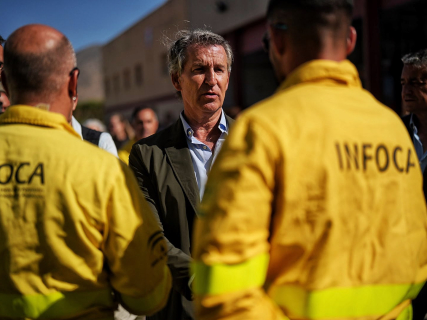
Sánchez and Feijóo agree to demand major agreements against fires after the Los Gallardos tragedy

Sánchez and Feijóo demand agreements with an eye on the fires but with their own reading of the situation: the head of the Executive recovers his State pact against the climate emergency and the leader of the opposition defends a great agreement for prevention, coordination, and response to natural risks.

5 minutes

a2d91031 cf9f 4d99 9483 1bc24d6ba3e6

a2d91031 cf9f 4d99 9483 1bc24d6ba3e6

Add DEMÓCRATA to Google

Ask FREN

Published

Last updated

5 minutes

Most read

The tragedy caused by the forest fire in Los Gallardos (Almería), which has left at least 13 dead and several seriously injured, has triggered similar reactions this Monday from the President of the Government, Pedro Sánchez, and the leader of the Popular Party, Alberto Núñez Feijóo, albeit with their own particular interpretation on how to tackle future fires of this magnitude.

From the Advanced Command Post set up in Turre, Sánchez has revived his grand State pact against the climate emergency, while, hours later, Feijóo has defended the need for a grand national agreement for prevention, coordination, and response to natural risks.

The day saw long-awaited news since Thursday, when the forest fire in Los Gallardos broke out. The President of the Junta de Andalucía, Juanma Moreno, announced this afternoon from the Advanced Command Post that the fire has been officially brought under control.

This is a decisive step in the evolution of the fire, which had already been stabilized during Sunday and which has mobilized an extensive Infoca Plan device for five days, supported by state resources and numerous emergency personnel.

Sánchez calls for a grand State pact against the climate emergency

Hours before Moreno's announcement, Pedro Sánchez visited Turre to meet with operational managers and the mayors of the affected municipalities.

During his appearance, the President of the Government reiterated his defense of the need to reach a grand State pact against the climate emergency, insisting that prevention must become a permanent priority and not be limited to acting only when a catastrophe has already occurred.

Sánchez recalled that approximately one-third of all the surface area burned last year in Europe was concentrated in Spain, a figure he attributed to the worsening climate emergency that particularly affects the Iberian Peninsula.

In this context, he explained that the Executive has already put forward a proposal to articulate a national agreement to strengthen preventive policies through actions such as the creation of security perimeters in municipalities, the promotion of training programs for young people on civil protection, or the strengthening of a culture of fire prevention.

"From the General Administration of the State we are promoting a good part of those measures linked to that State pact", he assured. The president also insisted that climate change no longer constitutes a future scenario but a reality with direct consequences on the population.

"The climate emergency kills, we are seeing it throughout Europe, we are also seeing it in Spain and, consequently, all administrations and society as a whole must rise to the challenge ahead."

Condolences to the victims

On another note, Sánchez highlighted the institutional coordination developed during the emergency and assured that the Government has provided all the means requested by the Junta de Andalucía to combat the fire.

At the same time, he warned that Spain faces a particularly complicated summer in terms of forest fires, although he recalled that the Executive reinforced the state device before the start of the summer campaign through the Plan for Combating Fires presented last May at the Torrejón de Ardoz air base.

The head of the Executive concluded his speech by extending his condolences to the families of the thirteen fatal victims and wishing a speedy recovery to the seriously injured. He also recalled that among the deceased are British and Belgian citizens fully integrated into the towns where they resided.

Feijóo proposes a major national agreement on natural risks

Also from Los Gallardos, the president of the Popular Party, Alberto Núñez Feijóo, for his part, raised the need to reach a major national agreement on prevention, coordination, and response to natural risks.

The leader of the opposition defended in a joint statement with Juanma Moreno that said pact must serve to guarantee "safe towns and living mountains" through a stable strategy that clearly defines the competencies of each administration, the available resources, and multi-year budgetary planning.

"Spain cannot continue without a major agreement where the General Administration of the State leads that impulse, presents a proposal, and we all work with the interest of getting it right", he stated.

As he explained, that pact should include the participation of autonomous communities, city councils, scientists specialized in fires, forestry technicians, and also those who live in rural areas and directly know the management of the territory.

In this regard, Feijóo referred to the situation of extensive livestock farming and defended listening to professionals who warn of the difficulties in carrying out preventive cleaning and brush-clearing tasks due to, as he pointed out, certain restrictive regulations.

Call to maintain institutional coordination

Like Sánchez, the president of the PP wanted to highlight the joint functioning of the different administrations during the emergency. "Let no one spoil it", he asked, considering that collaboration between administrations has been one of the key factors during the management of the fire.

Feijóo also acknowledged that he is not optimistic about the rest of the summer campaign. In his opinion, the abundant rains recorded during the spring have left a huge amount of vegetation that now constitutes fuel for possible fires.

Therefore, he described this summer as a "maximum risk" season and appealed to citizen responsibility to follow the instructions of Civil Protection, take extreme precautions, and collaborate with the Security Forces and Corps in the face of any suspicious behavior.

The popular leader also conveyed his solidarity to the families of the thirteen victims, expressed his support for the injured who remain hospitalized, and thanked the work carried out by all the professionals who participated in extinguishing the fire.

Juanma Moreno declares the fire concluded

"The fire is now technically considered under control." Thus began Juanma Moreno's press conference this afternoon. The president of the Junta de Andalucía explained that the fire no longer represents an active threat, although a brigade will remain in the area carrying out surveillance and cooling tasks to prevent possible reactivations.

The Andalusian president also highlighted that the meteorological evolution favors extinction work thanks to the expected increase in relative humidity, which could reach 90% in the coming hours.

Despite this improvement, authorities are keeping the investigation open to determine the origin of the fire and continue to assess the enormous environmental, material, and human damage caused by one of the worst fires recorded in Andalusia in recent years.

More key points, information and questions with FREN

AI-GENERATED CONTENT

What parliamentary procedures would be necessary to achieve a grand state pact against the climate emergency in Spain?

A grand state pact against the climate emergency is not a unique legal figure but a set of political and regulatory decisions articulated through various parliamentary procedures. In practice, it would combine study instruments (commissions and subcommissions), political impetus tools (declarations and non-legislative motions), and, above all, formal legislation (government bills or parliamentary bills). Below is a detailed procedural outline of how it could be structured in the Congress and the Senate.

1. Preliminary phase of diagnosis and consensus building

Before reaching a formal law or agreement, it is common to open a structured dialogue space:

  • Creation of a specific commission or subcommission: within the competent committee on environment or energy, a subcommission or study panel on the climate emergency can be created. Its function would be to gather testimonies from experts, administrations, economic sectors, and civil society, and to prepare a conclusions report.
  • Government hearings: the competent ministers (ecological transition, economy, industry, transport, agriculture, etc.) would undergo monographic hearings to present diagnoses and plans that serve as the basis for the future pact.
  • Consensus report: the subcommission or panel would close its work with a report voted on in committee, setting common objectives (time horizon, emission reduction targets, criteria for a just transition, etc.). This report guides the text of the future law or political agreement.

2. Political coverage instruments for the pact

In parallel or as an intermediate step, non-regulatory instruments could be used to visualize the consensus:

  • Institutional declaration: in the Congress or Senate, an institutional declaration on the climate emergency requires unanimity of the Board and spokespersons. It does not create legal obligations but establishes a solemn and shared political commitment.
  • Non-legislative motions (PNL): according to available information, PNLs are impetus initiatives without the force of law, debated in Plenary or committee. A PNL agreed by a very broad majority can set the main lines of the pact (objectives, timetable, commission to draft a framework law, etc.).
  • Resolutions in general debates: for example, in a general policy debate or on the state of the nation, groups can agree on climate resolutions that mandate the Government to present a broad legislative initiative.

3. Processing of the framework law of the climate pact

3.1. Choice of route: government bill or parliamentary bill

The core of the state pact is usually materialized in a framework law (climate or ecological transition), which can reach the Cortes in two ways, according to the figures described in the sources:

  • Government bill: approved in the Council of Ministers and sent to Congress. This route strengthens the Executive's leadership and allows more intense coordination with economic and budgetary planning.
  • Parliamentary bill: promoted by one or more parliamentary groups representing the broad spectrum of the pact. It follows a very similar procedure but does not originate from the Government.

The sources remind that the Government can oppose the processing of parliamentary bills that imply an increase in expenditure or a reduction in budget revenues, due to their impact on the Budgets. In a climate state pact, with strong budgetary implications, this limit makes coordinating the text with the Executive especially relevant.

3.2. Phases in Congress

According to the general scheme of bills in Spain, the processing would include:

  • Qualification and admission for processing by the Board of Congress.
  • Opening of the amendment period, both for the entirety and for the articles.
  • Plenary debate on the entirety, where the text could be rejected or returned to the Government (in case of a bill) if there is insufficient consensus.
  • Work in committee: discussion and voting on partial amendments, preparation of the report, and, if applicable, coordination with the subcommission or panel that prepared the consensus report.
  • Final debate and vote in Plenary, including amendments maintained by the groups ("live" amendments).
3.3. Processing in the Senate and return to Congress

Once the text is approved in Congress, it is sent to the Senate, which can:

  • Approve it without changes, making the law ready for sanction and promulgation.
  • Amend it or veto it, returning it to Congress, which can accept the amendments or lift the veto with the required majorities.

The goal, in a state pact, would be to also achieve a very broad majority in the Senate to reinforce the stability of the norm over time.

4. Monitoring and updating the pact

Finally, the pact could be completed with:

  • Periodic review clauses in the law itself, obliging the submission to Parliament of evaluation reports and proposals for updating climate objectives.
  • Annual Government hearings to report on the fulfillment of the pact.
  • New PNLs or resolutions that adjust the political orientation without the need to constantly reform the basic law.

With this set of procedures — study, broad political declarations, and a framework law processed with a vocation for stability — a true state pact against the climate emergency would be articulated in parliamentary terms.

What minimum content should that hypothetical climate framework law have for the state pact to be effective in the long term? What role could the autonomous communities and their parliaments play in a climate state pact articulated from the General Courts? How could it be guaranteed that future governments respect and do not undo the state pact against the climate emergency?

What are the specific competencies of the President of the Government regarding the prevention and management of forest fires according to Spanish legislation?

The competencies of the President of the Government in forest fires do not generally appear as direct operational functions but as powers of political direction and activation of the instruments that legislation assigns to the Government itself in civil protection and emergencies. Based on the Constitution, the Government Law, and the National Civil Protection System Law, the president sets the guidelines for prevention and emergency management policy, convenes and directs the Council of Ministers that adopts key measures (plans, declarations of disaster zones, royal decree-laws, etc.), and participates in the regime of exceptional states when fires reach the category of catastrophe. Sectoral regulations on forest fires and disasters are addressed to the "Government" or specific Ministries (Interior, Ecological Transition, Defense, etc.), and the president's specific role is the leadership and coordination of that set of decisions and resources. There are no provisions that grant him a singular operational command over firefighting services beyond his position as head of the Executive.

Constitutional framework and exceptional states

The Spanish Constitution establishes the general scheme: the Government directs internal and external policy and is accountable to Congress, and the president directs the Government's action (articles developed in Law 50/1997). In extreme situations, Organic Law 4/1981 on states of alarm, exception, and siege, Organic Law 4/1981, allows the Government to declare a state of alarm "in all or part of the national territory" in the face of disasters, expressly including "urban and forest fires."

According to this law, the state of alarm is declared by decree of the Council of Ministers, which is a collegiate body convened and presided over by the president (this is detailed in the Government Law). Although the law does not detail the individual role of the president, in practice he is the one who politically drives this declaration, directs the Government during its validity, and reports to Congress on the management of the emergency.

General functions of the president according to the Government Law

The Law 50/1997, of the Government, is key to understanding the transversal competencies of the president applicable to forest fires:

  • Direction of the Government's action and coordination of ministers (art. 2.1 and 3.1). This includes civil protection policy, environment, and emergency management, although forest fires are not expressly mentioned.
  • Determination of the guidelines of internal policy and ensuring their compliance (art. 3.2.b), which covers risk prevention strategies, emergency planning, and use of state resources (UME, Security Forces and Corps, etc.).
  • Convening and presiding over the Council of Ministers (art. 3.2.g), a body that, according to the law itself, approves royal decree-laws, regulations, and "binding programs, plans, and guidelines" (art. 5.1), competencies commonly used to approve urgent norms and measures in the face of large fires.

These competencies are not specific to forest fires but are the legal basis that places the president as the ultimate responsible for the state policy of prevention and response to these emergencies.

Government and civil protection in Law 17/2015

Law 17/2015, of the National Civil Protection System, regulates civil protection in detail and expressly mentions the competencies of the "Government" (collegiate body) in this area. Among them are:

  • Regulating the National Information Network and the Civil Protection Alert Network.
  • Approving the Basic Civil Protection Standard and the State General Civil Protection Plan.
  • Approving special plans of state scope, including those for forest fires.
  • Declaring a zone severely affected by a civil protection emergency, a common figure after large fires, with the associated package of aid and fiscal and labor measures (articles on declaration and measures, from which part of the wording has been extracted).
  • Approving the intervention protocol of the Military Emergency Unit.

Formally, these are competencies of the Government as a whole, but, according to Law 50/1997, the president directs that action, sets political priorities, convenes and presides over the Council of Ministers where these decisions are made, and coordinates the sectoral heads (Interior, Defense, Ecological Transition, etc.).

Specific regulations on fires and state plans

Besides the civil protection framework law, there are specific provisions on fires and disasters, such as Royal Decree-law 15/2022 on forest fires, RDL 15/2022, laws on aid after disasters (for example, Law 14/2012 and Law 3/2010), or the State Civil Protection Plan for Forest Fire Emergencies approved by Council of Ministers Agreement published by resolution in 2014 (State Forest Fire Plan), which is supported by the basic forest fire directive approved by Royal Decree 893/2013.

In these regulations, operational and management functions are assigned to the Government as a whole, the Ministry of Interior, and other departments, not singularly to the president. His role again derives from his function as head of Government, who approves these norms and plans and assumes political responsibility for their execution.

Civil protection in the Executive structure

The organic structure in civil protection matters (general plans, basic guidelines, Ministry of Interior structure, etc.) is developed in various regulations such as the State General Emergency Plan published in 2020 (State General Emergency Plan) or basic risk guidelines for specific emergencies (aviation emergencies, tsunamis). The UME has also been regulated (UME Order) as well as the Ministry of Interior structures (RD 146/2021, RD 561/2017), or general measures against disasters (RDL 11/2019).

In all of them, the Presidency of the Government exercises general political direction: sets priorities, promotes or halts reforms, decides together with the rest of the Council the approval of plans and measures, and coordinates the Executive's response to large forest fires, but operational and technical details fall to the competent ministries. No further information in the consulted sources attributes additional specific powers to the president beyond this general leadership of the Government in forest fire prevention and management.

What exactly does the declaration of a “zone severely affected by a civil protection emergency” consist of in the case of large forest fires? What specific competencies does the Minister of Interior have compared to the President of the Government in the management of forest fires according to Law 17/2015? How is the role of the Military Emergency Unit articulated in forest fires within the framework of Law 17/2015 and other cited regulations?

What results did the Popular Party obtain in the last general elections in the province of Almería?

In the province of Almería, the "last general elections" refer to the elections to the Congress of Deputies on July 23, 2023 (23J). In that call, the Popular Party (PP) was the most voted force in the Almerian constituency, with approximately 41.05% of the votes, which meant about 130,279 votes and the obtaining of 3 of the 6 seats at stake for the Congress from the province. The PP thus improved its representation compared to 2019, when it had 2 deputies for Almería.

Reference election

After July 2023, the next major events in Andalusia and Almería appearing in the sources are of an autonomous nature (Andalusian Parliament elections of 2026), not general. Therefore, when asked today about the PP results in the "last general elections" in Almería, the correct reference is the Congress elections of 23J 2023, not the autonomous ones.

The Andalusian elections of 2026, held on May 17, affect the Parliament of Andalusia, not the Congress. In them, the PP again won in the province of Almería with 6 of the 12 autonomous seats, according to the provincial distribution described in result chronicles and post-electoral analyses, such as the one detailing the distribution of Andalusian deputies by province in media articles like Antena 3 Noticias (2026 Andalusian results in Almería). But that information corresponds to autonomous elections and does not alter the 2023 general data.

PP results in Almería in the 23J 2023 general elections

In the 2023 general elections, with the provincial constituency of Almería electing 6 deputies to Congress, the PP obtained the results summarized in the following table, based on data disseminated by media and official result aggregators such as RTVE (RTVE results Almería 23J) and other provincial breakdowns like those from ABC Almería or laSexta:

  • Voting date: July 23, 2023.
  • Scope: General elections to the Congress of Deputies.
  • Province: Almería (6 seats at stake).
Specific details of the Popular Party
  • Votes obtained: around 130,279 ballots for Congress.
  • Vote percentage: about 41.05% of the total valid votes cast in the constituency.
  • Seats won: 3 deputies (of the 6 allocated to Almería).
  • Relative position: first force in the province.

In the seat distribution by parties, various sources agree that the PP was ahead of PSOE and Vox. For example, general media breakdowns (COPE, RTVE, ABC, laSexta) reflect a very stable distribution: the PP takes 3 seats, followed by PSOE with 2 and Vox with 1, confirming that the center-right vote was very notably concentrated in the popular candidacy in Almería. You can check the national context and seat translation of these results in interactive summaries from RTVE and other aggregators, such as those showing the general results map by constituencies (RTVE map, La Vanguardia special).

Comparison and political context

The data show that the PP improves its representation compared to the previous cycle: it goes from 2 to 3 deputies for Almería between 2019 and 2023, consolidating the province as one of the most favorable territories for the Popular Party within Andalusia in general elections. This strength in the general elections is also reflected in the 2022 and 2026 autonomous elections to the Andalusian Parliament, where the PP was also the first force in Almería, with a very relevant weight in the right-wing bloc, as chronicled in autonomous reports and historical Andalusian vote series (2022 autonomous in RTVE, 2026 analysis).

At the state level, the provincial result of Almería contributed to the overall PP seats in Congress arising from 23J, which various reference and synthesis pages like Wikipedia aggregate (series of general results). In a context of high parliamentary fragmentation and complex negotiations, constituencies like Almería, where the PP obtains percentages above 40% and leads the seat distribution, reinforce its role as one of the electoral strongholds of the right in the Spanish map.

Play

Test your knowledge with FREN!

How much do you know about this topic? Answer the following 3 questions.

What agreement has Pedro Sánchez proposed after the Los Gallardos fire?

Question 1 of 3

Who has officially confirmed that the Los Gallardos fire is under control?

Question 2 of 3

What reason has Feijóo given to consider summer as a season of maximum fire risk?

Question 3 of 3

Hola, soy Fren. ¿Cómo te ayudo?