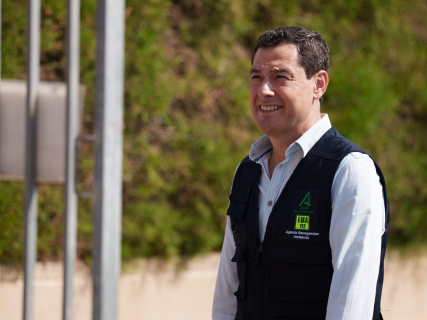
Juanma Moreno declares the Los Gallardos fire controlled after five days of intense fight against the flames

The Andalusian president confirms that the fire no longer poses a threat, although an Infoca brigade will remain in the area to prevent possible reactivations

2 minutes

EuropaPress 7661787 presidente junta andalucia juanma moreno visita puesto mando avanzado

EuropaPress 7661787 presidente junta andalucia juanma moreno visita puesto mando avanzado

Add DEMÓCRATA to Google

Ask FREN

Published

Last updated

2 minutes

Most read

The president of the Junta de Andalucía, Juanma Moreno, announced this Monday that the forest fire declared last Thursday in Los Gallardos (Almería) has been officially controlled, after five days of intense work by the extinction team.

The news represents significant progress in the evolution of the fire, which had already been stabilized on Sunday and has left a provisional death toll of at least 13 people, making it one of the most serious fires recorded in Andalusia in recent years.

"The fire no longer poses a threat"

Moreno made the announcement during a press conference from the Advanced Command Post, set up in the municipality of Turre, accompanied by the president of the Partido Popular, Alberto Núñez Feijóo, who traveled to the affected area this Monday.

The Andalusian president described the evolution of the fire as "good news" and explained that the operational technicians now consider the fire to be under control.

"Technically, the fire is now considered controlled", Moreno stated.

However, he specified that a brigade from the Infoca Plan will remain on the ground carrying out surveillance and cooling tasks, with the aim of preventing possible flare-ups.

Improved weather favors extinction

As explained by the president of the Junta, the meteorological conditions forecast for the coming hours are favorable, especially due to the notable increase in relative humidity.

Moreno indicated that humidity could reach 90%, a circumstance that will facilitate the cooling of the terrain and considerably reduce the risk of the flames spreading again.

"The fire no longer poses a threat as such", he assured.

Five days of fighting one of the worst fires of the year

The fire broke out last Thursday in the municipality of Los Gallardos, forcing the deployment of a large operation from the Infoca Plan, with ground and air resources that worked uninterruptedly to contain the spread of the fire.

Although the fire is now under control, the extinction teams will continue over the next few days inspecting the affected perimeter to ensure that no new outbreaks occur.

The authorities maintain the investigation open to clarify the origin of the fire, while the priority now is to completely secure the area and evaluate the personal, environmental, and material damages caused by one of the most devastating episodes of the summer in Andalusia.

More key points, information and questions with FREN

AI-GENERATED CONTENT

What is the legal process to officially declare a forest fire controlled in Andalusia?

In Andalusia, a forest fire is officially declared controlled when, according to the INFOCA Plan, its entire perimeter is surrounded by a control line and the Technical Extinction Directorate formally decides to “declare the fire controlled.” This process is embedded in the Andalusian civil protection legal framework (Law 2/2002 and its amendment by Law 2/2023) and in the Andalusian Forest Fire Emergency Plan, approved by Decree 371/2010. The declaration is essentially a technical decision, made by the single extinction command on the ground and communicated to the coordination chain (COP, CECEM‑112/CECOP), within the competential framework set by these regulations.

Basic legal framework in Andalusia

The legal scaffolding of the process rests on several regional regulations:

  • Law 2/2002, on Emergency Management in Andalusia, which organizes the Andalusian civil protection and emergency system and defines planning and coordination centers (text of Law 2/2002).
  • Law 2/2023, which amends Law 2/2002 regarding fire prevention and extinction and rescue services (amendment of Law 2/2002).
  • Decree-law 2/2023, on emergency and forest fire measures, which creates the Agency for Security and Comprehensive Emergency Management and strengthens the competential unification of the INFOCA device and provincial COPs (Decree-law 2/2023).
  • Decree 371/2010, which approves the Andalusian Forest Fire Emergency Plan (INFOCA Plan) and defines operational organization, fire classification, and the role of the Technical Extinction Directorate (INFOCA Plan 2010).
  • Decree 160/2016, which modifies the INFOCA Plan, mainly in zoning and local plan obligations, without altering the basic fire direction and control scheme (modification of the INFOCA Plan).

Additionally, Law 2/2002 assigns civil protection competences to the Andalusian Government and municipalities and defines the role of the Andalusian Emergency Coordination Center (112‑CECAM/CECOP) and operational centers as basic emergency management elements.

Legal definition of “controlled fire”

The INFOCA Plan, annexed to Decree 371/2010, explicitly defines a controlled fire as:

“A fire in which the entire perimeter is surrounded by a control line, formed by a strip of land without vegetation or with already burned vegetation, possibly leaving some ignition points inside.”

It is differentiated from:

  • Incipient fire or initial attack fire.
  • Extinguished fire: when no materials remain ignited within the perimeter and fire reproduction is not possible.

Who decides that the fire is controlled

The INFOCA Plan details the command structure and states that the Technical Extinction Directorate is the professional with specific training in fire behavior and extinction techniques, responsible for extinction and recognized as an authority agent.

Among its functions, the Plan explicitly includes:

  • Evaluating the fire’s evolution and severity.
  • Defining the attack plan and directing extinction actions.
  • Establishing the Forest Fire Analysis Post (PAIF) and the Waiting Area.
  • “Declaring the fire controlled.”
  • “Declaring the fire extinguished.”

That is, the formal competence to declare a fire controlled lies with the Technical Extinction Directorate, which acts as the single extinction command on the ground within the Forest Fire Emergency Management System (SMEIF).

Operational process and phases until the controlled declaration

1. Activation and fire classification

According to the INFOCA Plan, the following schematic steps are followed:

  • Receipt of the alert at CECEM‑112 or Provincial Operational Centers (COP).
  • Initial fire classification according to:
    • Potential severity levels (0, 1, 2, 3), depending on whether it affects people and non-forest assets and if state resources are required.
    • Evolution degrees (A to E) based on virulence, need for additional resources, and operational complexity.
  • Deployment of the INFOCA Intervention Group and establishment of the Advanced Command Post (PMA), where technical direction of the emergency and extinction is exercised.
2. Extinction direction and single command

For level 0 fires, the PMA may be reduced to the PAIF, led by the first commander arriving at the fire, who assumes the Technical Extinction Directorate. If severity increases (levels 1 and 2), command structure and coordination with civil protection are reinforced, but fire extinction remains under the Technical Extinction Directorate as the sole responsible.

3. Criteria and act of declaring a fire controlled

Once attack maneuvers and perimeter anchoring have been executed, and when:

  • The entire fire perimeter is surrounded by a control line (without vegetation or already burned).
  • Only residual ignition points remain inside the perimeter, without reasonable capacity to escape the control line under foreseeable conditions.

the Technical Extinction Directorate performs the final evaluation and, if these requirements are met, decides to declare the fire controlled. This decision:

  • Is communicated to the COP and CECOP (112‑Andalusia), within the Plan’s information procedures.
  • Does not mark the end of the emergency but the transition to a phase of liquidation, finishing, and monitoring until the subsequent “extinguished” declaration.

No further information is available in the consulted sources about the internal format (minutes, forms) of this declaration, but normatively it is clear that it is a technical act by the extinction command, framed within Andalusia’s civil protection and emergency system defined by Law 2/2002, Decree-law 2/2023, and the INFOCA Plan.

What are the legal and operational differences between declaring a forest fire stabilized, controlled, and extinguished in Andalusia? What role do municipalities and their local emergency plans play when INFOCA declares a forest fire at level 1 or 2? How has forest fire management in Andalusia changed after the creation of the Agency for Security and Comprehensive Emergency Management in 2023?

What powers does the President of the Andalusian Government have in managing forest fire emergencies?

The President of the Andalusian Government does not operationally direct forest fires but does concentrate the political and high-level management powers in civil protection matters: he leads the Andalusian emergency system, promotes and approves planning (including the INFOCA Plan), coordinates his Government, and is the institutional reference before the State when an emergency exceeds regional capacity. These functions are supported by Andalusia’s exclusive competence in civil protection recognized in the Statute and regional emergency management legislation. In major forest fires, his role is key to activating and reinforcing the device, ensuring the principle of single command, mobilizing extraordinary resources, and requesting state aid. Below is a detailed legal structure of this set of powers.

Basic legal framework of competences

The core of Andalusian competences in civil protection lies in the Statute of Autonomy, amended by Organic Law 2/2007, of March 19 (Statute of Andalusia). It establishes that the Autonomous Community has exclusive competence in civil protection, which includes:

  • Regulation, planning, and execution of measures related to emergencies and civil safety.
  • Direction and coordination of civil protection services, including fire prevention and extinction.

Although the Statute refers to the Autonomous Community and not specifically to the president, in practice these powers are exercised through the Government Council and its president as the highest authority of the Andalusian executive.

At the state level, Law 17/2015, of July 9, on the National Civil Protection System (Law 17/2015) defines the general system and regulates, among other issues, national interest emergencies and the possibility for autonomous communities to request their declaration when the fire’s scale requires national direction and resources.

INFOCA Plan and Andalusian fire planning

In Andalusia, the specific instrument against forest fires is the Andalusian Forest Fire Emergency Plan (INFOCA Plan), approved by Decree 371/2010, of September 14 (Decree 371/2010) and later amended by Decree 160/2016, of October 4 (Decree 160/2016).

Decree 371/2010 is issued by the Government Council and signed by the President of the Andalusian Government, reflecting two relevant presidential competences:

  • Promotion and approval of special civil protection planning (INFOCA), through the Government Council he presides over.
  • Ultimate political responsibility for the organization and intervention procedures in forest fires, which the Plan sets for all Andalusian Government means and services.

Additionally, Law 2/2002 on Emergency Management in Andalusia (amended by Law 2/2023, of March 15, Law 2/2023) structures the Andalusian emergency system, including fire prevention and extinction, under regional direction and coordination. The 2023 reform specifically strengthens the regime of prevention and extinction services, over which the Andalusian Government—and thus its president—exercises ordering and homogenization capacity.

Decree-law 2/2023 and creation of the Emergency Agency

Decree-law 2/2023, of April 11 (Decree-law 2/2023), approved by the Government Council and ratified by the Andalusian Parliament (ratification agreement), takes a further step:

  • Regroups emergency and forest fire competences into a single regional structure.
  • Authorizes the creation of the Agency for Security and Comprehensive Emergency Management of Andalusia, which will integrate the INFOCA operative as a comprehensive natural environment emergency fighting device.
  • Emphasizes the principle of single command in civil protection emergencies and the need for a unique direction and comprehensive management system.

Although the Decree-law mainly specifies the administrative architecture (competent ministry, future agency, INFOCA integration), as a Government Council decree-law it again places the president as the highest responsible for defining the model, approving it urgently, and politically answering for its effectiveness during major fire episodes.

Relationship with the State and national interest emergencies

Law 17/2015 foresees that certain emergencies, due to their scale or affecting multiple autonomous communities, are declared of national interest. In such cases:

  • The declaration corresponds to the Minister of the Interior, but can be made at the request of autonomous communities, through their competent authorities.
  • Once declared a national interest emergency, direction passes to the state level, integrating regional coordination bodies into the National Civil Protection Emergency Monitoring and Coordination Center.

In practice, when a forest fire in Andalusia reaches that magnitude, it is the President of the Andalusian Government—directly or through the competent minister—who leads the dialogue with the central Government to:

  • Request support of state resources (for example, reinforced deployment of the Military Emergency Unit, whose organization is regulated in Order DEF/160/2019, UME).
  • Propose, if appropriate, the convenience of the national interest emergency declaration.

Coherence with state planning

The Andalusian forest fire system coordinates with state planning included in the State Civil Protection Plan for Forest Fire Emergencies (state fire plan) and in the Basic Emergency Planning Guideline for Forest Fires approved by Royal Decree 893/2013 (RD 893/2013), partially amended by the Basic Civil Protection Standard (Royal Decree 524/2023, of June 20, Basic Standard).

Strategic documents such as the 2019 National Civil Protection Strategy (Strategy 2019) and its 2024 update (Strategy 2024) reinforce the idea that autonomous communities, and thus their presidents, must integrate forest fire fighting into a global vision of climate risk, national security, and protection of people and assets.

In summary, the President of the Andalusian Government exercises in forest fires a function of political direction, planning approval, inter-administrative coordination, and request for state aid, while daily operational direction is concentrated in the competent ministry, the INFOCA device, and the future Agency for Security and Comprehensive Emergency Management.

Which other autonomous communities have recorded severe forest fires in recent years and what measures have they adopted?

In recent years, besides Andalusia, the communities that have recorded the most severe forest fires are Galicia, Castilla y León, Valencian Community, Catalonia, Castilla-La Mancha, Extremadura, Asturias, Cantabria, Madrid, and the Balearic Islands. National data place Galicia, Castilla y León, Asturias, and parts of Cantabria as those accumulating the most incidents, while in terms of burned area, Andalusia, Castilla-La Mancha, Extremadura, and the Valencian Community also stand out, as explained by Demócrata. Following these crises, the autonomous communities have mainly reinforced preventive forest management, extinction devices, and coordination with the State and the UME. Below is a summary of the most relevant cases and measures.

Communities with the most severe fires

According to the Ministry for Ecological Transition and the European EFFIS system, 2025 was one of the worst years in the recent series, with over 350,000 hectares burned, especially in Galicia, Castilla y León, Andalusia, and the Valencian Community, as reported by analyses cited by EcoAvant and Europa Press, and summarized by [link]. In 2026, Spain accounted for nearly 40% of the burned area in the EU in the first semester, according to the fire map published by Demócrata (fire map).

Statistics from the Directorate General of Civil Protection indicate that in 2024 there were almost 5,000 fires and 17 large fires over 500 hectares (Interior note 2024), with numerous activations of regional plans, almost half in the Valencian Community.

Most notable regional measures

Andalusia

Andalusia is one of the communities with the most affected area, with large fires in Huelva and, in 2026, the devastating Los Gallardos fire (Almería), already stabilized after burning about 6,600 hectares and causing 12 deaths, the deadliest forest fire of the 21st century in Spain, according to several Demócrata reports (Los Gallardos fire, fire evolution, [link], official mourning). The regional government has reinforced the INFOCA Plan, with historic budgets (around 271–257 million euros, according to investment ranking and INFOCA report) and has approved a decree-law to promote controlled grazing as a tool to reduce vegetation fuel (grazing decree).

Galicia

Galicia historically concentrates a very high volume of fires; in a recent summer Copernicus recorded more than 171,000 hectares burned in the community (Copernicus Galicia report). The Xunta has reinforced the PLADIGA Plan with more aerial means and brigades (reinforcement of means, additional brigades, 121 brigades in A Coruña). Firebreaks, prescribed burns, and forest track improvements are also being expanded over about 34,000 hectares in 2026 (Verín‑Viana firebreaks), and a network of 177 surveillance cameras covering over 85% of Galician territory has been deployed (Xunta‑State coordination). Additionally, silvicultural aids co-financed by FEADER have been created for clearing, pruning, and other preventive tasks (legal analysis on forest clearing).

Castilla y León

Castilla y León suffered large fires in Zamora and León in 2025; Minister Suárez‑Quiñones explained in the regional parliament that a “profound transformation” of the operative is underway, with nearly doubled budget, annual fire plans, and implementation of the Infocal system (parliament debate, 2025 fire campaign briefing). Law 3/2009 on Forests requires approval of annual prevention, surveillance, and extinction plans; the regional government announced preventive silvicultural treatments worth 12.4 million euros in five provinces ([link]). Tables with agricultural organizations have also been promoted to optimize firebreaks and aid affected areas (Junta‑OPAs meeting).

Catalonia and Valencian Community

Catalonia experienced in 2026 a wave of fires in Les Gavarres and Anoia, with tens of thousands confined and municipalities in emergency (La Bisbal fire, Les Gavarres stabilized, massif closure, [link], confinements). The regional government responded with massive confinements, preventive closures of natural spaces, and a new sustainable forest management strategy to anticipate fires “beyond human extinction capacity” (Catalan strategy).

In the Valencian Community, severe fires such as Soneja‑Azuébar (Castellón) required activation of the Special Forest Fire Plan and UME request (UME request in Castellón). According to Interior, nearly half of regional civil protection activations for fires in 2024 were concentrated in this community (monitoring report).

Madrid, Asturias, Extremadura, Balearic Islands, and Cantabria

The Community of Madrid launched the “Madrid Forestal” program, mobilizing 160 million euros until 2030 to shield forests, with AI, sensors, drones, and biomass promotion (Madrid Forestal), and plans to exceed 5,000 hectares treated in 2026 through firebreaks, ditch work, and preventive grazing (prevention in Madrid).

The Principality of Asturias is preparing a new Forest Plan to strengthen prevention and has launched a rural infrastructure and prevention agreement with 18 million euros for 74 municipalities (Asturian forest plan), while Extremadura expands its device to 1,077 personnel and new work centers (Infoex reinforcement), in a context where NGOs like SEO/BirdLife call for a comprehensive plan against large fires (Extremadura plan request).

In the Balearic Islands, the government is using prescribed burns in S’Albufera and plans to expand them in Mallorca and Menorca, as well as incorporating a drone unit into its device (controlled burns, EU funds for 2025 fires). Cantabria, which in 2026 has already exceeded a thousand caused fires and 12,000 hectares burned, faces a “particularly dark” year, according to its Rural Development ministry (Cantabria crisis).

State framework and calls for more prevention

At the state level, the Government has approved a royal decree to set common guidelines for coordination, use of aerial means, and safety standards among administrations (state royal decree, developed in the Council of Ministers reference). Interior has advanced the state fire campaign to June 1 for the second consecutive year due to drought and high temperatures (2024 advance, 2026 advance, 2025 advance, Interior note), and President Sánchez has called for a “national pact” against the climate emergency in his campaign presentation (Sánchez intervention).

Organizations like Greenpeace emphasize that despite the reinforcement of extinction means, the key is stable investment in prevention and forest management, demanding at least 1 billion euros annually and evaluable regional plans (investment report, 2024 alert, 2026 call, post-fire management, [link]).

Could you detail the specific changes included in the new Andalusian decree on controlled grazing to prevent fires? What is the status of the new Asturias Forest Plan processing and what total budget will it mobilize against fires? According to the most recent data, which autonomous community currently invests the most per hectare in forest fire prevention and extinction?

Play

Test your knowledge with FREN!

How much do you know about this topic? Answer the following 3 questions.

Who officially announced the control of the Los Gallardos fire?

Question 1 of 3

How many days did the fight against the fire in Los Gallardos last until it was controlled?

Question 2 of 3

What is one of the main reasons why the extinguishing efforts improved according to Juanma Moreno?

Question 3 of 3

Hola, soy Fren. ¿Cómo te ayudo?