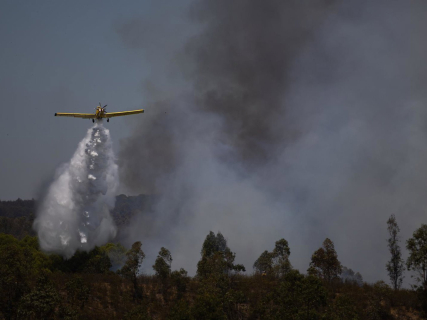

The counselor of the Presidency, Health and Emergencies and director of the Forest Fire Emergency Plan of Andalusia (Plan Infoca), Antonio Sanz, has pointed out that 70 people continue in preventive distancing due to the fire declared last Thursday in the Raboconejo area of Niebla (Huelva).
The emergency phase remains activated in operational situation 2, due to the "instability" of the fire, which has motivated the intervention of the Military Emergency Unit (UME).
At this moment, the Infoca Plan operation is made up of 10 aerial resources, 215 personnel, and 79 vehicles. To these resources are added 60 military personnel and 15 vehicles from the UME, according to what the first vice president of the Junta indicated in a publication on the social network 'X'.
From the UME, they have detailed that the contingent deployed in the area is carrying out anchoring and advance work with heavy machinery, in addition to reconnaissance tasks with drones over the areas affected by the flames.
The weather forecasts, particularly the changes in wind direction, the widening of the head of the fire, and its progression, have led to reinforcing the device with more resources and formally requesting the participation of the UME.
Sanz explained on the night of this Friday that "there have been different changes in the wind that have tremendously complicated" the evolution of the fire. The wind, which initially blew towards the west-southwest, later shifted to the northwest, leaving "few opportunities" to halt the advance.
According to what he has indicated, the evolution of the fire "remains complex," as "the northern area has had a rapid evolution, which has caused a widening of the fire and we are having few opportunity areas."
However, he pointed out that "the forecasts we had, like last night, of another change in the wind" are "starting to be fulfilled," which would be "the fourth radical change in the wind" and would direct the front towards the southeast, "which puts us back in another complexity."
Sanz emphasized that "the aggressiveness that it has had at the head of the fire, in the northern area, and the evolution of the perimeter" have made the situation remain "complex and difficult." Therefore, the Operations Committee and the Emergency Management have agreed to maintain the fire in operational situation 2, especially "due to the extent that the fire may reach and due to the forecasts of constant wind changes."