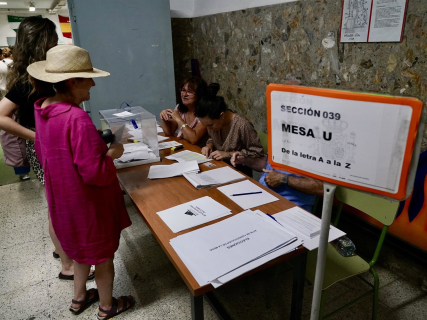

The Central Electoral Board (JEC) has confirmed this Thursday that the digital version of the National Identity Document cannot be used "for voter identification" in the elections to the Parliament of Andalusia scheduled for next May 17, considering that "the control of the verification of the identity of the electors" through this system is not "sufficiently secure".
The pronouncement appears in an agreement approved this Thursday, April 23, to which Europa Press has had access, in response to a query raised by the Andalusian Electoral Board (JEA) "regarding the impact on the suspension of the effectiveness of the 'MiDGT' and 'MiDNI' applications as a valid means of identification of voters for the elections to the Parliament of Andalusia" on May 17.
The JEC had already decided on March 26 to annul its previous resolutions that allowed the use of the digital ID card since September to identify oneself at the polls, and at the request of the PP, it agreed that said medium cannot be used in the Andalusian elections of May 17 until it is proven that the verification system is "sufficiently secure".
In the agreement of this April 23, the Central Electoral Board reaffirms that decision of March 26, 2026 "on the suspension of the effectiveness of its agreements by which the use of the applications 'MiDGT' and 'MiDNI' by voters at the time of casting their vote, in person or by mail" was permitted.
Thus, "as stated in the aforementioned agreement, said applications may not be used for voter identification, as long as it is not guaranteed that the control of the verification of the identity of voters by these systems is sufficiently secure, which does not occur in the elections to the Parliament of Andalusia called for next May 17," concludes the resolution of the JEC to the query formulated by the Andalusian Electoral Board.
From the Ministry of Health, Presidency and Emergencies of the Junta de Andalucía, they recalled in March that the JEC's decision also came "after the formal challenge and the allegations presented by the General Secretariat of the Interior of the Junta de Andalucía, dependent" on said department, which "questioned whether said document met the guarantees of electoral regulations for voter identification".
"With this resolution, the Board's request that voter identification be carried out exclusively through the physical documents expressly provided for by law is addressed," they stressed at the time from the Ministry of the Presidency, adding that "the Andalusian administration understands that, as long as there are no fully operational and accessible verification mechanisms, the use of digital media does not meet the guarantees required by electoral regulations."
The Junta de Andalucía "warned that the use of the digital version of the DNI lacked the necessary guarantees to ensure the integrity of the voting process, as the electoral administration does not currently have the technological means or the official applications necessary to verify the dynamic QR codes generated by the 'MiDNI' application, which prevents ensuring secure and complete communication".
The document sent by the Andalusian Executive "was based on the fact that Article 85.1 of the Organic Law of the General Electoral Regime requires identification by means of physical documents, such as the DNI or passport, which contain the holder's photograph".
Furthermore, "it pointed out that the polling stations lack the devices for real-time verification provided for in the system design".
Likewise, "the dependence on the 'MiDNI' application raised doubts in cases where adequate communication coverage could not be guaranteed, which would generate evident legal uncertainty and disparity of criteria among the different polling stations," stated the Andalusian government, demanding that the use of the digital DNI not be authorized as a valid document to identify voters on May 17.