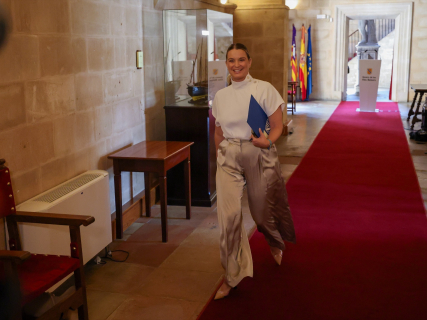

After more than two decades of claims, the people of Formentera are going to see one of their main desires fulfilled: to elect their own senator. The Senate debates and votes this Wednesday by a single reading on the proposal for Reform of section 3 of article 69 of the Spanish Constitution.
It is the fourth reform of the Magna Carta that will be approved since 1978 and the first time the Magna Carta is modified at the request of an Autonomous Community. The initiative faces its final parliamentary procedure and after receiving the green light from the Upper House it will be published in the BOE.
The text of the proposal, barely a line, will allow the island's citizens to choose their own representative independently of Ibiza. The initiative has not aroused great criticism and all phases of the debate have taken place in good terms.
As it passed through Congress in February, the norm achieved 176 votes in favor and only Vox voted against it, calling it a “unnecessary public expense”. The PP opted for abstention and claimed that the constitutional reform be strictly limited to this matter, as has happened.
It is also the first reform that modifies a matter linked to the territorial sphere. Previous processes have been aimed at expanding passive suffrage for foreigners (1992), safeguarding budgetary stability (2011), and replacing the term "disabled" with "people with disabilities" (2024).
For its modification, the Constitution itself provides for requirements that demand a minimum of consensus. To date, all reforms have been carried out with the agreement of the PP and PSOE. On occasion, these pacts of bipartisanship have been criticized by minority groups, as happened with the modification of art. 135 in the midst of the crisis and at the behest of the European Union.
On this occasion, the minority, nationalist, and independentist parties have celebrated the measure and only the party of Santiago Abascal has opposed it, being very critical also of the Chamber's decision to process the initiative by a single reading.
single reading
The processing by single reading is a parliamentary procedure that can be applied in both the Congress and the Senate when a legislative initiative, due to its simplicity or urgency, does not require the full development of the ordinary procedure.
In this case, the text is not sent to a committee, but is debated and voted on directly in the Plenary session, which significantly reduces processing times and concentrates the debate in a single session.
Parliamentary groups can intervene and present amendments, although these are discussed immediately in the Plenary session itself.
From Eivissa to Ibiza
This reform has been negotiated in the background, but it has also had some points of friction. The definitive support of the PP, which was somewhat reluctant in its consideration, was unblocked in Congress after the PSOE allowed an amendment to this reform to be approved so that the name Ibiza in Castilian is maintained in the Constitution and not Eivissa, as proposed by the Balearic Parliament. Vox had also focused on this issue and made it known in one of its amendments.
As the initiative itself foresees, the creation of the constituency of Formentera will have effects for the upcoming elections to the Senate, which would see its composition expanded to 267 parliamentarians. In this way, Formentera would become independent after almost fifty years from the electoral 'tandem' it currently forms with Ibiza.
CURRENT DISTRIBUTION
The current wording of Article 69 of the Constitution provides for the following distribution of senators until the 266 senators that make up the Upper House are reached:
- Each province elects 4 senators.
- The major islands (Gran Canaria, Mallorca, and Tenerife) elect 3 senators.
- Ceuta and Melilla elect 2 senators.
- The islands or groups of Ibiza-Formentera, Menorca, Fuerteventura, Gomera, Hierro, Lanzarote, and La Palma each elect 1 senator.
- The autonomous parliaments appoint 1 senator and one more for each million inhabitants of their respective territory.
Decades of waiting
The initiative was sent to Congress by the Balearic Islands in November 2018, however, it had not been included in the agenda until last February. In between, four legislatures (XII, XIII, XIV and XV) in which the proposal was "inherited", waiting for the Board of Spokespersons and the Bureau of Congress to put it on the agenda. But before reaching this point, the proposal has gone from institution to institution until it reached its destination.
-
2004, the Formentera City Council agrees unanimously to request that Formentera be able to elect its own senator and requests the modification of article 69.3 of the Constitution.
-
2009, the Plenary Session of the Senate approves unanimously to urge the Government to promote the necessary changes so that Formentera and Ibiza each elect their own senator.
-
2010, the Organic Regulations of the Consell Insular de Formentera (created in 2007) regulate the statute of a future Formentera senator in relation to the institution itself.
-
2010, the Plenary Session of the Consell Insular de Formentera resolved to request the Parliament of the Balearic Islands to either request a Bill from the Government for the modification of the LOREG so that the island of Formentera is established as an electoral constituency to elect a senator; or to send a Bill to the Table of the Congress with the same purpose.
-
2011, the Commission for Institutional and General Affairs of the Parliament of the Balearic Islands urges the Chamber to modify art. 69.3 of the Constitution.
-
2017, the Plenary Session of the Consell Insular de Formentera adopts as a resolution proposal in the annual debate on the state of the island to propose a legislative initiative to the Parliament of the Balearic Islands for a reform of the Constitution.
-
2018, the Balearic Parliament approves an initiative in this regard and sends it to Congress.
REFERENDUM?
After approval in the Plenary Session of the Upper House, a 15-day period will open to request that the reform be submitted to a referendum for its ratification.
The article subject to reform (69) does not affect the Preliminary Title, Chapter Two, Section One of Title I, or Title II, so we are dealing with an ordinary reform of the Constitution.
In this case, a consultation for its ratification is only possible if one-tenth of the members of either Chamber request it: 35 deputies or 26 senators.
Taking into account that only Vox has openly opposed the reform, and that Abascal's party has 33 deputies and 3 senators, there is no sign that this option will prosper.