The eclipse will be able to be seen in Madrid: these are the best points to observe it

Madrid capital will see the Sun practically covered, while the north of the Community will enter the totality zone. Buitrago del Lozoya will be the epicenter of the regional device and the City Council is also preparing observations from Barajas and Vicálvaro.

3 minutes

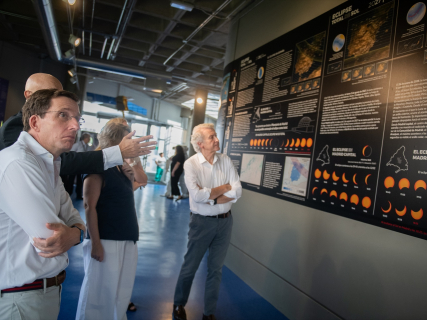
EuropaPress 7690751 alcalde madrid jose luis martinez almeida visita planetario madrid parque

EuropaPress 7690751 alcalde madrid jose luis martinez almeida visita planetario madrid parque

Add DEMÓCRATA to Google

Ask FREN

Published

Last updated

3 minutes

Most read

The total solar eclipse on the next August 12 will also be observable from Madrid, although with a fundamental difference depending on the chosen location. In the capital Madrid, it will technically be partial, while a part of the north of the Community will be within the totality band and will be able to experience the complete disappearance of the Sun for several seconds.

The phenomenon will begin in the region around 7:30 PM and will reach its maximum phase approximately at 8:32 PM, with the Sun already very low on the western horizon. The Community of Madrid has enabled 51 official observation points distributed throughout municipalities in the region.

Juan Carlos I Park: practically at the limit of totality

One of the options within the capital Madrid is the surroundings of Juan Carlos I Park, in Barajas. Its location, to the northeast of the city, places it very close to the limit of the totality band.

The calculations from Timeanddate for the park itself place the maximum at 8:32 PM and assign it a magnitude of 1.000, although they classify the phenomenon at that point still as a partial eclipse. That is to say, the Sun will be practically covered, but a phase of totality cannot be assured from the entire area.

The City Council has organized an official activity in the Barajas district called "An Astral Experience," which will be held between 8:00 PM and 9:00 PM at the Mirador de la Playa, on Playa de Barlovento street. There, glasses will be distributed for free to follow the eclipse.

Buitrago del Lozoya, 1 minute and 19 seconds of darkness

For those who want to experience the total eclipse without leaving the Community, the main point prepared by the regional Government will be Buitrago del Lozoya.

The town will enjoy approximately 1 minute and 19 seconds of totality and will host the Eclipse Festival in the Riosequillo recreational area, with educational activities, workshops, games, and music.

The northern area of Madrid is, in general, the zone that offers the best possibilities to observe the total phase. The band will cross the Community with an approximate duration of between 30 and 90 seconds, depending on the municipality.

The municipalities of Madrid within or close to totality

Among the municipalities included by the Community of Madrid in its official observation network are Somosierra, Buitrago del Lozoya, Rascafría, Lozoya, Canencia, Braojos, La Cabrera, Cabanillas de la Sierra, El Molar, San Agustín del Guadalix, Colmenar Viejo, Tres Cantos, and San Sebastián de los Reyes.

There are also points distributed in other places in the region such as Becerril de la Sierra, Navacerrada, Moralzarzal, Los Molinos, San Lorenzo de El Escorial, Robledo de Chavela, Brunete, Chinchón, or Navas del Rey. In total, the regional website currently lists 51 municipalities with observation points.

Not all of them will be within the totality. The points in the north allow for observing the complete eclipse, while in municipalities located further south, the obscuration will be partial.

The Community will also distribute approved glasses for free at the official points, until supplies run out.

Valdebernardo also organizes an observation in Madrid capital

Those who prefer not to leave the city have another official alternative in the Este Park of Valdebernardo, in Vicálvaro.

The City Council has scheduled the "Night of the Sun" there from 8:00 PM, with observation using appropriate glasses and live music.

The Planetarium of Madrid also maintains a special program dedicated to the so-called "trio of eclipses" until the same August 12, with educational activities, sessions, and recommendations to prepare for the observation. The City Council is distributing approved glasses at the Planetarium, museums, and municipal libraries until supplies run out.

The western horizon will be as important as the municipality

The IGN insists on a particularly relevant condition for this eclipse: it will not be enough to be within the appropriate strip. The phenomenon will occur at sunset and the Sun will be very low on the horizon.

In Madrid, the maximum will occur around 8:32 PM. Therefore, it will be necessary to choose a space with a clear view towards the west, without buildings, mountains, trees, or other obstacles that block the Sun during the last minutes.

This factor can make parks, open spaces, and viewpoints better options than certain elevated points with obstacles towards the west.

Precaution due to the risk of fires

The high expected influx coincides with a particularly delicate situation due to the wildfires this summer. The Forest Agents have requested to reduce unnecessary travel, use only designated parking areas, and not block access routes for emergency services.

It is also advisable to check on the same day if the chosen municipality is maintaining its activity, as some town halls are reviewing or canceling events due to the risk of fires.

To observe the Sun directly, it will be essential to use glasses approved according to the standard EN ISO 12312-2:2015. Sunglasses, X-rays, tinted lenses, and homemade filters do not provide sufficient protection.

More key points, information and questions with FREN

AI-GENERATED CONTENT

What are the legal requirements for organizing astronomical observation activities in public spaces in the Community of Madrid?

To organize astronomical observation activities in public spaces in the Community of Madrid (meetups with telescopes, open workshops, etc.) you must fit the event within the regulations on public shows and recreational activities, obtain the municipal authorization for occupation of public roads or use of open space when applicable, and have adequate civil liability insurance. The Community of Madrid sets the general framework through the Law 17/1997 on Public Shows, while the municipalities (and especially the Madrid City Council due to its capital city law) specify licenses, ordinances, and capacities. Additionally, you must comply with safety, noise, and environmental regulations (night noise, outdoor lighting, protection of sensitive environments) and, if the activity is massive or unique, additional civil protection measures may be required. Below I detail the key points differentiating the regional from the municipal.

1. Does it count as a “public show” or recreational activity?

Law 17/1997 applies to any show or recreational activity carried out in the Community of Madrid, whether for profit or not, and whether habitual or sporadic, as long as it is open to public attendance (art. 1). It includes cultural and leisure activities in open spaces, so an astronomical observation announced to the public (posters, social media, open registration, whether or not there is an entrance fee) fits within this regime.

Meeting in a very small and completely private way (small group, no public dissemination or charge, in a park and without setting up structures or effectively occupying an area) is closer to a “private activity” and falls outside the scope of Law 17/1997, but as soon as it is publicized and organized with a public vocation it is advisable to treat it as an organized recreational activity.

2. Municipal authorization and space occupation

Law 17/1997 itself distinguishes between premises and open spaces. For activities in open spaces:

  • Enabled open spaces: the law establishes that holding shows and recreational activities in “open spaces” requires prior municipal authorization, after hearing affected neighbors, and obliges delimiting the public area (article reproduced in the consulted text).
  • Public road: when the activity uses the public road (squares, streets, etc.) the law also requires specific municipal authorization, with the same requirement of civil liability insurance for damages to attendees and third parties.

Details (forms, deadlines, fees, capacity criteria) are set in the ordinances of each municipality. In the case of Madrid city, the Law 22/2006 on Capitality reinforces the City Council’s regulatory powers, which develops this matter in its mobility and urban environment ordinances (not appearing in the sources, so no further concrete details are available).

3. Civil liability insurance and other safety obligations

Law 17/1997 expressly establishes that:

  • Premises and establishments subject to the law must have fire and civil liability insurance for damages to attendees and third parties (art. 6.3).
  • For shows in open spaces and for the use of public roads, municipal authorization requires organizers to prove civil liability insurance for damages to attendees and third parties in the amount determined by regulation.

Additionally, it sets obligations on structural safety, risk prevention, healthiness, and nuisance to third parties (noise, accessibility, etc.). The sanctioning regime classifies not having the mandatory insurance as a serious infraction and holding shows without the required licenses or authorizations as a very serious infraction, with fines that can reach €600,000 (final articles of the law amended by Law 4/2013 and Law 5/2002).

Regarding emergencies, the Community relies on the Law 5/2023 on Civil Protection, the Territorial Civil Protection Plan (territorial plan) and sectoral plans such as the flood plan (INUNCAM), which are activated only in large concentration events.

4. Noise, schedules, and environment (including light)

Although astronomical observation is usually silent, since it is done at night and in public spaces noise regulations come into play. In the Community of Madrid, Decree 55/2012 refers to the basic state noise legislation, and municipalities can set maximum night levels and time restrictions. Law 17/1997 allows municipalities to adjust recreational activity schedules on a case-by-case basis.

Regarding air pollution and air quality, Law 34/2007 applies, complemented in Madrid by Law 2/2002 on Environmental Assessment (partially repealed) and regional plans such as the NO₂ protocol (NO₂ protocol). For outdoor lighting and energy efficiency, the state-level Royal Decree 1890/2008 applies. None of these regulations specifically govern astronomical observation, but they do condition lighting installations, generators, spotlights, etc.

In the broader urban and environmental planning sphere, Law 9/2001 on Land, Law 8/2005 on Urban Trees, the recent Law 7/2024 on environment and territorial planning, and sectoral protection rules for reservoirs and wetlands (Law 7/1990) or discharges (Law 10/1993) are relevant if the activity takes place in protected natural spaces.

5. Where there is more municipal discretion

Municipalities specify, through ordinances, crucial practical aspects:

  • Participant quotas and density of occupation of squares and parks.
  • Requirements for fencing, signage, presence of access control personnel, and basic self-protection plans (harmonized with the Basic Self-Protection Standard cited in Law 17/1997).
  • Compatibility with traffic and road safety (in coordination with the consolidated traffic text, Royal Legislative Decree 6/2015).

In Madrid city, this margin is exercised within the special framework of the Law 22/2006 on Capitality, but the specific ordinances do not appear in the sources, so “No further information is available in the consulted sources” about their technical details.

6. Practical recommendation

In practice, if you want to organize an astronomical observation open to the public in a Madrid municipality, the prudent approach is:

  • Contact the city council to process authorization for occupation of public road or open space, indicating date, schedule, exact location, estimated capacity, and whether there is an entrance fee.
  • Contract civil liability insurance and attach proof with the application.
  • Commit in writing to respect municipal noise and schedule limits, and not to install spotlights or other lighting elements contrary to lighting regulations.

If the activity is expected to be very large, crosses several municipalities, or has unique characteristics (for example, a large regional event), also consult with the Community of Madrid, because Law 17/1997 reserves to the Community the authorization of extraordinary, unique activities or those that exceed one municipality.

7. Other normative texts mentioned in the sources

The sources include many related or contextual regulations, linked for completeness though not all are directly applicable to an astronomical meetup, among them: Law 6/2024, Law 5/2015, Law 8/2012, Law 4/2012, Royal Decree 532/2025, STC 160/2019, question 5927‑2018, Royal Decree 653/2017, Royal Decree 1076/2012, STC 20/2024, Royal Decree 1057/2022, Royal Decree 1785/2011, Law 8/2024, Law 3/2008, STC 95/2025, STC 13/2021, exercise of sports professions, Decree 3/2021, Decree 56/2020, mobility plans such as Plan Mueve Madrid, public employment and local organization rules (Law 16/2000, Law 4/1997, Law 4/1989, Law 5/1989) and others of a more general nature such as Order ESS/763/2016, Royal Decree 30/2000, Order of July 30, 1987, Royal Decree 2099/1983 or Order of April 21, 1976, among many others cited in the documentary trail.

In which specific cases would I also need authorization from the Community of Madrid in addition to the city council for an astronomical activity? What civil liability insurance and capacity requirements does the Madrid City Council usually demand for small-scale recreational events? Is there any specific regulatory project on light pollution or night sky protection in the Community of Madrid?

What powers does the Madrid City Council have to regulate the use of parks and public spaces during special events?

The Madrid City Council has broad capacity to regulate the use of parks and public spaces during special events (concerts, parties, sports activities, etc.), but this capacity is framed by state, regional regulations and its own special capital regime. It can impose prior authorizations, set schedules, capacities, safety, noise, and cleaning conditions, as well as suspend or limit an event for reasons of public safety or environmental protection. These powers are exercised through municipal ordinances and specific administrative decisions, always respecting fundamental rights (assembly, demonstration) and basic state and regional regulations.

General framework of local powers

The basic regime of municipal powers is given by Law 7/1985, Regulating the Bases of Local Regime (Law 7/1985). Although the available excerpts do not show article details, this law configures the scope of municipalities’ powers and their capacity to approve ordinances on the use of municipal assets, including parks, gardens, and public roads.

Additionally, Madrid has a reinforced regime as the State capital through Law 22/2006, on Capitality and Special Regime of Madrid (Madrid Capitality Law). This norm stems from Madrid’s uniqueness due to its size and being the seat of state institutions and specifies that it needs a “special legal treatment that makes effective municipal government possible.” This special regime justifies greater organizational capacity and coordination with the State and Community of Madrid for large acts in public spaces.

Public safety and control of meetings and acts

Regarding public safety, the reference norm is Organic Law 4/2015, on the protection of public safety (LO 4/2015). Its preamble details the powers of authorities and Security Forces and Corps to:

  • Establish traffic restrictions and controls on public roads.
  • Evacuate premises or establishments and prohibit access or evacuate buildings “in emergency situations essential to guarantee public safety.”
  • Adopt measures to “protect the holding of meetings and demonstrations, as well as to restore normality in their development in cases of public safety disturbances.”

These powers are state-level, but the law expressly recognizes that the intervention regime in public shows and recreational activities is exercised “without prejudice to the powers of autonomous communities and local entities regarding their normal development.” That is, the Madrid City Council can condition or limit events in parks and squares for safety reasons, but coordinating with the Government Delegation and the Community when affecting public order or fundamental rights.

Noise, environment, and event conditions

Law 37/2003, on Noise (Noise Law), sets the basic framework for acoustic pollution. Its preamble indicates that state regulation serves as a “basic scheme” on which regional and local regulation is based. It introduces concepts such as:

  • Acoustic quality of a space, linked to the activities carried out in it.
  • Acoustic areas and noise maps, which must respect certain limit values.

Very relevant for special events, the law foresees “situations in which, exceptionally, it may be advisable to suspend the enforceability of acoustic quality objectives, on the occasion of certain events.” This enables administrations (including the Madrid City Council, in its scope) to authorize concerts or other acts in parks with noise levels higher than usual, but only exceptionally and under conditions.

This is added to sectoral regulations on accessibility in urbanized public spaces, such as Order TMA/851/2021 (Order on accessibility in public spaces), which conditions how temporary installations, stages, stands, etc., can be set up to guarantee universal access.

Public shows and recreational activities in Madrid

At the regional level, the key regulation is Law 17/1997, on Public Shows and Recreational Activities of the Community of Madrid (Law 17/1997). According to its preamble, chapter II “is dedicated to shows and activities held in temporary facilities, open spaces, and public roads requiring appropriate insurance for all.”

This means that for concerts, festivals, fairs, etc. in parks and squares of Madrid, the City Council acts applying this regional law and its regulatory developments: it requires insurance, analyzes safety conditions, can deny or condition authorizations and, if applicable, initiate sanctioning procedures when authorization conditions are breached or risks to people arise.

Special regime and heritage

Certain green spaces in Madrid have specific protection. For example, Casa de Campo is declared a Cultural Interest Asset by Decree 39/2010 (Casa de Campo BIC Decree). This heritage protection further limits what types of events can be held, their intensity, and their effects on the environment.

Limits and development by ordinances

The City Council completes this framework through its own ordinances (on coexistence, noise, cleaning, etc.), which specify schedules, capacities, authorization procedures, and sanctioning regimes for the use of parks and public spaces. The available information does not include these specific municipal ordinances, so no further detail on their specific content is available.

In summary, the Madrid City Council’s powers to regulate events in public spaces are based on Law 7/1985, the Capitality Law, Organic Law 4/2015, the Noise Law, and Law 17/1997 on shows, and are deployed through authorizations, technical and environmental conditions, security controls, and, if necessary, sanctions and suspension or eviction of events when required by public safety or environmental protection.

Which specific Madrid City Council ordinances currently regulate concerts and parties in parks and squares? How does the Madrid City Council coordinate with the Government Delegation to manage demonstrations in public spaces? What noise limits and schedules are usually applied to outdoor musical events in Madrid?

How many total solar eclipses have been visible from the Community of Madrid in the last century?

The question about how many total solar eclipses have been visible from the Community of Madrid in the last century is an astronomical and scientific question, not related to political, institutional, or social activity in a regulatory sense. Due to the design and scope of this assistant, specialized in politics and socio-political current affairs in Spain, I cannot provide a rigorous or updated answer about that specific astronomical phenomenon.

Thematic scope of this assistant

This assistant, FREN, is specifically oriented to issues related to:

  • Spanish politics at the state level: Government, General Courts (Congress and Senate), and major national debates.
  • Parliamentary activity: bill projects and proposals, royal decree-laws, government oversight, appearances, committees, votes, etc.
  • Executive activity: Council of Ministers agreements, strategic plans, public policies, approved regulations and norms.
  • Social and economic context linked to politics: labor, fiscal, energy, health, education reforms and others with normative or institutional reflection.
  • Political actors and organizations: parties, parliamentary groups, unions, and business organizations insofar as they relate to regulatory processes or political debates.
  • Political and social current affairs covered by specialized media, especially the newspaper Demócrata, which covers news on politics, parliament, and society in Spain.

When the question falls outside these areas—as is the case of a historical count of total solar eclipses visible from a specific region—I do not have the necessary information base to provide a reliable figure or detailed analysis.

Why I cannot answer your question precisely

Correctly answering how many total solar eclipses have been visible from the Community of Madrid in the last century requires:

  • Access to specialized astronomical catalogs that record all solar eclipses with their paths of totality and geographic visibility.
  • Technical verification whether the path of totality specifically passed over the territory corresponding to the Community of Madrid (not just Spain in general).
  • Precisely determining the time interval (for example, from 1926 to 2026) and verifying astronomical phenomena in that range.

Since my current configuration does not include such scientific databases or astronomical calculation tools, any figure I provided would be merely speculative and therefore inadequate and misleading. In line with the criterion of not inventing information or giving unverified data, I must limit myself to indicating that I cannot provide the number of total solar eclipses visible from Madrid in the last century.

What types of questions I can help you with

Although I cannot answer this astronomical question, I can be useful if the conversation is oriented towards political, institutional, or social aspects related (even tangentially) to science, climate, or astronomical observation. For example:

  • Spanish or European regulations on light pollution and its impact on night sky observation.
  • Parliamentary debates or initiatives on scientific policy, funding of research centers, or scientific outreach programs.
  • Government or autonomous community actions related to astronomical observatories or scientific infrastructures.
  • How the use of public space is regulated for large citizen observation events of astronomical phenomena, if they have been subject to institutional decisions or regulations.

I can also help you contextualize, from a political and social point of view, how natural or astronomical phenomena (such as eclipses, heat waves, extreme climatic events, etc.) have motivated debates in the Congress of Deputies or the Government, provided there is a trace of this in institutional activity or media coverage such as the newspaper Demócrata.

How to reformulate your question to fit the political scope

If you are interested in keeping the focus on eclipses or astronomical phenomena but within the political or regulatory field, you could ask questions such as:

  • Whether there have been parliamentary initiatives in Spain related to sky observation, promotion of astronomy, or protection of areas of special astronomical interest.
  • What role Spanish scientific policy plays in funding astronomical or astrophysics projects.
  • How large astronomical observation events that have mobilized citizens have been managed by public administrations.

In all these cases, I could offer detailed analyses, normative references, and political context.

What scientific policies has the Government of Spain promoted in recent years related to astronomy or space research? Have there been debates in the Congress of Deputies about light pollution and night sky protection in Spain? What type of public funding do astronomical observatories and astrophysics centers receive in Spain?

Play

Test your knowledge with FREN!

How much do you know about this topic? Answer the following 3 questions.

Where can the solar eclipse be observed as total within the Community of Madrid?

Question 1 of 3

What element is essential to safely observe the eclipse?

Question 2 of 3

What is the main recommendation from forest agents regarding the high influx due to the eclipse?

Question 3 of 3

Hola, soy Fren. ¿Cómo te ayudo?