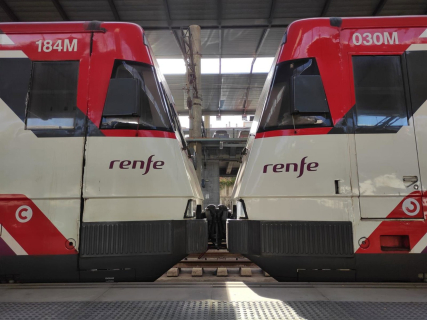
A worker dies and two others are injured in a workplace accident at the Renfe base in Villaverde

A worker from a subcontracted company has died and two others have been injured this Wednesday during maintenance work at the Renfe integral base in Villaverde, Madrid.

1 minute

fotonoticia 20260714132006 1920

fotonoticia 20260714132006 1920

Add DEMÓCRATA to Google

Ask FREN

Published

Last updated

1 minute

Most read

A worker has died and two others have been injured to varying degrees this Wednesday while performing maintenance work at the comprehensive maintenance base of Renfe located in the Madrid district of Villaverde.

The accident occurred during the morning shift and, according to the railway operator, the deceased belonged to a contracting company that provided services at the facilities.

More key points, information and questions with FREN

AI-GENERATED CONTENT

What is the status of the processing of Renfe's 2025-2030 Comprehensive Workshops and Maintenance Plan?

Renfe's 2025-2030 Comprehensive Workshops and Maintenance Plan is not in a classic normative “processing” phase (it is neither a law nor a plan approved by the Official State Gazette), but rather already functions as an internal roadmap for the public group and the Ministry and is currently in full deployment. It was officially presented on October 10, 2025, with an investment of around 1 billion euros and refers to more than 60 actions in workshops and maintenance bases throughout Spain. Since then, specific projects (new workshops, expansions, and logistics centers) and tenders linked to the plan, such as the new Móstoles-El Soto base, have been activated. In parallel, Renfe is strengthening personnel and reorganizing its maintenance model to execute the program during the 2025-2030 period.

Nature of the plan and degree of approval

The plan is approved and managed as Renfe's corporate and industrial strategy, politically supported by the Government, not as a regulation with the rank of law or royal decree. The Minister of Transport and Sustainable Mobility, Óscar Puente, presented it at the Fuencarral II workshops on October 10, 2025, announcing “an investment of 1 billion euros” to launch the 2025-2030 Workshops and Maintenance Plan, described as “the largest investment in railway maintenance in its history” according to the Ministry's note and the Moncloa note.

The newspaper Demócrata summarizes that Renfe “has announced an ambitious plan that contemplates an investment of 1 billion euros until 2030” to modernize and create new maintenance facilities, aiming to reduce incidents and improve service, in its piece “Record investment in train maintenance”. Another report from the same newspaper, about an open day, explicitly states that “Renfe has launched the 2025-2030 Comprehensive Workshops and Maintenance Plan, with an investment exceeding 1 billion euros” and that it is part of a “new maintenance model” that is more digital and sustainable (workshops report).

The consulted sources do not show a specific Official State Gazette resolution approving or publishing the plan as a single document; everything indicates that its processing is internal (Renfe and Ministry), and its “officialization” has been done via public presentation and press releases, not through a legal norm. No further information is available in the sources about a formal Council of Ministers agreement specific to this plan.

Planned actions and execution status

According to the Ministry of Transport, the plan includes more than 60 actions, with at least 10 already in execution or with a project. Among the main ones, listed in the official information, are:

  • Madrid Commuter Rail: new workshops in Aranjuez, Móstoles-El Soto, and another in Fuencarral, with an investment of 48 million euros, “where the project is already being drafted.”
  • Catalonia Rodalies: new workshops in Ripoll, Manresa, Sant Andreu, and expansion of Vilanova i la Geltrú, with nearly 100 million already in project or execution.
  • High-speed and freight bases: projects in Murcia, Málaga, Santander, and Valencia, as well as new bases in Almería, Irún, and La Sagra.
  • Logistics centers: three new Park Parts Logistics Centers in La Sagra, Venta de Baños, and Villaverde, and adaptation of the El Berrón workshop for narrow-gauge trains.

In parallel, the new high-speed hall at Fuencarral II (18,900 m² and nearly 100 million investment) is part of the same strategy and was expected to be operational before the end of 2025, doubling the maintenance capacity for standard gauge trains, according to the Transport Ministry note.

Additionally, Renfe has begun tendering works associated with the plan, such as the Móstoles-El Soto maintenance base (42.7 million and 18 months duration), included in a group press release (Renfe news). Other press reports place several projects contemplated in the global program already in drafting or execution (Infobae piece, economic summary).

Human resources, regulatory conflict, and financial fit

The plan's deployment is accompanied by staff reinforcement in workshops: Renfe has launched a public employment offer to incorporate 360 Engineering and Maintenance professionals in 2026, specifically to strengthen activity in workshops and maintenance bases, as detailed by Demócrata in this information. It is also part of a broader investment effort in fleet and maintenance that includes new debt authorized by royal decree for train purchases and improvement of workshops and stations (parliamentary news).

On the regulatory front, the plan is even cited by Renfe in its appeal before the CNMC: the company recalls that its workshops are subject to “a public investment plan of 1 billion euros” to serve its own fleet, to justify its reluctance to massively open these facilities to competitors like Iryo, as explained by Demócrata in this piece. This confirms that, as of July 2026, the 2025-2030 Plan is considered fully in force and in progressive execution phase.

In summary, there are no other known formal “procedures” pending: the plan is politically launched, internally approved by Renfe, and materially deployed through projects, tenders, and staff reinforcement, with an execution horizon until 2030. No further information is available in the consulted sources about a detailed internal approval schedule or a consolidated public document of the plan.

What specific actions does the plan include in my autonomous community and in what phase (project, tender, work) are they? How is this Renfe workshops plan coordinated with Adif's investments and the different Rodalies and Cercanías plans? What labor and union impact is the 2025-2030 Comprehensive Workshops and Maintenance Plan having in the different Renfe centers?

What are the legal competencies of the Comisiones Obreras union regarding occupational safety?

Comisiones Obreras (CCOO), as a union, does not have its own “public powers” in occupational safety, but Spanish legislation recognizes it broad competencies in information, consultation, participation, monitoring, and negotiation in occupational risk prevention. These powers are mainly exercised through unitary and union representation in companies (staff delegates, works councils, and prevention delegates) and, due to its status as the most representative union, also in institutional participation bodies in prevention. Its competencies are, therefore, those recognized by law to unions and workers' representation, not an exclusive “special statute” of CCOO.

1. Basic legal framework

CCOO's legal competencies in occupational safety are based on three major normative blocks:

  • Workers' Statute (ET): regulates the rights of information, consultation, and participation of workers' representation in the company, often promoted or led by union candidacies (such as CCOO).
  • Organic Law on Trade Union Freedom (LOLS): recognizes unions the defense and promotion of workers' economic and social interests, including safety and health, as well as the capacity to represent them before the company and administrations.
  • Occupational Risk Prevention Law (LPRL): specifies the functions of prevention delegates and health and safety committees, which are the core of workers' participation in prevention.

2. Information and consultation in the company

Through works councils and staff delegates where CCOO usually has presence, the union exercises rights to:

  • Receive information about the company's safety and health situation: risk assessments, preventive planning, work accidents and occupational diseases, results of working condition controls, etc.
  • Be consulted beforehand about business decisions affecting safety and health (organizational changes, introduction of new technologies, modifications in work methods, etc.).

These rights allow CCOO's union sections and representatives to actively participate in designing and monitoring the company's preventive policy.

3. Prevention delegates and health and safety committees

The LPRL grants a central role to prevention delegates, usually elected among unitary representatives supported by unions like CCOO. Their key legal functions include:

  • Collaborate with company management to improve preventive action.
  • Promote workers' cooperation in complying with prevention regulations.
  • Be consulted beforehand about any action that may have substantial effects on safety and health.
  • Exercise monitoring and control over compliance with occupational risk prevention regulations.

In companies of a certain size, a health and safety committee (a joint body between company and workers' representation) is established. In this committee, representatives linked to CCOO participate in:

  • Analyzing the company's preventive situation.
  • Proposing initiatives to improve protection levels.
  • Supervising plans, procedures, and actions of prevention services.

4. Monitoring, reporting, and rights protection

Legally, CCOO can:

  • Require the company to adopt preventive measures when detecting non-compliance or risks.
  • Accompany the Labor Inspectorate during visits (through prevention delegates or representatives), providing information on risks and violations.
  • File complaints with the Labor Inspectorate for safety and health non-compliance.
  • Act judicially, defending collective rights and, in certain cases, individual rights related to prevention and working conditions.

These monitoring and reporting competencies are key to enforcing compliance with occupational risk prevention regulations.

5. Collective bargaining and institutional participation

As one of the most representative unions at the state level, CCOO also has:

  • Enhanced collective bargaining capacity, promoting the inclusion of safety and health clauses in collective agreements (specific assessments, additional committees, training, protective equipment, rest times, etc.).
  • Participation in institutional bodies for consultation and participation in occupational risk prevention and occupational health (social dialogue tables, tripartite councils and commissions), where it can propose regulatory reforms, action plans, awareness campaigns, or changes in prevention services' operation.

Although these functions are not exclusive to CCOO, its status as the most representative union means it has a decisive influence in the development and monitoring of public occupational safety and health policies.

What specific functions do prevention delegates, usually promoted by CCOO within a company, have? How can a worker channel a complaint about lack of safety measures at their workplace through CCOO? How does CCOO influence collective bargaining to improve occupational risk prevention?

What legal requirements must contracting companies meet to operate in railway facilities in Spain?

In Spain, a contracting company wishing to work in railway infrastructures and stations (ADIF, ADIF AV, or other administrators, both in the General Interest Network and regional networks) must simultaneously comply with sectoral railway regulations, occupational risk prevention, and public procurement laws, as well as certain insurance and guarantee requirements. The central piece in the railway field is Law 38/2015, of the railway sector, amended by Law 26/2022, complemented by the operational safety regime of Royal Decree 929/2020 and the Railway Traffic Regulation. Added to this are the general obligations of Law 31/1995 and Royal Decree 171/2004 on coordination of business activities, as well as Law 9/2017, on Public Sector Contracts for relations with ADIF, Renfe, or other public entities. Based on this, the main legal requirements can be summarized.

1. Railway authorizations and licenses

The basic framework is in Law 38/2015, of the railway sector, amended by Law 26/2022. It distinguishes between:

  • Railway companies: if the contractor provides transport services (passengers or freight), it must obtain a license and a safety certificate issued by the State Railway Safety Agency (AESF). Law 38/2015 assigns AESF the function of issuing, renewing, modifying, or revoking safety certificates and managing the Special Railway Register, where entities and persons requiring licenses, authorizations, or qualifications are registered.
  • Contractors who only perform works or services on facilities: they do not need a license as a railway company but must:
    • Obtain authorizations from the infrastructure administrator for any work or activity in public domain and protection zones, according to Law 38/2015 (which may even require economic guarantees for possible damages).
    • Comply with the technical and safety requirements set by ADIF/ADIF AV, Renfe, private operators, or regional administrators' specifications, in accordance with sector legislation.

2. Operational safety and traffic

Operational safety rules are mainly articulated in Royal Decree 929/2020, on railway operational safety and interoperability, which develops Law 38/2015, and in the Railway Traffic Regulation, amended by Royal Decree 1011/2017. From these derive, among others, the following general requirements for contractors:

  • Integrate into the infrastructure administrator's safety management plans and systems, complying with the operational and traffic procedures it establishes.
  • Ensure that personnel accessing track areas, working near infrastructure, or involved in safety systems have the training, authorization, and, if applicable, psychophysical certifications required by AESF and traffic regulations.
  • Respect railway technical instructions (for example, those related to infrastructure and energy approved by Order TMA/135/2023, or infrastructure monitoring established in Order TMA/698/2023).
  • Apply incident and accident notification and investigation procedures, consistent with the regime of Royal Decree 623/2014 on railway accident investigation (partially modified by the creation of the new investigation authority in 2026).

3. Occupational risk prevention and coordination of activities

Regardless of the sector, every contracting company is subject to Law 31/1995, on Occupational Risk Prevention and its developments. In railway environments, Royal Decree 171/2004 is especially relevant, which develops article 24 of Law 31/1995 regarding coordination of business activities. From this derive requirements such as:

  • Cooperate with the employer owning the workplace (usually ADIF/ADIF AV or station operator) by exchanging information on risks and preventive measures.
  • Establish appropriate coordination means (coordination meetings, work permit procedures, designation of preventive resources, etc.), proportional to the activity's hazard (work on track, catenary, tunnels, etc.).
  • Have risk assessments and specific health and safety plans for the railway environment, integrated with those of the infrastructure administrator.

Additionally, the railway contracting sector has its own labor framework, included in the XXIII Collective Agreement for Railway Contractors, which usually specifies additional obligations regarding training, preventive organization, and working conditions.

4. Insurance, guarantees, and civil liability

Insurance and guarantee requirements are based on two levels:

  • The general insurance regulation and supervision framework of Law 20/2015, which regulates insurance entities.
  • Specific provisions of Law 38/2015, which allow the infrastructure administrator to require, before authorizing activities in the railway public domain, the establishment of guarantees to cover damages that may be caused to railway assets or operations, in addition to applicable indemnities and sanctions.

In practice, ADIF/ADIF AV and Renfe specifications require civil liability policies and, where applicable, decennial, assembly, or other insurances, with coverage and minimum sums contractually defined.

5. Public procurement and contractor classification

When the activity is performed for public sector entities (ADIF, ADIF AV, Renfe, regional administrations, municipalities), Law 9/2017, on Public Sector Contracts applies. Generally, the company must:

  • Demonstrate sufficient technical and economic solvency and, for certain contract amounts and types, have classification as a works or services contractor, according to subgroups established, among others, by Order HAC/34/2026 (subgroups for technical solvency purposes).
  • Comply with social and labor obligations required by Law 9/2017 (including those related to subcontracting and conditions of posted workers), usually reinforced with execution clauses in the specifications.
6. Practical summary

Overall, to operate legally in railway facilities, a contractor must: have, when applicable, a railway license and safety certificate; obtain authorizations from the infrastructure administrator and comply with its traffic and operational safety rules; strictly comply with occupational risk prevention and coordination regulations; have sufficient insurance and guarantees against damage to infrastructure and third parties; and meet solvency, classification, and labor and social compliance requirements derived from public procurement.

What specific requirements does ADIF usually demand in its specifications for a contractor to access track areas? How are the obligations of coordination of business activities from Royal Decree 171/2004 practically integrated into a specific railway work? What differences exist in legal requirements for a company that only performs maintenance in stations versus one that operates as a railway company with a safety certificate?

Play

Test your knowledge with FREN!

How much do you know about this topic? Answer the following 3 questions.

In which district of Madrid is the Renfe maintenance base where the accident occurred located?

Question 1 of 3

What type of company employed the worker who died in the accident?

Question 2 of 3

What is the main objective of Renfe's 2025-2030 Comprehensive Workshops and Maintenance Plan?

Question 3 of 3

Hola, soy Fren. ¿Cómo te ayudo?