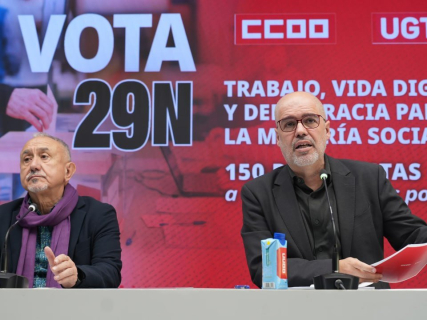

CCOO and UGT have made public a document with 150 proposals addressed to the political forces standing for the general elections of next November 29. The union plan sets as priorities achieving full employment within a four-year horizon, mobilizing 67,600 million euros in public resources to expand the supply of affordable housing, and safeguarding the sustainability of the public pension system.
The general secretary of CCOO, Unai Sordo, has insisted that Spain must achieve full employment in the next legislature and has emphasized that, to achieve this, it is essential to deepen the energy transition and attract new industrial investment. "If Spain keeps creating jobs, if Spain moves closer to full employment, the wages in our country, I am convinced, can rise over the next four years," he said.
Regarding pensions, Sordo called on the parties to define clearly whether they are willing to devote up to 15% of GDP to the system: "If the answer is yes, the system is perfectly sustainable. If the answer is no, there will be drastic cuts in pensions."
The general secretary of UGT, Pepe Álvarez, has warned of the danger that the agreements reached in recent years through social dialogue may be undone, and he brought up the 2013 pension reform, which limited the revaluation of benefits to 0.25% and introduced the sustainability factor.
"What makes us think they won’t do it again?" he said, referring to the possibility that future governments could reverse the reforms agreed with social agents. In addition, he warned that the transfer to mutual insurance companies of the authority to grant medical leave creates a scenario that affects the "right to be ill."
Protected housing and public stock
In the area of housing, the union headquarters propose allocating 1% of GDP, equivalent to 67,600 million euros, over the next four years to build, acquire, and secure properties in order to substantially increase the stock of protected housing.
Sordo has argued that it is essential to reach a park of 1.5 million protected homes and has pointed out that, in addition to new construction, it is necessary to mobilize empty flats, homes held by investment funds, and more than 132,000 tourist flats for other uses. Álvarez has emphasized that "it is not just about building housing; it is about building official protected housing" adapted to the economic capacity of citizens and to their salaries.
Working hours, minimum wage and AI
The 150 measures, organized into eight major areas, also include the approval of a maximum working week of 37.5 hours in the first year of the legislature and subsequently moving forward toward 32 hours, ensuring that the interprofessional minimum wage represents at least 60% of the average wage, and reinforcing the set of public services.
Unions also call for specific regulation of artificial intelligence in the workplace, a review of the rules on dismissal, and that the authority to decide on medical sick leave and medical discharge rests exclusively with professionals in the public health system.
((THERE WILL BE AN EXPANSION))