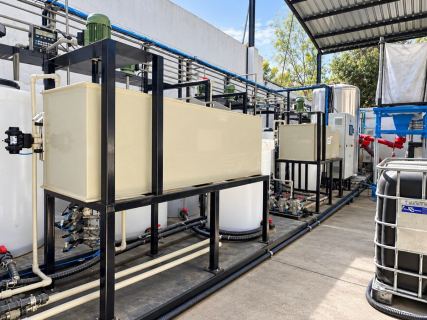










The company GDV has positioned itself as the first Spanish company to completely close the battery recycling cycle, covering the stages of repair, reuse, and recycling. The firm itself has communicated this in an official note, in which it also emphasizes that it is "one of the few in Europe" capable of completing this entire process.
With origins dating back to 1921, when it was founded by Óscar Bárcenas and Germán Agulló, the company carries out its operations at its plant in Alicante. These facilities have a processing capacity of 3,600 tons per year and, at present, operate at more than 70% of their productive potential.
At these moments, the technology of the GDV Group allows recycling 82% of each battery it manages. Only in the last year, its activity has prevented the emission of more than 21,000 tons of CO2 into the atmosphere, according to data from the company, which compares this impact to removing more than 5,000 vehicles from the roads per year or to the annual absorption capacity of 365,000 adult trees.
The work of GDV makes it possible to recover the raw materials present in batteries and to cut carbon dioxide emissions by extending the service life of operating batteries and manufacturing new second-life batteries from cells in good condition coming from batteries that have already been used.
For Agulló, achieving the complete recycling cycle means "a major technological leap and energy independence 'made in Spain'" and, in addition to contributing to the decrease in CO2, it allows obtaining during the process "almost half of the types of raw materials identified as critical by the European Union (EU)". Of the 17 critical raw materials cataloged by the EU, GDV manages to recover 7, a feat that the company defines as "an exceptional milestone".
The plant operates under the 'Circular Factory' model, based on the individual analysis of each battery from the time it arrives. From that assessment, it is determined whether it can be repaired (and is then repaired), whether it can be reused (it is dismantled, verified, and destined for a second life) or whether it must be completely recycled, in accordance with the methodology described by the company itself.