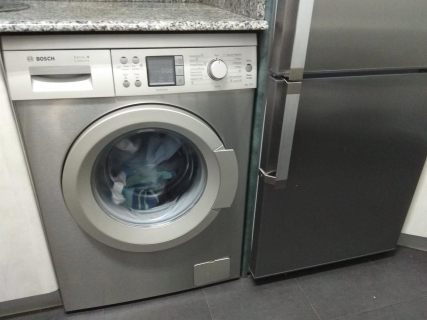

The Ministry of Industry has described as “viable” the state Plan Renove for household appliances proposed by the sector’s employers’ associations, which calls for an allocation of 50 million euros to replace around 300,000 obsolete units with models that consume less, according to what the Spanish Federation of Household Appliance Retailers (FECE) has announced.
This conclusion was reached at the third meeting held between the organizations FECE, Aecoc, Anged, Confemetal and Applia and the General Directorate of the Ministry of Industry, which took place on November 10, after the department headed by Jordi Hereu analyzed the documentation submitted by the associations.
FECE’s general secretary, Alfredo Gosálvez, has admitted that this positive position by the Ministry has generated a “bittersweet feeling” among companies. “Satisfaction at the recognition of the feasibility study carried out by the sector, but frustrated by having to leave the project on hold for electoral reasons,” he said.
The plan includes an average subsidy of 166 euros per household appliance to drive the replacement of equipment with about ten years of use with others with greater energy efficiency, with the aim of reducing household water and electricity consumption, lowering the carbon footprint, and supporting industrial activity and employment in local retail commerce.
“We want to reduce Spanish households’ water and energy bill and support commerce and industry,” Gosálvez emphasized, who asked that the household appliance sector be recognized as “essential and strategic,” in line with energy-efficient automotive or tourism.
The report submitted to the Government recalls that households account for nearly 20% of national energy consumption and that household appliances account for approximately half of domestic electricity demand, placing the annual use of a typical household at around 4,000 kilowatt-hours.
The employers’ associations argue that replacing appliances more than a decade old makes it possible to significantly reduce these consumption levels. As a reference, they note that a modern refrigerator can save up to 30% of energy compared with an old one, while efficient washing machines and dishwashers also help to decrease water use.
The project aligns with the home equipment renewal measure included in the Integrated National Energy and Climate Plan 2023-2030, which aims to reduce final energy consumption by replacing household appliances with others of higher performance.
The request is made in a scenario that the report defines as “widespread crisis and extreme economic vulnerability” for the sector, affected by the slowdown in demand, pressure on margins, and rising costs.
According to Applia Spain data incorporated into the report, the growth of accumulated invoicing was slowed from 3.83% in January 2026 to 0.96% in May. In terms of unit volume, the increase was reduced from 3.61% to 1.76% in the same period.
To this dynamic, according to the associations, are added the shift of purchases toward more affordable ranges, the increase in the price of raw materials, energy, and logistics, as well as greater regulatory requirements without sufficient support to facilitate their adaptation.
As a response, the employers’ associations highlight the high uptake of the regional renewal plans implemented in Aragón, La Rioja, Madrid, or Galicia, whose funds were spent in a short time and activated several million euros in sales.
FECE argues that a state program would have an “immediate driving effect” on a value chain which, according to the data provided, employs more than 100,000 people directly and indirectly, has ten production plants in Spain, and supports close to 12,500 specialized retailers.
In a market that exceeds seven million units sold per year, the sector considers that encouraging the renewal of between 300,000 and 350,000 appliances would generate a “visible impact” on domestic consumption, employment, and economic activity.
The report calculates that purchases associated with the program would provide around 28.2 million euros in direct VAT income, equivalent to 56.4% of the public funding requested, which the State would recover in less than one fiscal year, in addition to a possible increase in revenue from the Corporate Income Tax derived from higher business profits.
The plan also includes the collection and processing of removed household appliances. According to the sector’s estimates, replacing 300,000 appliances would make it possible to manage more than 15,000 tons of metal and technological waste.