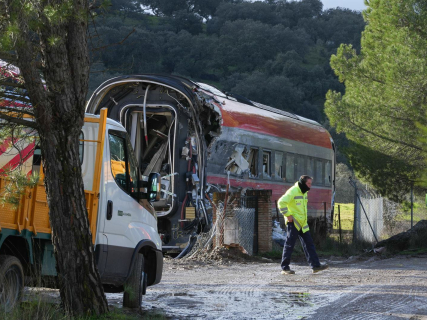

The data from the JRU registrar --the black box-- of the Iryo train involved in the rail accident in Adamuz (Córdoba), in which on Sunday 18 January 46 people lost their lives and more than 150 were injured, are "consistent with a scenario in which the derailment constitutes the initial triggering event, while all the anomalies recorded afterwards correspond to effects derived from the derailment and the subsequent collision, with no evidence in the analyzed data of prior failures of the vehicle that could be assumed to be precursors to the accident".
So it is detailed in the conclusions of the study of the information stored in the convoy's legal recorder, collected in a report dated 21 November that Europa Press has had access to. The document is drawn up after the diligence of interpretation of the data from the legal registrars of the trains involved in the incident, carried out on 12 November in the Civil and Instruction Section of the Court of Instance of Montoro, Plaza number 2, the body that investigates the case.
From the examination of the records and the events captured by the vehicle's TCMS system during the provision of the Iryo 6189 service on 18 January 2026, "it is concluded that the train maintained behavior without notable events in its systems until 19,43:33,462 hours (Moment 0), not allowing the origin of the accident to be associated with a prior failure of the rolling stock".
It is emphasized that "the location of Moment 0 coincides with the area where the accident took place". From that instant on, "abruptly and practically simultaneously" incidences begin to appear in numerous train systems, starting with high-voltage power supply and continuing with fault detection in different equipment --temperature sensors, door mechanisms, dynamic monitoring systems, auxiliary systems, and communication equipment--.
The coincidence in time and at the kilometer point between the start of the alterations and the place of the incident leads the technicians to determine that "those anomalies are a direct consequence of the process of derailment and the subsequent collision suffered by the vehicle".
It is also indicated that "the chronological evolution of the events shows a coherent sequence with the mechanical, electrical and functional requests compatible with a derailment, later observing detections of dynamic instability, disturbances in different onboard equipment, openings of power circuits, sensor failures and progressive degradation of various systems as a result of the accident's own dynamics".
Decryption of the recorders at the judicial premises
The judge convened on November 12 specialists from Iryo and Renfe, as well as technicians from other companies and court experts, to carry out in the court the diligence of access, decryption and interpretation of the data from the two legal recorders, the black boxes of both trains.
In the order, the magistrate specified to the company Hasler Rail --manufacturer of the equipment-- that the technical report it must send within the time set, as the party responsible for the legal recorders and provider of the tools for access, viewing and presentation of the information, "must be descriptive of the actions carried out during the practice of the diligence and of the results obtained within the scope of its competences --assistance in the loading and viewing of the recordings, identification and technical explanation of the signals, configuration of graphical views and chronology, checks of the recording system itself that are necessary, etc.--".
To the rest of the participating technicians --except for the court experts-- she indicated that their report "must reach the interpretation of the overall behavior of each train, functional correlation of its different subsystems, determination of possible causes and contributing factors of the accident and other matters that may be raised during the practice of the diligence that fall within the scope of its competences of interpretation".
Opening of the black boxes in the CIAF
The facilities of the then Railway Accident Investigation Commission (CIAF) in Madrid held on March 5 the opening of the black boxes of the two trains involved, after the Court of First Instance of Montoro authorized on February 26 access, extraction and analysis of their contents, as well as access and extraction of the data from the security cameras inside the Iryo train.
The judge allowed the use of any software that verified "the integrity of the files, their creation date, alteration or any other data of interest." The dumping, extraction and analysis of the information was carried out in the presence of agents of the Judicial Police, who drew up a record of the procedure, "obtaining digital evidence of the content and/or a certified copy of the data obtained," keeping one copy to proceed with the investigations and delivering another immediately to the judicial body.
Finally, it was decided not to move the recording equipment to the judicial premises in Montoro, in order to avoid the risks associated with the movement of the material that was the subject of analysis.