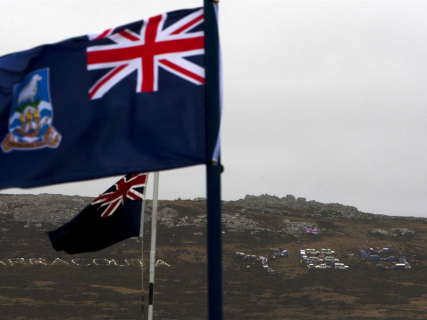

The International Tribunal for the Law of the Sea has decided this Saturday, by 18 votes to three, to reject the request for provisional measures submitted by Argentina to halt the exploitation of hydrocarbons by the United Kingdom in the Falkland Islands, a territory whose sovereignty Buenos Aires claims, in the context of the Sea Lion project.
In its ruling, the body based in Hamburg indicates that "The Tribunal, given the conclusions of paragraph 129, rejects the request for the prescription of the provisional measures presented by Argentina on October 13, 2026".
Paragraph 129 details that the court "has examined the allegations submitted by Argentina in the Notification Declaration and Declaration in the Request, as well as the positions expressed by the parties in the oral hearings and is of the opinion that the rules to which the applicant appeals do not appear 'prima facie' to serve as a basis for the jurisdiction of Annex VII of the arbitration tribunal".
By considering that it does not have "prima facie" jurisdiction, the Tribunal does not even go on to assess the urgency or the possibility of irreparable harm, central elements of the Argentine submission.
"Having reached this conclusion, the Tribunal does not need to examine whether any other condition is met for the prescription or issuance of interim measures pursuant to Article 190, paragraph 5 of the Convention," the opinion adds, thereby ruling out addressing the substance of the dispute over sovereignty of the Falkland Islands, by understanding that it does not fall within its competence.
Conflicting reactions from Argentina and the United Kingdom
After the decision became public, the Argentine Presidency "celebrates" that the International Tribunal for the Law of the Sea "has recognized the existence of a sovereignty dispute between the Argentine Republic and the United Kingdom," although it questions that, precisely because of that dispute, the court concluded that it lacks jurisdiction to order the provisional measures requested by Buenos Aires.
From the Casa Rosada, they emphasize that "Argentina did not ask the Tribunal to rule on sovereignty, but rather to apply the United Nations Convention on the Law of the Sea to the unilateral exploitation of our resources by the United Kingdom. The sovereignty dispute does not prevent protecting those resources while it is resolved," the Presidency insists.
In any case, the Argentine Government emphasizes that "it respects the Tribunal's decision and will continue to defend its rights within the framework of international law" and stresses that this resolution "in no way legitimizes the unilateral exploitation of our natural resources."
For its part, the British Executive interprets the ruling as support for its legal line. The decision "is backed by the robust legal position and the strategy of the United Kingdom," Foreign Secretary Ed Miliband and Attorney General Ellie Reeves have said, for whom "Argentina has asked that it be prevented for residents of the Falkland Islands to make their sovereign decisions and has failed."
London insists that "the United Kingdom has no doubt about our sovereignty over the Falkland Islands, our sovereignty and sovereign rights over the surrounding maritime areas, and the right to self-determination of the inhabitants of the Falkland Islands."
Along these lines, it urges Buenos Aires to "respect the right of the inhabitants of the Falkland Islands to decide their own future and calls on Argentina to put an end to its economic pressure in general against the Falkland Islands."
The Argentine Foreign Minister, Pablo Quirno, has gone one step further by describing the statement as "a historic step." "Contrary to what its communiqué suggests (British), the Tribunal recognized the existence of a sovereignty dispute that has not yet been resolved. Likewise, it expressly urged the prompt establishment of the Arbitral Tribunal, scheduled for January 2027 at the latest," he said in an official note, where he underscores that it is "a very important victory for Argentina."
Sea Lion project and dispute over resources
The Tribunal's resolution comes after the hearings held on November 10 and 11, in which the Argentine delegation focused its arguments on the possible irreversible damage resulting from the drilling, while the United Kingdom sought to move the debate to the level of the sovereignty of the islands, with the aim of having the court declare itself incompetent by understanding that the issue goes beyond the United Nations Convention on the Law of the Sea.
The Sea Lion project provides for the extraction of 319 million barrels of crude oil, with a potential of billions of euros in revenues, from which mainly British companies would benefit.
Before the decision was known, the Argentine president, Javier Milei, had reiterated that "The Argentine Republic reaffirms, once again, its legitimate and imprescriptible rights of sovereignty over the Malvinas Islands, South Georgia and the South Sandwich Islands, and the surrounding maritime spaces".
Argentina had requested provisional measures to stop the exploitation of hydrocarbons by the United Kingdom on the continental shelf of the North Malvinas Basin "while the dispute over sovereignty over the Malvinas is resolved".
In response to Buenos Aires' accusations, the British Government maintains that oil operations are carried out under the legislation of the Malvinas Islands and that they are carried out "in full compliance with International Law", once again reiterating its sovereignty over the archipelago despite ongoing Argentine claims.
The Malvinas Islands constitute an overseas territory of the United Kingdom and in 2013 its inhabitants voted overwhelmingly in favor of maintaining that status. In April 1982, Argentine troops occupied the archipelago, but they surrendered in June of that same year after the British military response.