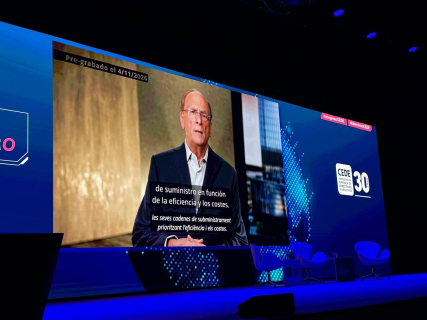

The chairman and chief executive officer of BlackRock, Larry Fink, has quantified the exposure of the world’s largest asset manager in Spain at 100 billion euros, by adding equities, sovereign and corporate debt, and private assets. This figure, he has pointed out, demonstrates the major opportunities the country offers and “the importance of the role that global capital can play in supporting its long-term growth.”
Fink spoke at the 25th CEDE Congress, which is taking place at the Palau de Congressos de Catalunya, where he stressed that channeling the savings of European citizens into productive investments will be decisive for the competitiveness of the European Union in the coming decades.
During his speech, he emphasized that Spain is “particularly well positioned” in this process, and highlighted the dynamism of its economy, as well as the advancement of its capabilities in areas such as energy, infrastructure, and technology.
The top executive of BlackRock has said that the world is immersed in one of the biggest investment cycles in history, driven by the urgency of building new infrastructure, ensuring the supply of electricity, and deploying AI and new manufacturing. At the same time, he warned that all of this coincides with governments that are carrying an “enormous debt.”
In this context, he has asserted that capital markets will be decisive for supporting economic growth in the coming years: “We need deeper capital markets everywhere, new ways to finance investments, and more participation by long-term investors,” he said.
The role of business financing
Fink also insisted on the need to simplify and make access to capital cheaper for companies, noting that this financing is essential so they can invest and innovate. In his view, these investments will translate into the modernization of infrastructure and technology, while at the same time contributing to building a stronger economy and creating more jobs.
AI as a driver of transformation
Regarding artificial intelligence, Fink has argued that this tool has the potential to transform the economy, illuminate new sectors of activity, and open a wide range of opportunities. However, he has warned that its deployment will require an "extraordinary amount of investment" in computing capacity, energy, infrastructure, and specialized talent.