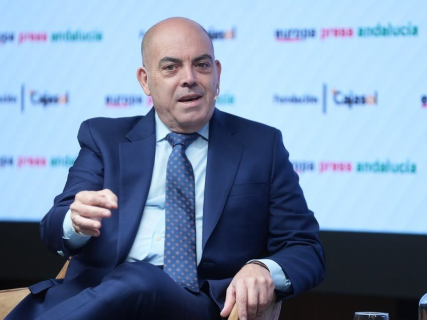










The president of the National Federation of Associations of Self-Employed Workers (ATA) and vice president of the Spanish Confederation of Business Organizations (CEOE), Lorenzo Amor, has launched attacks this Tuesday against the Government for refusing to adjust the IRPF rate to inflation in order to preserve the purchasing power of taxpayers. "It's very easy to accuse and say that the employers who don't want to raise wages are so bad," Amor said.
At an information meeting of Europa Press Andalucía held in Seville with the collaboration of the Fundación Cajasol, in which he took part together with the councilor for Employment, Business and Self-Employment of the Junta, Rocío Blanco, Amor defended that an update to the IRPF would have meant a direct improvement in the disposable income of employees, self-employed workers and pensioners. "What they take home at the end of the month would have gone up," he said.
The ATA leader criticized the Executive, arguing that the increase in tax revenue has not been reflected in a strengthening of infrastructure or public services. As an example, he mentioned the difficulties he says he encounters in traveling by train to Salamanca, a situation he linked to a lack of investment in the rail network.
Regarding the interprofessional minimum wage (SMI), Amor insisted that it should be increased "taking into account the level of inflation we have at these times." However, he questioned the technical basis that justifies the 5.3% rise announced by the Government and recalled that the experts' report cited during the event pointed to 4.9%.
Amor said that the Executive should have waited for the November CPI advance data, scheduled for the 30th day, and for the December figures before closing the SMI increase. He recalled that the previous review was approved in February with retroactive effect and accused the Government of turning the Council of Ministers into an "electoral lottery" by adopting decisions that, in his opinion, could have been postponed until all technical reports were in hand.
"If anyone thinks that employers and self-employed workers don't want to raise wages, they're very much mistaken," he reiterated. Amor praised social concertation and criticized that business organizations find out "through the press or through the Council of Ministers" about measures that directly affect them and whose costs, he stressed, they must assume themselves.
The president of ATA has linked the debate over the SMI with the difficulties faced by self-employed workers when it comes to hiring staff. He has explained that, in addition to the increase in labor costs, they are up against complex procedures and a lack of candidates to fill certain positions, especially in businesses with one, two or three employees. "The accounts don't add up," he said, also referring to the drop in turnover and the rise in delinquency that certain self-employed workers suffer.
Amor has placed the number of self-employed workers in Andalusia at 608,000 and has specified that approximately one in four generates employment. Despite the obstacles to hiring, he has underscored that the businesses of Andalusian self-employed workers are increasing in size.
For her part, the minister Rocío Blanco has agreed on the advisability of reviewing the IRPF. "What deflating the IRPF means to me seems fundamental," she said, arguing that the aim is for the worker to "have more left in their pocket." In her view, when inflation eats up wage increases, companies bear a higher cost and the State increases its revenue collection, while the employee hardly notices any improvement in their purchasing power.
Blanco has also argued for adjusting IRPF withholdings for families, middle and lower incomes, self-employed workers and young people. With regard to employment, she has highlighted the proposal included in the PP electoral program to bonify 100% of the contribution for the first worker that a self-employed person hires and 50% for the second.