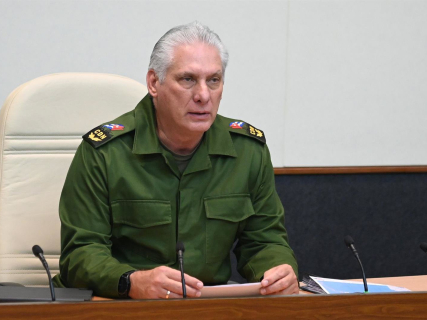










Cuba’s President, Miguel Díaz-Canel, held a meeting at the Palace of the Revolution with the Director-General of the World Health Organization (WHO), Tedros Adhanom Ghebreyesus, a meeting in which he once again denounced the consequences of the United States’ blockade on the island’s health system.
During the meeting, Díaz-Canel conveyed his thanks for Tedros and his team’s presence, who are visiting Havana “at such a difficult moment” for the Cuban population due to the “hardening of the blockade, the energy blockade that the Government of the United States has also imposed, and the maximum pressure policy that has a fundamental impact on the day-to-day lives of Cuban families”.
The head of state insisted that this “imperialist policy affects all activities of the country’s economic and social life” and causes “a special impact on the health system”. According to the newspaper 'Granma', he provided updated data and indicated that waiting lists for certain surgical procedures have increased.
Díaz-Canel clarified that “more than 67% of the basic list of medicines is affected” and explained that more than 10,000 radiology patients have been harmed by the shortage of supplies and equipment. “We have suffered a deterioration in health indicators,” he added, underscoring that among those indicators is infant mortality, which has recorded an increase.
The president assured his counterpart: “I know that you have been keeping track of this situation, because you have already visited health centers and have had an exchange with the colleagues of the Ministry of Public Health. But what I can assure you is that, regardless of that situation, no blackout, nor any blockade, extinguishes our hope”.
Díaz-Canel also thanked Tedros for messages in which he recognizes the impact of the energy blockade on health in Cuba and reiterated his Government’s willingness to continue collaborating with the UN health body. In this regard, he said: “We have every disposition to work with the WHO, to find new forms of cooperation, for joint research, and for the modest contribution that Cuba can make to any regional or global situation, in relation to health”.