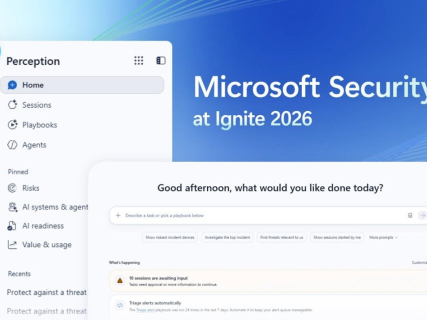

Microsoft has unveiled a renewed cybersecurity strategy with the launch of the Microsoft Perception artificial intelligence platform, conceived as a central system from which autonomous agents dedicated to detecting, investigating, and mitigating threats and vulnerabilities in the environments of companies and organizations are coordinated.
The announcement was made during Microsoft Ignite 2026, the annual event aimed at developers and IT and security professionals, where the company has officially established Perception as the evolution of the known Project Perception, first presented last July.
"In the last 12 months, frontier AI models have become extraordinarily effective at discovering and exploiting vulnerabilities in 'software', and similar levels of capability are rapidly becoming available in open weights models with limited cyber safeguards," explained Microsoft Security president and chief architect Ales Holecek, in a statement published on the company’s website.
This context, Holecek recalled, contrasts with that of just a year ago, when "finding an exploitable and serious vulnerability was slow and a costly job done by elite security researchers".
To respond to this new scenario, Microsoft has built Perception on an architecture that begins with a layer of signals, sensors, and actuators that alert when an anomaly occurs, processing more than 165 trillion daily signals coming from Microsoft Defender, Microsoft Entra, the network, the operating system, and other services.
On that basis sits a context layer that organizes in real time those signals according to each client’s specific environment. Finally, the solution incorporates a layer of specialized agents, coordinated through 'playbooks' and different AI models, selecting the right model for each task and making them work together.
Microsoft Perception, already available generally, is structured into three groups of AI agents—red, blue, and green teams—each with a specific security role to test and strengthen defenses.
The red team is responsible for simulating attacks from the attacker’s point of view before a real breach occurs; the blue team focuses on detecting, classifying alerts, and investigating incidents, freeing analysts’ workload so they can focus on critical decisions; and the green team is dedicated to remediating vulnerabilities and supporting the correction of security flaws.
"Perception is designed to help security teams move at machine speed, drive outcomes instead of simple tasks, and automate while maintaining control. Your team sets the security boundaries and approves high-impact actions, while automatic triggers activate the 'playbooks' when an incident meets the criteria you have defined", Holecek said.
Regarding the cost associated with using these agents to audit corporate security systems, Microsoft has added new expense management dashboards and a cost estimator that allows users to log AI consumption, plan budgets, and link them to quantifiable security outcomes.
Together with Perception, the company has announced ISOC in Microsoft Defender, a security operations center that integrates event management capabilities (SIEM), behavioral analytics, and threat intelligence.
In addition, Microsoft has expanded the preview of MDASH, its agentic code scanner, designed to help customers locate and fix vulnerabilities. Among the improvements are its ability to analyze repositories of up to 5 GB and operate in regulated clouds; in addition, the Web App Pen Test Agent can leverage its code scans to prioritize and resolve vulnerabilities.
AI agents as "new 'insiders'"
The company has also wanted to emphasize the role of AI agents, which organizations must start treating as if they were human employees with privileged access. It defines them as "new 'insiders'" because they operate autonomously 24 hours a day, seven days a week, with broad access to data, applications, and tools and, "like an 'insider', they can make mistakes, be manipulated, or be compromised".
To manage them properly, Microsoft indicates that it is necessary to assign them their own identity (Microsoft Entra Agent ID) and temporary permissions. Tools such as Agent 365, Intune and Defender allow users to view which agents are running and measure their "impact radius" —with the ability to detect up to 60 types of agents— while, with the AI Transparency Initiative, the company seeks to create open standards that make it easier to audit the behavior of an AI agent, from knowing what it did to being able to verify it independently.
"AI is changing the way attacks occur and how security work is carried out. Developers, IT teams and security teams now share responsibility for creating, managing and protecting AI, so Microsoft Foundry, Microsoft Agent 365 and Perception share the same signals and the same context," Holecek concluded, laying out the company’s vision for how the foundations of cybersecurity in organizations should be transformed.